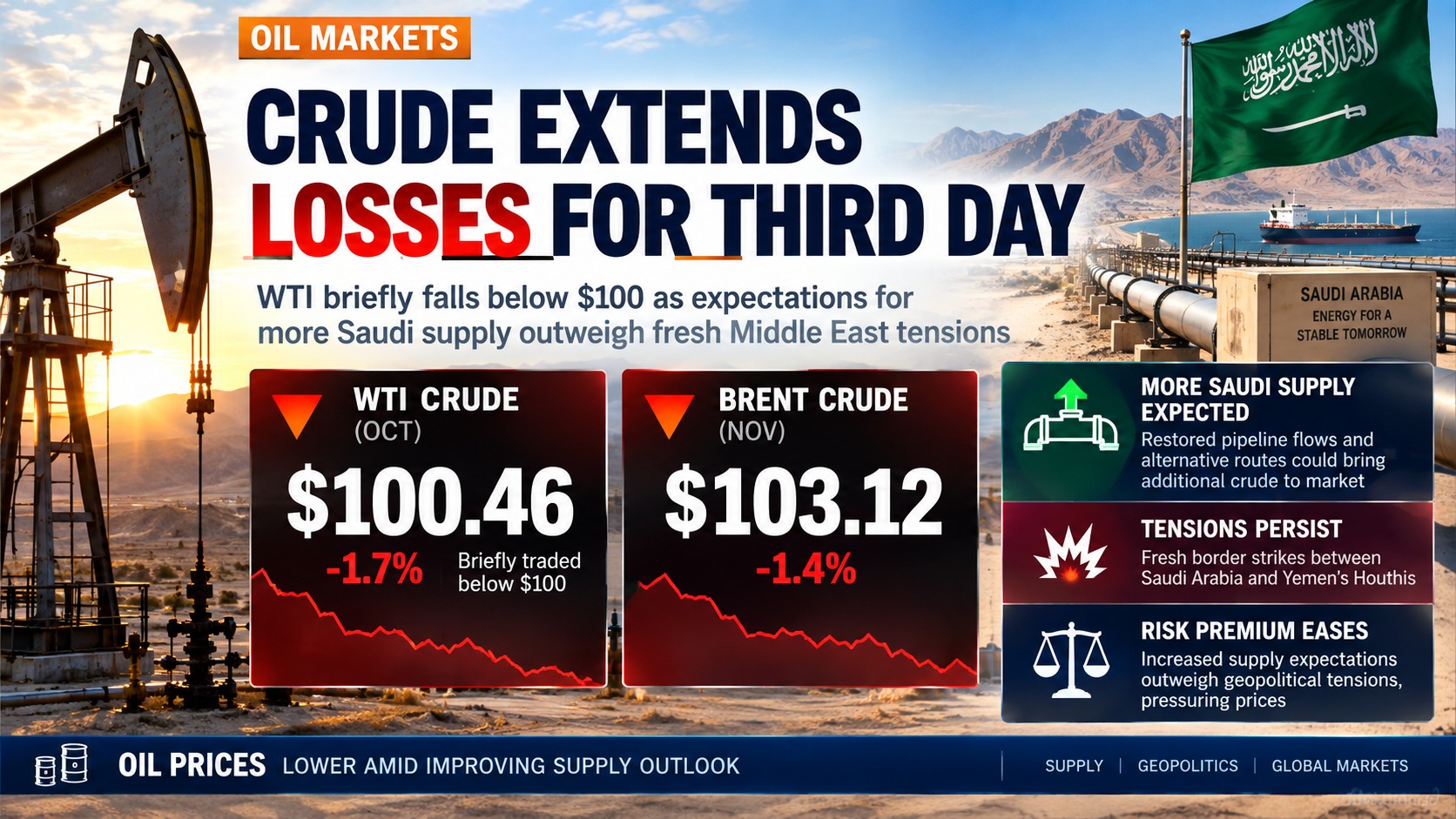
Oil prices fell for a third straight day on Friday as traders balanced signs of potential additional Saudi crude supply against continued military activity in the Middle East. West Texas Intermediate futures declined approximately 1 to 2 percent, briefly slipping below the psychologically important $100 per barrel threshold before recovering to trade near $100 to $101. Brent crude futures dropped a comparable amount to settle in the low $103 range, marking another session of losses after both benchmarks had already declined about 1 percent on Thursday.
The latest weakness came even as Saudi Arabia and Yemen's Iran-backed Houthis exchanged fresh strikes across their border, developments that under normal circumstances might have supported prices. Instead, market participants focused on reports and analysis suggesting that Saudi Arabia was making progress toward restoring flows through its East-West pipeline and identifying alternative routes for Middle Eastern crude that had been disrupted or constrained earlier in the crisis. Those supply-side hopes reduced the war-risk premium that had pushed Brent toward $110 earlier in the week when concerns about Strait of Hormuz disruptions and broader regional escalation were more acute.
Lower oil prices offered a modest offset to inflation concerns that had intensified following the Federal Reserve's quarter-point rate increase on Wednesday, the central bank's first hike in three years. Energy costs remain one of the most visible and persistent drivers of elevated consumer and producer price readings. A sustained retreat in crude therefore provides some breathing room for policymakers and for equity markets that have been sensitive to the inflation outlook. Equity futures showed a mixed but generally constructive reaction to the oil decline, with technology and growth-oriented names benefiting more than energy equities from the narrative of reduced near-term price pressure.
Despite the three-day slide, both benchmarks remain well above the levels seen in early 2026, when prices traded closer to $70 to $75 per barrel before the latest phase of Middle East conflict escalated. Analysts cautioned that geopolitical risk has not disappeared and that any deterioration in the security situation around key shipping lanes or production facilities could quickly reverse the recent losses. Inventory data, Chinese fuel export trends, and the volume of vessels successfully transiting the Strait of Hormuz continue to be monitored as secondary but still relevant factors.
The third consecutive down day puts both WTI and Brent on track for their first weekly decline in three weeks if the session closes near current levels. Energy-sector stocks underperformed the broader market in recent sessions as the crude pullback reduced near-term earnings upside for producers, while refiners and downstream names saw more mixed impacts. Broader market participants treated the oil move primarily through the inflation lens, viewing softer energy prices as incrementally supportive for risk assets after the hawkish Fed decision.
Looking ahead, traders will continue to parse every development related to Saudi production capacity, pipeline status, and any diplomatic or military escalation involving Iran or its proxies. The Federal Reserve's updated projections and the path of further rate hikes remain closely linked to the trajectory of energy prices. A durable move back below $100 for WTI would likely be interpreted as meaningful progress in relieving one of the key upside risks to the inflation outlook, potentially altering the odds of additional tightening this year. For now, the market is cautiously celebrating the supply-side relief while remaining alert to the still-elevated geopolitical backdrop.