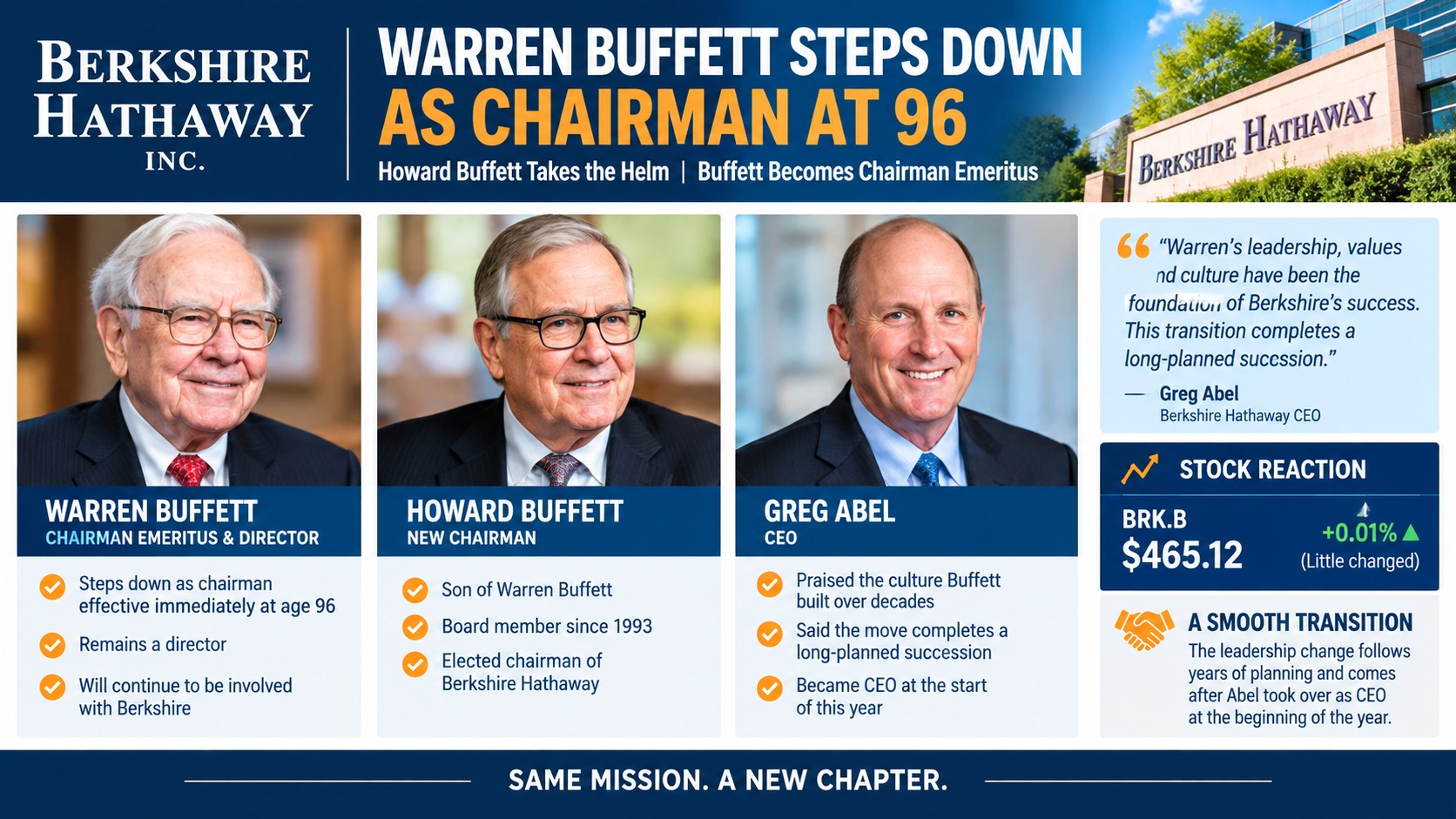
Berkshire Hathaway Inc. announced on Friday that Warren E. Buffett has stepped down as chairman of the board, effective immediately, and has been named chairman emeritus in recognition of his extraordinary contributions to the company and its owners. Buffett, who turned 96 on August 30, will remain a member of the board of directors and continue to offer his valued judgment and perspective. Consistent with the company's long-standing succession plan, the board elected his son, Howard G. Buffett, a Berkshire director since 1993, as the new chairman. Susan L. Decker will continue to serve as lead independent director.
In a letter to Berkshire shareholders released with the announcement, Buffett wrote: "Father Time always wins. He has, however, been generous with me. He has given me the opportunity to see Berkshire reach a point where I am more confident than ever about what lies ahead." He emphasized that CEO Greg Abel has exceeded expectations in running the company and that the timing felt right to complete the transition. Buffett had already stepped down as chief executive officer at the end of last year, with Abel taking over day-to-day operations while Buffett retained the chairmanship for a transitional period.
Abel issued a statement on behalf of the entire board: "Warren's impact on Berkshire and its owners is without parallel in the history of American business. The culture Warren built and the values he championed will remain at the heart of Berkshire, and Howard will be their guardian. We are grateful to Howard for the care, discipline, and deep understanding of Berkshire he will bring to his new role, and to Sue Decker for her continued leadership and valued contributions as Lead Independent Director." Howard Buffett, 71, is expected to serve in a non-executive capacity focused primarily on preserving the principles, culture, and values that have defined the conglomerate rather than on operational management, which remains firmly under Abel's control.
Berkshire Hathaway has grown into an approximately $1 trillion conglomerate under Buffett's leadership, encompassing dozens of wholly owned businesses including Geico car insurance, the BNSF railroad, Berkshire Hathaway Energy, Dairy Queen, Fruit of the Loom, and a wide portfolio of publicly traded equity holdings. Buffett transformed the firm from a struggling textile company into one of the most successful investment vehicles in history through disciplined value investing, patient capital allocation, and a decentralized management philosophy that granted significant autonomy to subsidiary leaders. Over decades the company generated compounded annual returns nearly double those of the S&P 500, turning many long-term shareholders into substantial wealth creators and elevating Buffett into a global icon of rational capitalism.
Market reaction to the announcement was muted, with shares of Berkshire Hathaway trading little changed in early Friday dealings. Investors largely viewed the move as the orderly completion of a multi-year succession process rather than a sudden disruption. Buffett first publicly detailed elements of the succession plan years earlier and formally announced his intention to step down as CEO at the 2025 annual meeting. The latest step removes the final formal title while keeping him available as a sounding board and cultural steward. Analysts noted that Abel has already been making the major capital-allocation and operating decisions for some time, reducing the risk of any abrupt shift in strategy or risk appetite.
Buffett's influence has long extended far beyond Berkshire's balance sheet. He co-founded the Giving Pledge with Bill Gates, shaped generations of corporate executives and investors with his emphasis on long-term thinking and straightforward communication, and turned the annual Omaha shareholder meeting into a pilgrimage for value investors worldwide. His annual letters became required reading for students of business and finance. The transition therefore carries symbolic weight even as the practical continuity of management appears high. Market participants will watch closely in coming quarters for any subtle changes in capital allocation priorities, acquisition appetite, or public communication style under the new board leadership structure.
The announcement arrives against a broader market backdrop of elevated interest rates following the Federal Reserve's first rate hike in three years earlier in the week, ongoing geopolitical tensions affecting energy markets, and lingering questions about the durability of technology-led equity leadership. For Berkshire specifically, the orderly succession is expected to support the premium valuation the market has long assigned to the firm's unique culture and permanent capital base. Investors remain focused on whether that culture can be fully institutionalized now that both the chief executive and chairman roles have formally passed to the next generation of leadership.