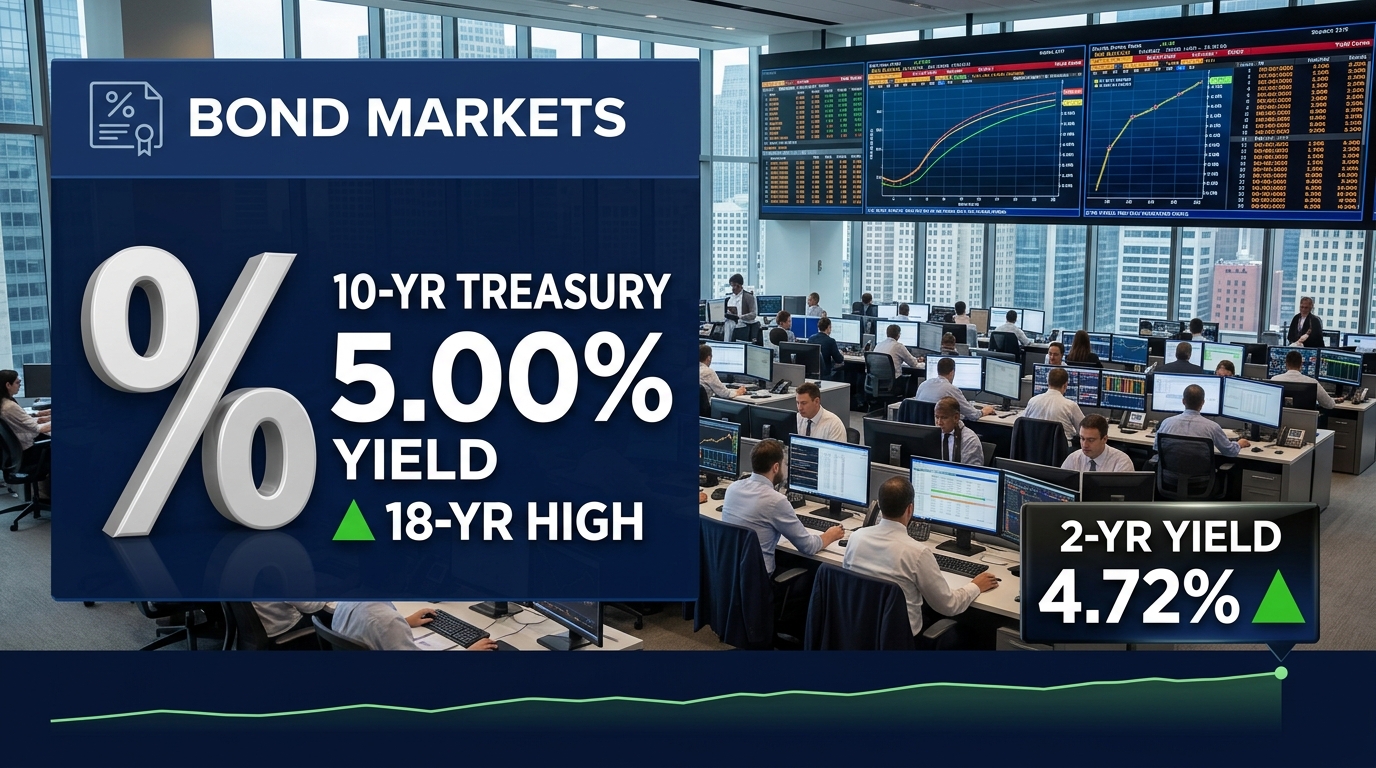
U.S. government bond yields were mixed but broadly elevated Thursday as fixed-income markets continued to digest the Federal Reserve's decision to raise its benchmark interest rate by 25 basis points to a range of 3.75%-4%, the central bank's first hike in three years. The 10-year Treasury yield held near 5%, just a day after touching its highest level since 2007, while the 30-year yield hovered around 5.37%.
The move at the front end of the curve was more pronounced in the immediate aftermath of Wednesday's decision. The two-year Treasury yield, which is especially sensitive to near-term Fed policy expectations, climbed to its highest level since 2024 as Chair Kevin Warsh's press conference signaled the central bank was not finished tightening. Warsh declined to characterize current policy as restrictive and pointedly distanced himself from the Fed's own Summary of Economic Projections, which shows officials expect only one more hike this year before a pause through 2027. By Thursday, the two-year yield had eased about one basis point to 4.72%, alongside a broader stabilization in Treasuries as equity futures climbed.
The combination of a hawkish Fed and oil prices above $100 a barrel amid Middle East supply disruptions has complicated the bond market's read on where policy heads next. Higher energy costs feed directly into headline inflation, reinforcing the case for a central bank wary of declaring victory too early, while a genuinely restrictive policy stance — which Warsh notably declined to confirm currently exists — would typically argue for a pause rather than further hikes. That tension has left Fed funds futures markets roughly split on whether the Federal Open Market Committee delivers another quarter-point increase at its late-October meeting.
Strategist commentary has reflected the split. Jeffrey Roach, chief economist at LPL Financial, wrote that "if the economy keeps up like it has, the Fed is telling us that we may not see a cut until 2028," while Chris Zaccarelli of Northlight Asset Management noted that historically "once the Fed begins raising rates, they do it multiple times." On the other side, Michael Pearce of Oxford Economics argued markets have "too much tightening priced in over the coming year" and expects just one additional increase before a sustained pause.
For fixed-income investors, the current environment argues for caution on duration risk until the Fed's path becomes clearer, with short-duration and floating-rate instruments offering relative insulation against further rate volatility. Equity investors, meanwhile, should watch the 10-year yield's relationship to the 5% threshold closely: sustained moves meaningfully above that level have historically pressured equity valuation multiples, particularly for longer-duration growth stocks, while any retreat back toward 4.5% would likely be read as a relief signal for risk assets broadly heading into the fourth quarter.