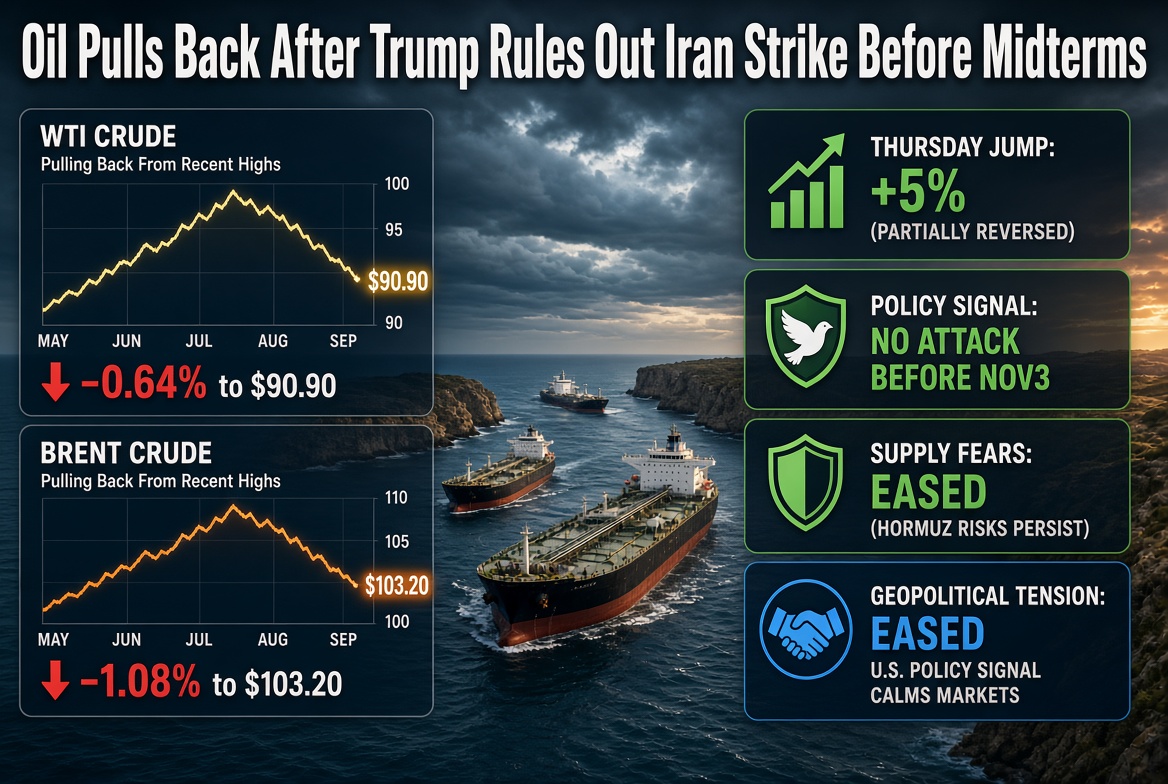
Crude oil prices fell in early Friday trading after President Donald Trump said the United States would not attack Iran at any time before the November 3 midterm elections. West Texas Intermediate dropped 0.64% to $90.90 per barrel, while Brent crude sank 1.08% to $103.20.
In a post on Truth Social, Trump said the US is having productive discussions with Iran while stressing that the blockade will remain in full force and that Iran will not have a nuclear weapon. He said record volumes of oil are flowing through the Strait of Hormuz, citing 22 million barrels the previous night, with none going to or from Iran.
Iranian Foreign Minister Abbas Araghchi said Tehran was reviewing a US response to its proposal to reopen the Strait of Hormuz within seven days. Separately, China is set to resume fuel exports after a pause during its Golden Week holiday, a step that could ease tight global supplies of diesel, gasoline and jet fuel.
The pullback follows a sharp rise. Signs of Middle East escalation sent oil about 5% higher on Thursday, according to Schwab, and the relief is therefore partial. One market analyst noted that Brent retreated slightly on signs of progress in negotiations, but that continued attacks on shipping around the Strait of Hormuz mean the geopolitical premium is unlikely to disappear quickly.
Oil matters for equities mainly through inflation and interest rates. Higher crude threatens to keep inflation elevated, complicating the Federal Reserve's policy outlook and potentially putting renewed pressure on Treasury yields. On Wednesday, yields on 10-year and 30-year notes hit their highest levels since 2002 before retreating after a 10-year note auction drew strong demand, and Fed officials have recently floated the possibility of further rate increases.
Sector implications are straightforward. Energy producers benefit from elevated prices, while airlines, transportation companies and consumer-facing businesses absorb higher fuel costs. That divergence was visible Friday, when a major airline cut its profit outlook citing fuel, underscoring how quickly commodity swings can feed into corporate guidance and earnings revisions.
US stock index futures edged higher on the lower oil price, with technology shares trying to rebound after Thursday's selloff. The S&P 500 closed at a record high on Tuesday before slipping Wednesday as yields climbed, so equities remain close to their peak and sensitive to any move in energy that changes the rate outlook.
The key variables now are Iran's response to the US proposal, actual tanker traffic through the Strait of Hormuz, the pace of Chinese fuel exports and the durability of Trump's pledge. Notably, the commitment is limited to the period before the midterms, which leaves risk after November 3 unresolved and may keep a floor under crude prices despite today's dip.