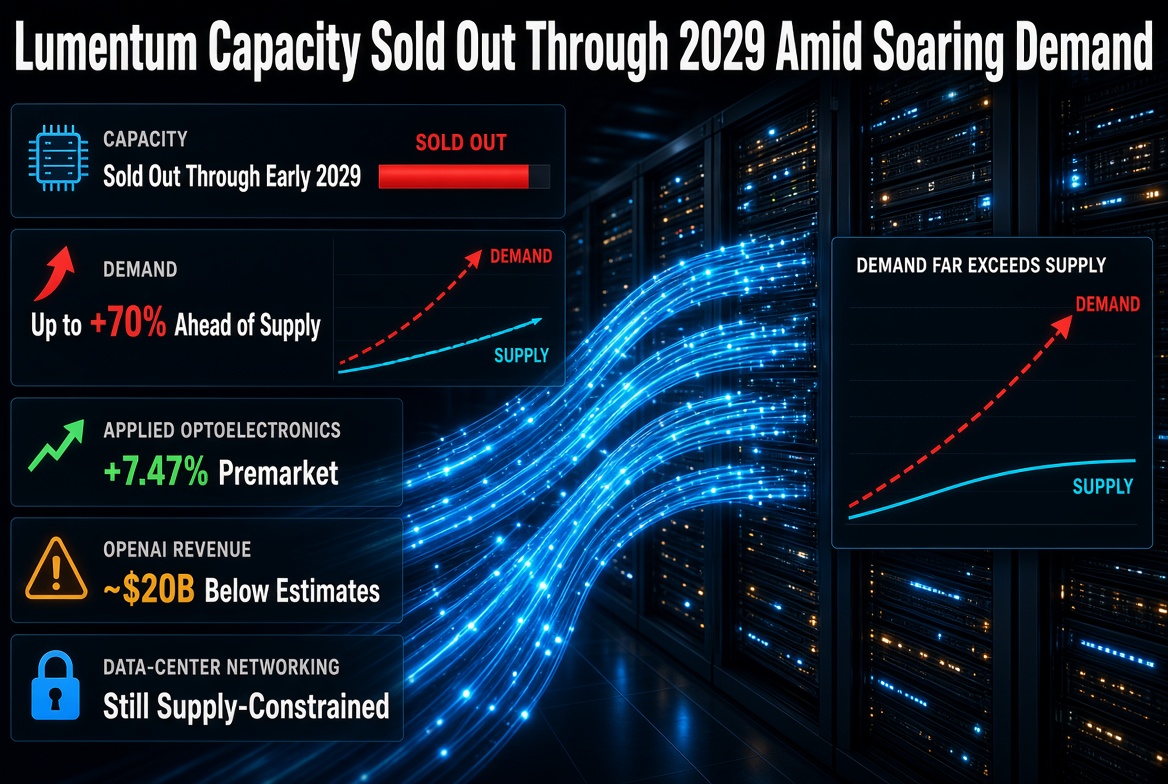
Lumentum Holdings' chief executive said the company's optoelectronic component capacity is completely sold out through early 2029, a remark that lifted optical networking stocks in premarket trading on Friday. Applied Optoelectronics rose 7.47% after Michael Hurlston made the comments to Bloomberg Television.
Hurlston said demand for some of Lumentum's products is running as much as 70% ahead of what the company can supply into next year. The comment points to an acute shortage in the components that move data between servers, switches and accelerators inside AI data centers, and it suggests customers are locking in capacity years in advance.
The timing is notable. On Thursday, technology shares led Wall Street lower, with the Nasdaq 100 falling 1.4%, its worst day in seven weeks, and a gauge of chipmakers sliding 3.4%. The selloff followed reports that OpenAI's annualized revenue was roughly $20 billion lower than previously estimated, which revived concerns about the sustainability of AI infrastructure spending.
Lumentum's remarks cut against that narrative, at least for the optical layer of the AI supply chain. A supplier that cannot meet demand through early 2029 is not suffering from a lack of orders. Still, supply-constrained companies are not immune to a change in sentiment, because backlog can shrink quickly if customers revise spending plans or financing conditions tighten.
Reuters reported Friday that Asian stocks were poised for a second straight weekly drop as investors worried about elevated energy prices, bond market turbulence and the huge sums needed to fund AI investment. Those concerns help explain why capital-intensive AI names remain vulnerable to sharp swings even when company-specific news is strong.
For Applied Optoelectronics, the read-through is straightforward: if industry capacity is tight, makers of competing optical components may benefit from spillover demand and stronger pricing. The 7.47% premarket jump reflects that logic, though investors should note the move rests on a single executive's comments about a different company rather than on reported results or guidance from Applied Optoelectronics itself.
The analyst's challenge is separating durable demand from momentum. Sold-out capacity can support revenue visibility and margins, but it also raises execution risks as suppliers race to expand output, and a timeline stretching toward 2029 introduces uncertainty about technology transitions, customer concentration and the pace of data center construction.
Traders should watch whether optical names hold their premarket gains after the open, how chip stocks trade after Thursday's rout, and whether further supplier commentary corroborates the capacity squeeze. Upcoming earnings calls from component makers will offer the next test of whether the AI hardware cycle remains intact despite the recent bout of valuation anxiety.