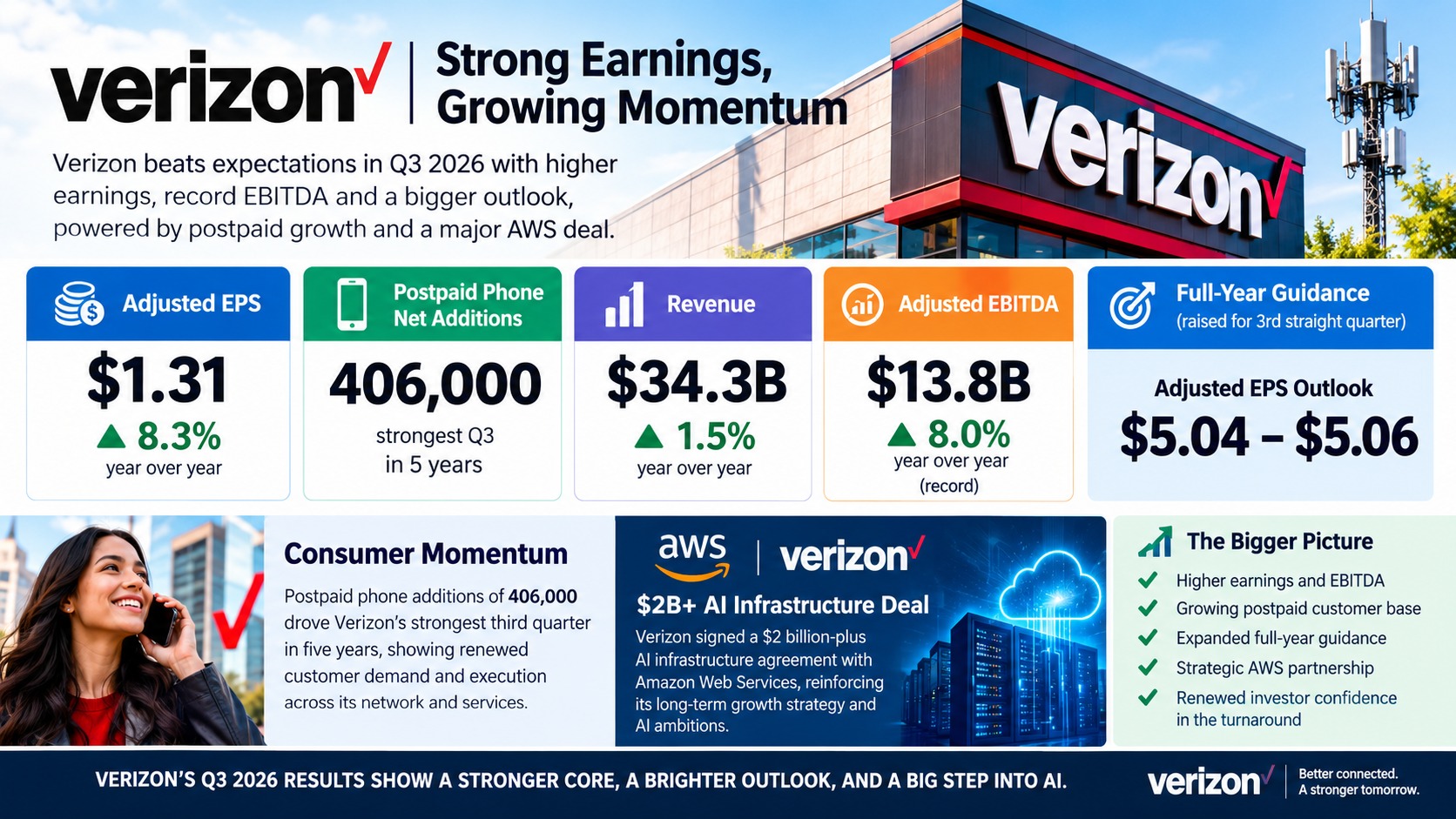
Verizon Communications delivered third-quarter 2026 results on Monday that pointed to a genuine acceleration in its consumer business, with adjusted earnings per share of $1.31, up 8.3% from $1.21 a year earlier. The company also raised its full-year guidance for the third consecutive quarter and announced a commercial agreement valued at more than $2 billion with Amazon Web Services to supply distributed compute for artificial intelligence workloads.
The subscriber numbers were the headline. Verizon added 406,000 postpaid phone net customers, more than eight times the prior-year figure and the strongest third quarter in five years, while postpaid net account additions of 137,000 were described as the best in more than a decade. Postpaid phone churn improved four basis points year over year to 0.94%. Management said promotional cost of acquisition fell 41% and promotional cost of retention improved 30%, evidence that growth is being bought less aggressively with device subsidies than in prior cycles.
Total operating revenue rose 1.5% to $34.3 billion. Mobility and broadband service revenue grew 2.9% to roughly $23.5 billion, a continued sequential improvement from 2.8% in the second quarter and 1.6% in the first, but wireless equipment revenue fell 9.0% as upgrade volumes dropped and subsidies were trimmed. One pre-earnings preview had pointed to consensus revenue near $34.9 billion, so the top line landed modestly light even as profitability beat. Consolidated adjusted EBITDA climbed 8.0% to a record $13.8 billion, and the adjusted EBITDA margin widened from 37.8% to 40.2%.
Cash generation was equally strong. Cash flow from operations reached $11.5 billion, up 2.2%, and free cash flow rose 12.1% to $7.8 billion. Over the first nine months, Verizon returned $12.8 billion to shareholders, up 49%, including $8.8 billion of dividends and $4.0 billion of share repurchases, and it still expects to buy back up to $4.5 billion for the full year. Net unsecured debt fell to $123.7 billion from $128.7 billion at the end of the second quarter, leaving net unsecured debt at 2.3 times adjusted EBITDA.
The raised outlook is where the quarter may matter most for the stock. Verizon now expects 1.1 million to 1.2 million postpaid phone net additions for 2026, up from the upper half of a 750,000 to 1.0 million range. Adjusted EPS guidance moved to $5.04 to $5.06, implying 7.0% to 7.5% growth, from 6.0% to 7.0% previously. Free cash flow growth is now expected to approach 12.0%, up from 9.0% to 10.0%, and the company forecast about 4.0% mobility and broadband service revenue growth in the fourth quarter.
The AI infrastructure agreement adds a new narrative layer. Verizon said the arrangement with Amazon Web Services creates a commercial framework to scale distributed compute for the real-time demands of agentic and generative AI, leaning on its fiber network. Analyst previews had noted that AI Connect revenue was not included in the 2026 guidance, with the first meaningful impact expected in 2027. Capital expenditure guidance remains $16.0 billion to $16.5 billion, which includes success-based AI Connect investment.
Context matters for the reaction. Trefis data show Verizon shares fell 17.8%, dividends included, over 18 trading sessions from September 15 to October 9, so expectations had been reset lower heading into the print. Open questions remain: postpaid account average revenue declined 1.9% to $168.08, fixed wireless net additions fell 39% year over year to 159,000, and the upgrade rate slid to 2.6% from 3.3%. Investors will watch whether volume gains keep outpacing pricing pressure.
For a paper-trading portfolio, the setup favors patience over chasing. The print reduces fundamental risk and supports the dividend, which stood at 70.75 cents per share for the quarter, yet the broader tape is cautious ahead of Wednesday's Federal Reserve decision and a heavy week of Big Tech earnings. Verizon's defensive profile and rising free cash flow make it a candidate for a staged entry rather than a single large position. This is analysis for a simulated account, not personalized investment advice.