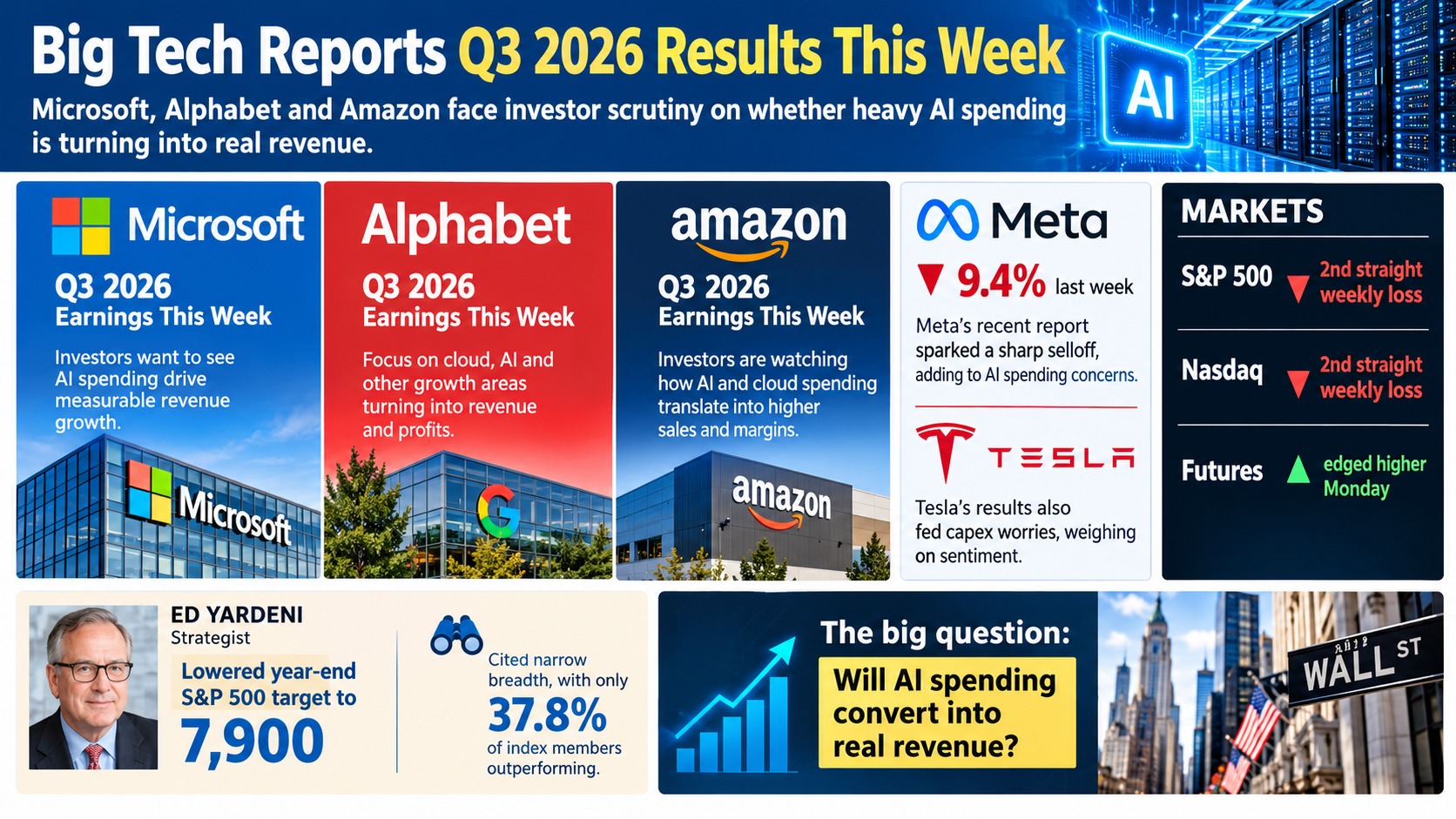
Wall Street enters the busiest stretch of the third-quarter earnings season with sentiment bruised. Microsoft, Alphabet and Amazon are scheduled to report this week, and investors have made clear they want evidence that enormous artificial intelligence spending is producing durable earnings power rather than simply larger capital bills. The question hanging over every call is how much these companies are spending and, crucially, what they are getting for it.
The backdrop is fragile. The S&P 500 and the Nasdaq Composite both posted a second straight weekly loss, and all three main U.S. indexes closed lower on Friday. Results from Meta and Tesla last week stoked concerns about the scale of capital outlays, and Meta led the latest leg down in the so-called Magnificent Seven group, falling 9.4% last week after its report. The pullback has revived a debate over whether the investment boom that powered record highs earlier in the year is running ahead of its returns.
Monday's early signals were modestly constructive. Futures pointed to gains of roughly 0.26% for the S&P 500, 0.31% for the Dow Jones Industrial Average and 0.21% for the Nasdaq-100, helped by a retreat in crude oil after President Donald Trump said there would not be a strike on Iran today. Prediction-market traders were pricing about a 69% chance of a higher S&P 500 open. That relief may prove short-lived if earnings guidance disappoints, since expectations for the largest technology names remain elevated.
Strategists are split on how much room is left. Ed Yardeni recently pushed out his 8,400 S&P 500 target from year-end 2026 to mid-2027 and set a revised year-end target of 7,900, citing the risk that a Middle East escalation could send oil back above its $120 peak. He also highlighted weak market breadth, noting that only 37.8% of S&P 500 companies are outperforming the index over the past year. On the other side, Wedbush analyst Dan Ives argues that Wall Street is underestimating technology earnings by as much as 25% and that the gap between AI capital spending and monetization is nearing its end.
What investors will scrutinize is specific. Capital expenditure guidance and growth rates will be examined line by line, alongside cloud revenue growth, backlog commentary and any evidence that AI products are lifting average revenue per customer. For Microsoft and Amazon, cloud segment growth and margin trends are central; for Alphabet, the focus includes search resilience and the pace of AI monetization. Free cash flow trends will matter because heavy investment is compressing the cash buffers that were once taken for granted.
The macro calendar compounds the risk. The Federal Reserve begins a two-day meeting on Tuesday, with markets pricing about 90% odds that it holds rates at 3.75% to 4%, and the September PCE inflation reading lands on Thursday. A hawkish tone alongside a disappointing capex-to-revenue story would be an awkward combination for valuations in the mega-cap complex.
For a paper-trading account, this is a week for sizing discipline rather than conviction bets. Binary earnings events can produce gaps of 5% to 10% in either direction, as Meta's decline showed. A reasonable approach is to hold existing exposure at modest weights, avoid adding ahead of each report, and consider entries only after the post-earnings reaction clarifies whether the market is rewarding or punishing AI spending. This analysis is for a simulated portfolio and is not personalized investment advice.