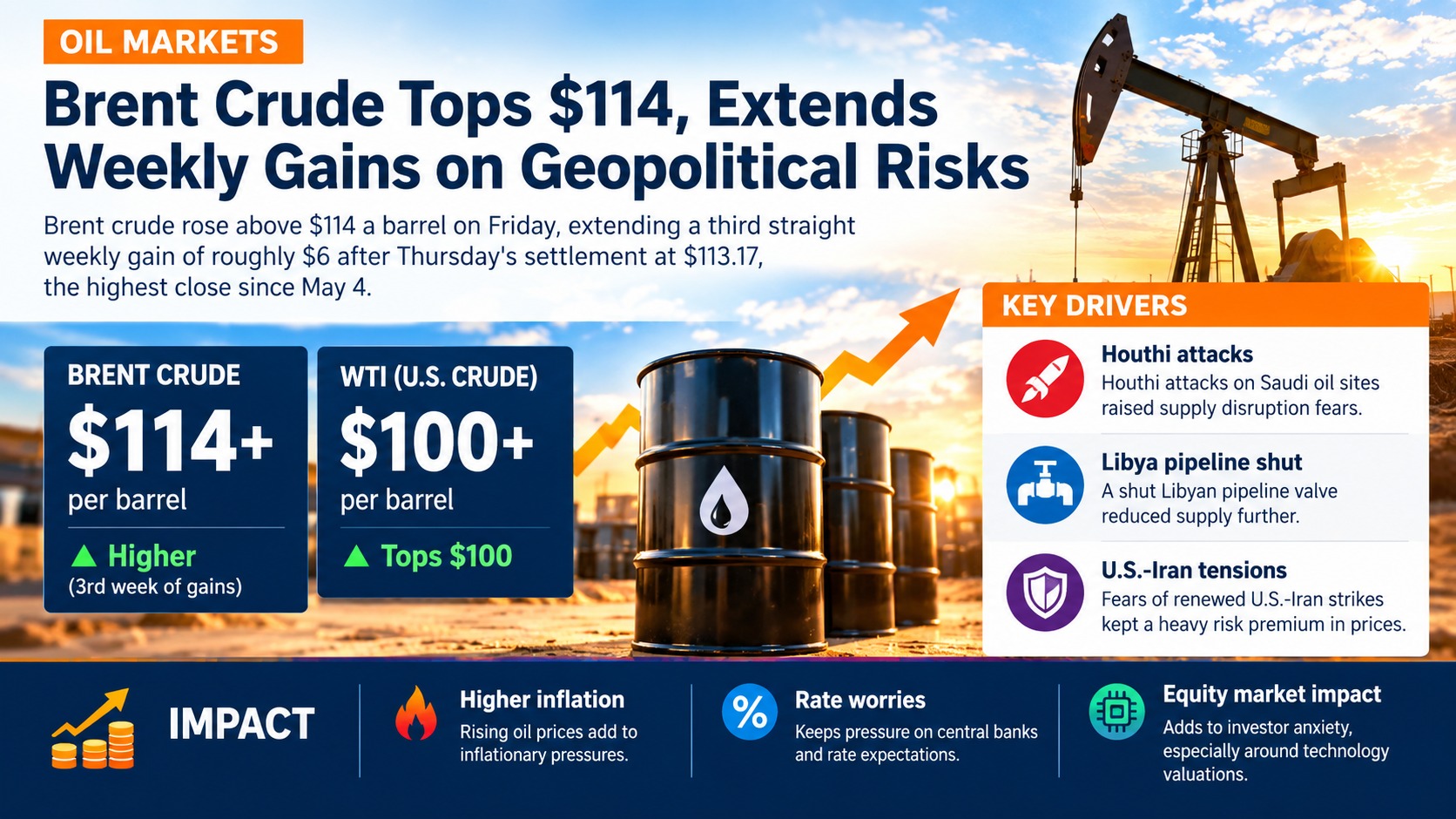
Oil prices pushed higher on Friday, with Brent crude futures trading above $114 a barrel and US West Texas Intermediate holding above $100 as renewed attacks in Saudi Arabia, a pipeline outage in Libya and fresh worries about US-Iran escalation kept supply risk front and center for investors.
Brent settled on Thursday at $113.17, a gain of $4.35 or 4.0%, its highest close since May 4. West Texas Intermediate settled at $99.47, up $2.32 or 2.4%. The global benchmark is on course for a gain of roughly $6 on the week and is set to post a third straight weekly advance. It has also traded in technically overbought territory for the third time in a week, a sign that the move has been fast and that sharp pullbacks are possible.
The latest leg higher followed intensifying Houthi attacks on Saudi Arabia. The kingdom's state oil producer ordered the evacuation of its headquarters in Dhahran, near Bahrain, underlining how close the fighting has come to the center of the Gulf's energy system. Separately, a pipeline valve carrying crude from the Hamada and Tahara oilfields to the port of Zawiya in Libya has been shut, reducing production at both fields, according to the head of Libya's national oil corporation.
Geopolitics add another layer of uncertainty. News reports this week indicated that the United States and Israel are weighing fresh strikes on Iran after the November midterm elections, and Tehran has vowed to retaliate, potentially against economic and civilian targets, the Wall Street Journal reported. Iran's Revolutionary Guard claimed that four tankers were hit during oil transfers and that three vessels struck mines near the Strait of Hormuz. President Donald Trump dismissed those claims as a stunt and accused Tehran of trying to lift crude prices ahead of the elections. The claims were not independently verified in the reports reviewed.
Analysts say the market is paying for risk even as physical flows hold up. One oil-market analyst noted that reports of Middle East exports recovering beyond pre-conflict levels are outweighed by attacks on ships in the Strait of Hormuz and strikes on Saudi infrastructure. Commodities strategists added that the possibility of renewed escalation in the Gulf could keep the risk premium elevated even if actual flows remain resilient.
For equity investors, the transmission channel is inflation and interest rates. Gold slid toward a three-month low as the oil rally stoked rate concerns, trading near $4,036 an ounce. The US 10-year Treasury yield hovered around 4.98%, the 30-year yield was above 5.3%, and the VIX volatility index was near 19.9. In early trading, S&P 500 futures were down about 0.3% and Dow futures about 0.6%, after a Thursday session in which the Nasdaq Composite fell 2.6% on worries about financing for artificial intelligence spending.
Sector implications are fairly direct. Higher crude typically supports upstream producers and oilfield services, which investors can access through funds such as the Energy Select Sector SPDR Fund, while it pressures airlines, transportation and consumer-discretionary businesses exposed to fuel and gasoline costs. Higher energy prices also complicate the outlook for central banks, because they feed headline inflation and can push yields higher at a moment when growth stocks are already sensitive to borrowing costs.
The risk is two-sided. A diplomatic breakthrough, a verified reopening of disrupted routes or a release of stranded barrels could erase part of the premium quickly, as earlier spikes this year have shown. Conversely, a successful strike on export infrastructure could send prices sharply higher.
What to watch next: headlines on Hormuz tanker traffic, any further strikes on Saudi facilities, a restart of the Libyan fields, weekly US inventory data and the tone of rate-policy commentary. With weekend headline risk elevated, position sizing may matter more than direction for traders holding energy exposure into Monday.