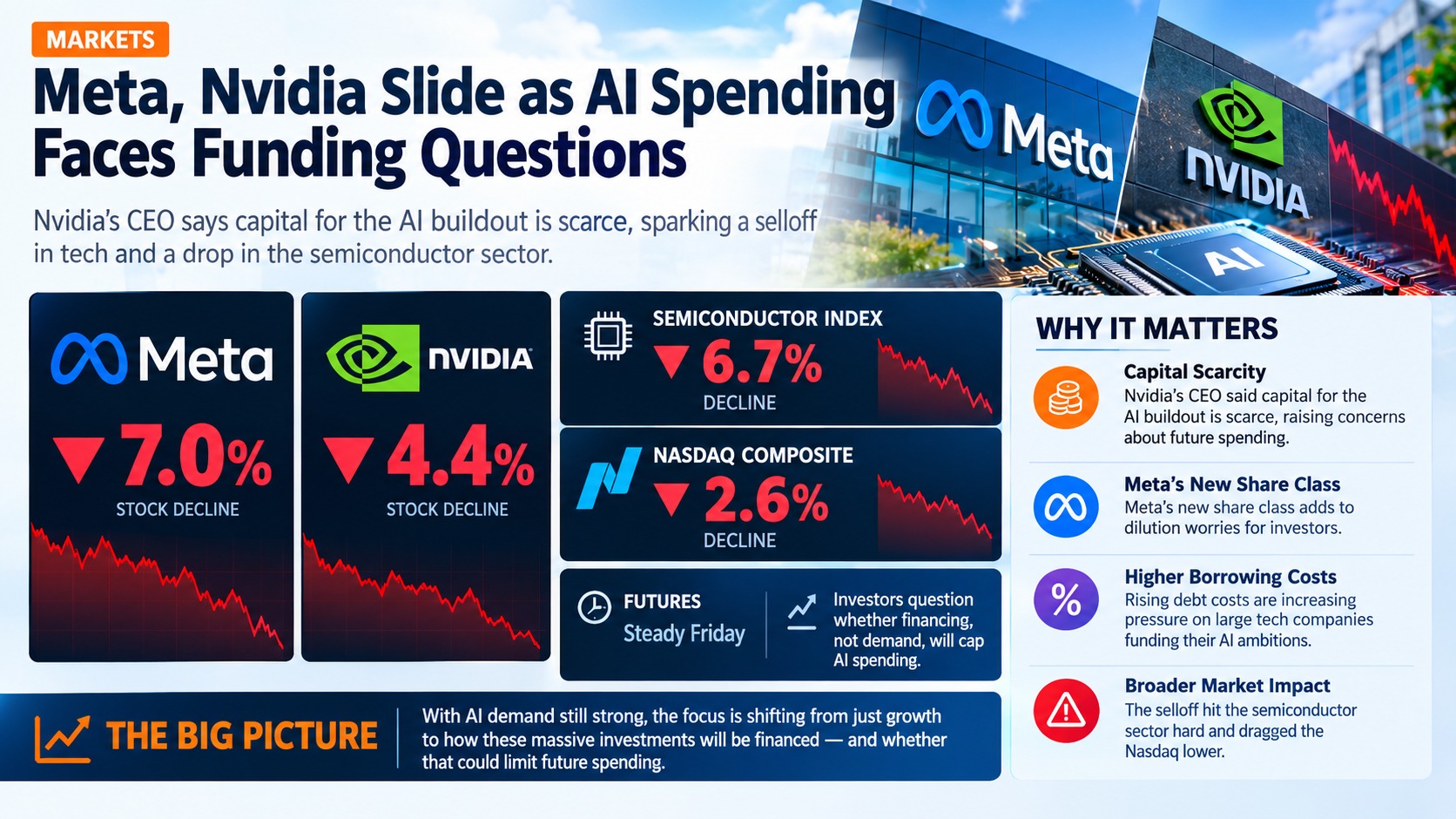
US technology stocks were trying to steady on Friday after the Nasdaq Composite fell 2.6% on Thursday, its worst session since June, as investors questioned how the artificial intelligence buildout will be financed. In early European hours, S&P 500 futures were roughly flat to slightly lower, Dow futures were down about 0.3% and Nasdaq 100 futures were up about 0.2%.
The catalysts were twofold. Meta Platforms said it would roll out a new class of shares, partly as a way to help raise funds for its AI ambitions, and its stock dropped about 7% to roughly $649, its largest one-day decline since July. Like other large technology groups, Meta has laid out plans to spend hundreds of billions of dollars on AI while carrying a growing debt load.
Then Nvidia chief executive Jensen Huang said in a television interview that there is a scarcity of capital for the AI buildout, adding that the demand for capital is much greater than its availability. Nvidia shares fell about 4.4% to around $212, Advanced Micro Devices dropped roughly 8.1%, and a tracker of the semiconductor industry shed 6.7%.
Analysts framed the move as a shift in the central question around AI. The concern is no longer only whether demand for computing exists, but whether enough financing does. Yardeni Research noted that the once ample free cash flows of these companies have turned negative, forcing them to borrow, and that investors fear rising financing costs and insufficient returns on the huge investments. Strategists also pointed out that, with borrowing costs expected to climb in coming months, technology groups may need to sell stock to fund the next round of spending, and dilution risk can weigh on share prices.
Asia echoed the unease. Japan's Nikkei 225 was down about 1.4% to around 62,050 in early trade after selling in AI and technology names pulled Wall Street lower. In South Korea, SK Hynix said it would discontinue its review of a pre-IPO round and initial public offering for its Solidigm memory unit, citing capital market conditions, after reports that the unit had considered raising about 5 trillion won, or $3.8 billion. A shelved listing is a small data point, but it fits the theme of capital becoming harder to source for AI-linked projects.
The pressure is not confined to technology. Brent crude futures were trading near $114 a barrel on Friday, and the US 10-year Treasury yield was hovering just under 5%, a level that makes debt-funded expansion more expensive. The VIX volatility gauge was near 19.9, up about 4.5% from the prior session. Ructions in French government bonds, where the yield gap to German debt widened by the most in a day since early 2020, also fed a risk-off tone.
For traders, the setup is a tug of war between momentum sellers and dip buyers. Thursday's selling was concentrated in AI infrastructure and chip names, while the Dow Jones Industrial Average finished roughly flat, a sign that money rotated toward defensive areas rather than leaving equities altogether. Whether Friday brings a rebound or a second leg lower will depend on whether financing worries spread beyond Meta and the chipmakers, and on how oil and Treasury yields behave through the session.
Investors may want to separate companies with strong free cash flow and funded capital plans from those relying on new debt or equity issuance. Position sizing and stop discipline matter more than usual after a move of this size, because both sharp rebounds and cascading liquidations are plausible in a market that has become highly concentrated in a handful of AI-linked leaders.