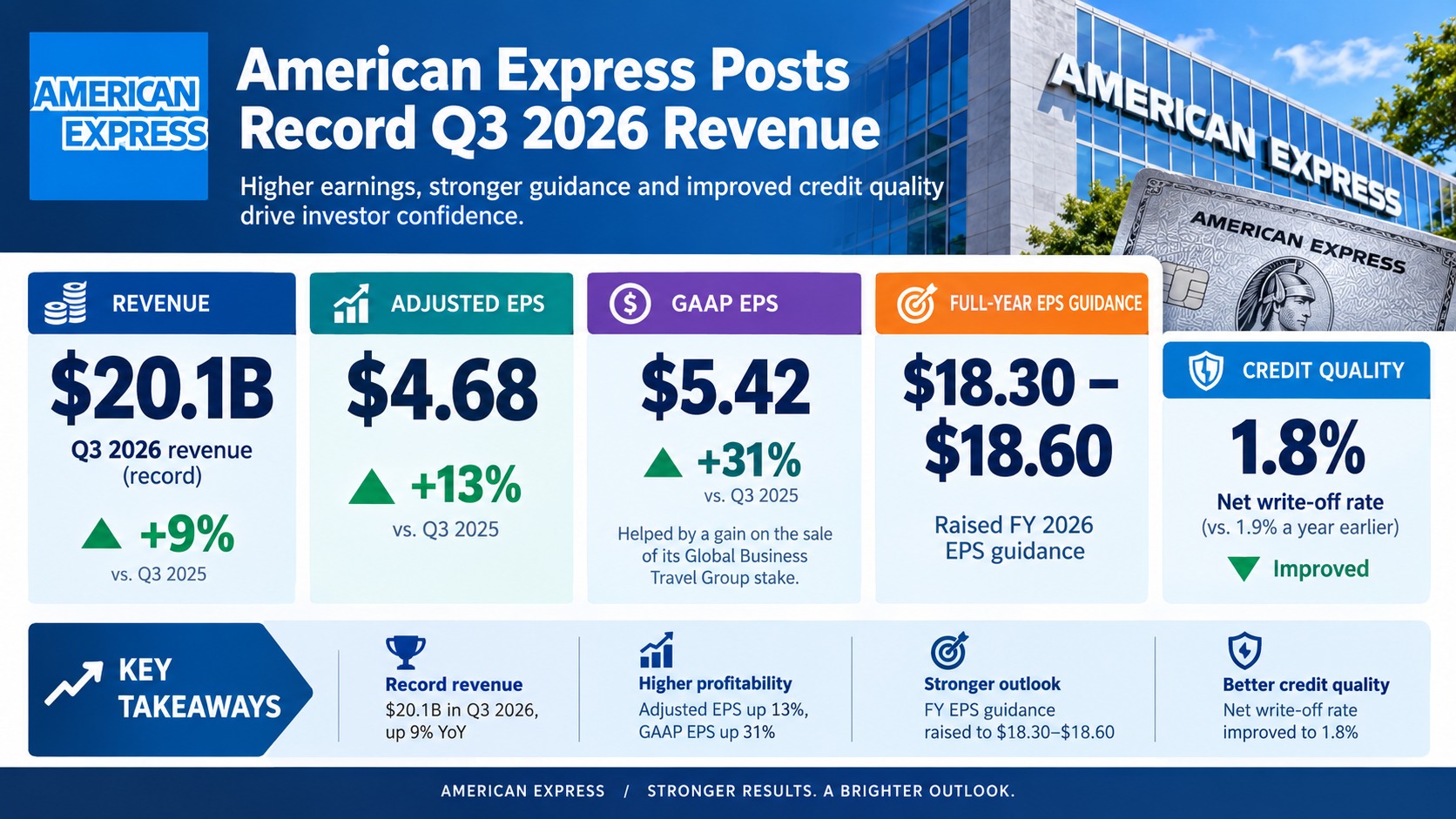
American Express reported record third-quarter 2026 revenue of $20.1 billion on Friday, up 9% from a year earlier, and raised its full-year earnings guidance, giving the premium card issuer a strong print on a day when investors are hunting for earnings reliability outside the artificial intelligence trade.
Net income rose 28% to $3.7 billion, and diluted earnings per share climbed 31% to $5.42 from $4.14 a year ago. That headline figure includes a $982 million pre-tax gain from the previously announced sale of the company's equity interest in Global Business Travel Group, net of a portion used to fund restructuring tied to efficiency initiatives. Excluding those items, adjusted net income was $3.2 billion and adjusted EPS was $4.68, up 13% year over year. Investors typically focus on the adjusted figure as the cleaner read on underlying performance.
Spending momentum held up. Billed business reached $454.0 billion, an 8% increase, and revenue net of interest expense of $20.06 billion rose 9% both as reported and on an FX-adjusted basis. The company attributed growth to higher Card Member spending, increased net interest income supported by growing card balances, and strong card fee growth, helped by the U.S. Platinum Card refresh. For the first nine months of 2026, revenue totaled $58.6 billion, up 10%.
Credit trends were a highlight. Provisions for credit losses fell to $1.0 billion from $1.3 billion a year earlier, reflecting a reserve release this quarter compared with a reserve build in the prior-year period, partly offset by higher net write-offs. The net write-off rate was 1.8%, down from 1.9%. Expenses rose 9% to $14.5 billion, driven by higher variable customer engagement costs and the Platinum refresh, partly offset by lower operating expenses, although legal reserves for previously disclosed matters and restructuring costs weighed on the line. A lower effective tax rate of 18.1%, down from 24.1%, also boosted the bottom line, reflecting discrete benefits from resolving prior-period tax items.
Management now expects full-year 2026 EPS of $18.30 to $18.60 on a GAAP basis, or $17.60 to $17.90 on an adjusted basis, compared with $15.38 last year. Chief Executive Stephen Squeri said the company is on track to deliver another year of roughly 10% revenue growth and cited strength in billings, new account acquisition and Card Member retention. Average diluted shares outstanding fell 3% to 674 million, adding support from buybacks.
The company also highlighted strategic moves. It extended its long-term partnership with Marriott International, including the U.S. cobrand cards, and launched an exclusive tie-up with Airbnb that brings more than one million listings to its travel platform. It introduced a new generation of its corporate card and expense software, launched a business savings account, and announced Resy integrations, including with OpenAI, alongside a framework for trusted agentic commerce. Card acceptance reached more than 190 million merchant locations worldwide.
Risks remain. In its forward-looking statements, the company cited the Middle East conflict, tariffs, energy costs, market volatility, regulatory pressure on pricing and acceptance, and competitive changes from agentic technologies. With Brent crude above $114 and Treasury yields near 5%, consumer and travel spending trends will stay under scrutiny.
For portfolio managers, the report reinforces the case for high-income, affluent-skewed consumer exposure, though investors should weigh the one-time gain and tax benefits when judging the quality of the beat. Shares will trade against a volatile tape, and any reaction should be read in the context of a broad technology-led risk-off backdrop.