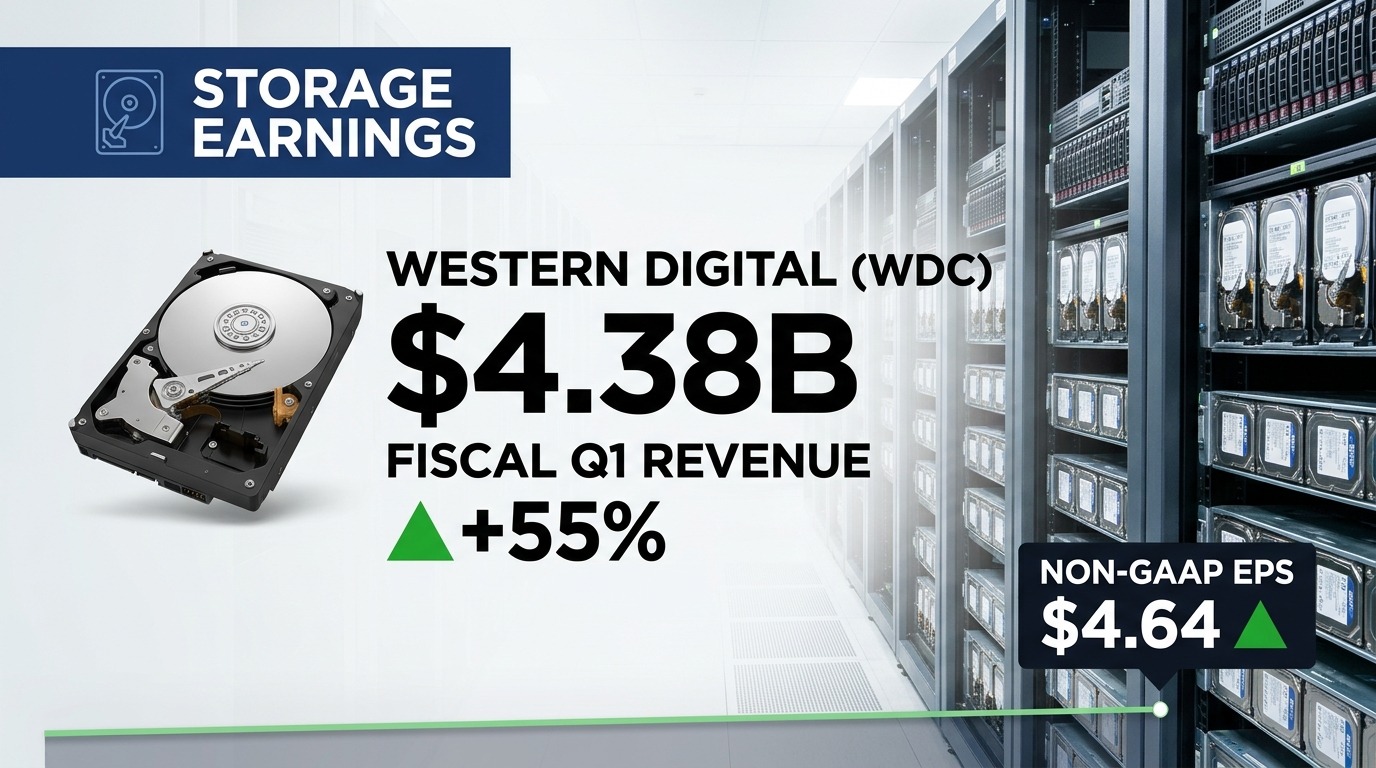
Western Digital delivered another quarter of rapid growth in its fiscal first quarter of 2027, yet its shares slid in extended trading as a wider retreat from artificial intelligence-linked stocks overshadowed the results.
Revenue reached $4.38 billion, up 55% from a year earlier, comfortably above the $4.1 billion midpoint the company had guided to in August and above Wall Street estimates. GAAP gross margin came in at 57.8% and non-GAAP gross margin at 58.1%, while the non-GAAP operating margin expanded to 49.1%. GAAP diluted earnings per share were $4.63 and non-GAAP EPS was $4.64, a 161% increase from a year earlier and well ahead of the roughly $4.00 the company had targeted at the midpoint of its guidance.
Cash generation was equally strong. Cash flow from operations was $1.60 billion and free cash flow was $1.38 billion for the quarter. Reflecting that strength, the board raised the quarterly cash dividend by 17% to $0.175 per share. Chief Executive Irving Tan said fiscal 2027 is off to a strong start, with results exceeding expectations on robust customer demand and disciplined execution, and that the company is deepening customer relationships and extending its visibility into future demand.
Looking ahead, Western Digital expects second-quarter revenue to rise between 66% and 72% from a year earlier, signaling that the pricing and volume tailwinds behind its storage products are not fading. Industry coverage noted that the company's blended average selling price per terabyte gained 28% during the quarter, a reminder of how tight supply has become as hard drives and memory chips serve as central components in AI systems.
Even so, the stock fell by more than 6% in extended hours trading. Shares had climbed more than 88% so far this year, setting a high bar for any report, and the post-earnings decline mirrored a rotation out of AI-linked names that accelerated after Thursday's technology rout. A similar pattern played out after the company's previous report in August, when the stock dipped despite an earnings beat and above-consensus guidance, suggesting that expectations were already elevated.
The reaction also reflects the broader debate now facing technology investors. The Nasdaq Composite fell 2.6% on Thursday and a semiconductor industry tracker shed 6.7% amid concerns about how the AI buildout will be financed. When capital is perceived as scarce, suppliers of storage and memory can be seen as exposed to any slowdown in data-center spending, even if current orders remain strong. Elsewhere in the memory and storage chain, SK Hynix said it was discontinuing its review of a potential pre-IPO and initial public offering for its Solidigm unit, citing market conditions.
For investors, the report underlines a split between fundamentals and sentiment. Revenue growth above 50%, margins near 58% and expanding free cash flow support the bullish thesis, while valuation, a very large year-to-date gain and sensitivity to AI financing headlines argue for caution on sizing. Traders will watch whether buyers step in near recent support levels, how peers react as they report, and whether cloud customers reaffirm capital spending plans in coming weeks.
The next catalysts include commentary from cloud customers, any further updates on supply constraints and pricing, and broader market direction as oil above $100 and Treasury yields near 5% keep pressure on high-multiple growth stocks.