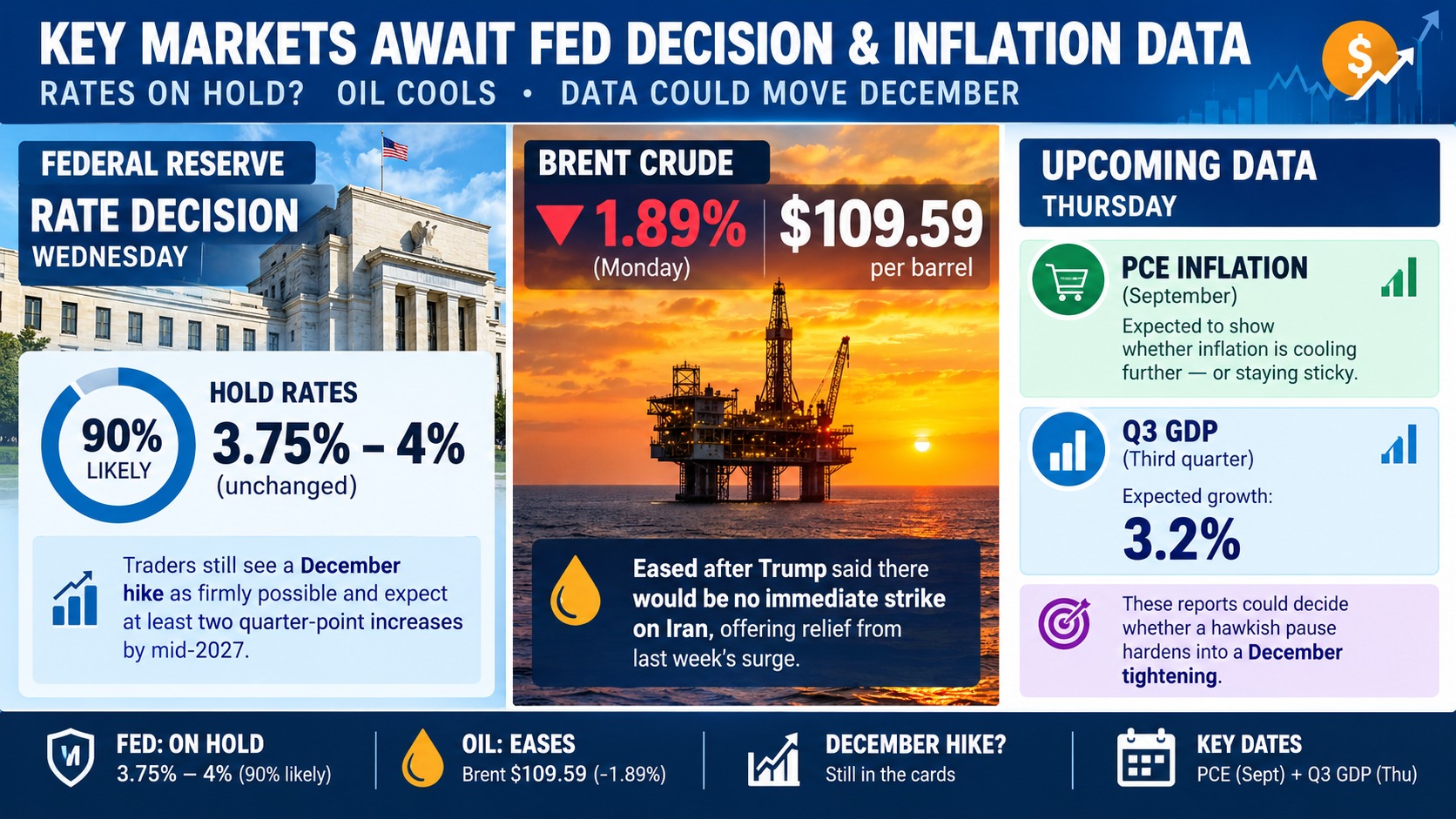
The Federal Reserve opens a two-day policy meeting on Tuesday with a decision due Wednesday, and the central question is less whether it will move than how firmly it signals what comes next. Pricing implies roughly 90% odds that the benchmark rate stays at 3.75% to 4%, making a pause after last month's rate increase the clear base case. Only about a 10% chance of a hike is priced for this meeting.
Even so, rate-sensitive assets are trading the guidance rather than the decision. Traders still see a December increase as firmly possible and expect at least two quarter-point hikes by mid-2027, according to market-data provider estimates. After hotter-than-expected inflation readings, many strategists expect Chair Kevin Warsh to deliver a hawkish pause, keeping the door open to further tightening without committing to a date. Participants will be searching the statement and press conference for any sign that the central bank is warming up the market for a December move.
The data calendar adds to the tension. The September Personal Consumption Expenditures index, the Fed's preferred inflation gauge, arrives on Thursday, alongside third-quarter GDP, which is expected to show 3.2% growth. Monday's smaller releases include the Chicago Fed national activity index for September, forecast at -0.1, and the Dallas Fed manufacturing index, which stood at 9.8 in the prior reading. Policy decisions from the European Central Bank, the Bank of Canada and the Bank of Japan are also due this week, which could amplify currency and bond volatility.
Energy is the other swing factor. Brent crude fell 1.89% to $109.59 a barrel and West Texas Intermediate dropped 2.19% to $101.01 after President Donald Trump said there would not be a strike on Iran today. That retreat followed a Friday surge of more than 3% that pushed oil to near six-month highs on supply concerns tied to the Middle East and Ukraine as the northern hemisphere heads into winter. The relief is fragile: U.S. diplomatic missions across the Middle East have tightened security over intelligence warnings of Iranian plots targeting Americans.
Strategist Ed Yardeni has warned that an escalation could push oil back above its $120 peak, which would tax consumer and corporate spending and complicate the Fed's inflation fight. Elevated crude feeds directly into headline inflation, which is why the oil move matters for the rate path as much as the PCE print itself.
Early indications for U.S. equities were modestly positive. Futures pointed to gains of about 0.26% for the S&P 500, 0.31% for the Dow Jones Industrial Average and 0.21% for the Nasdaq-100, while the VIX sat near 19.7. The 10-year Treasury yield hovered just under 5%, and gold traded above $4,000 an ounce. Wall Street is also increasingly focused on the November 3 midterm elections, which will decide control of Congress and could shape fiscal and trade expectations.
For a simulated portfolio, the setup argues for smaller position sizes and defined risk into Wednesday and Thursday. A hawkish surprise would likely pressure long-duration assets and growth equities, while a softer tone paired with falling crude could extend the early rebound. Investors seeking a direct read on rate expectations can watch long-dated Treasury exposure such as the iShares 20+ Year Treasury Bond ETF (TLT), which tends to react quickly to shifts in December hike odds. This analysis is for a paper-trading account and is not personalized investment advice.