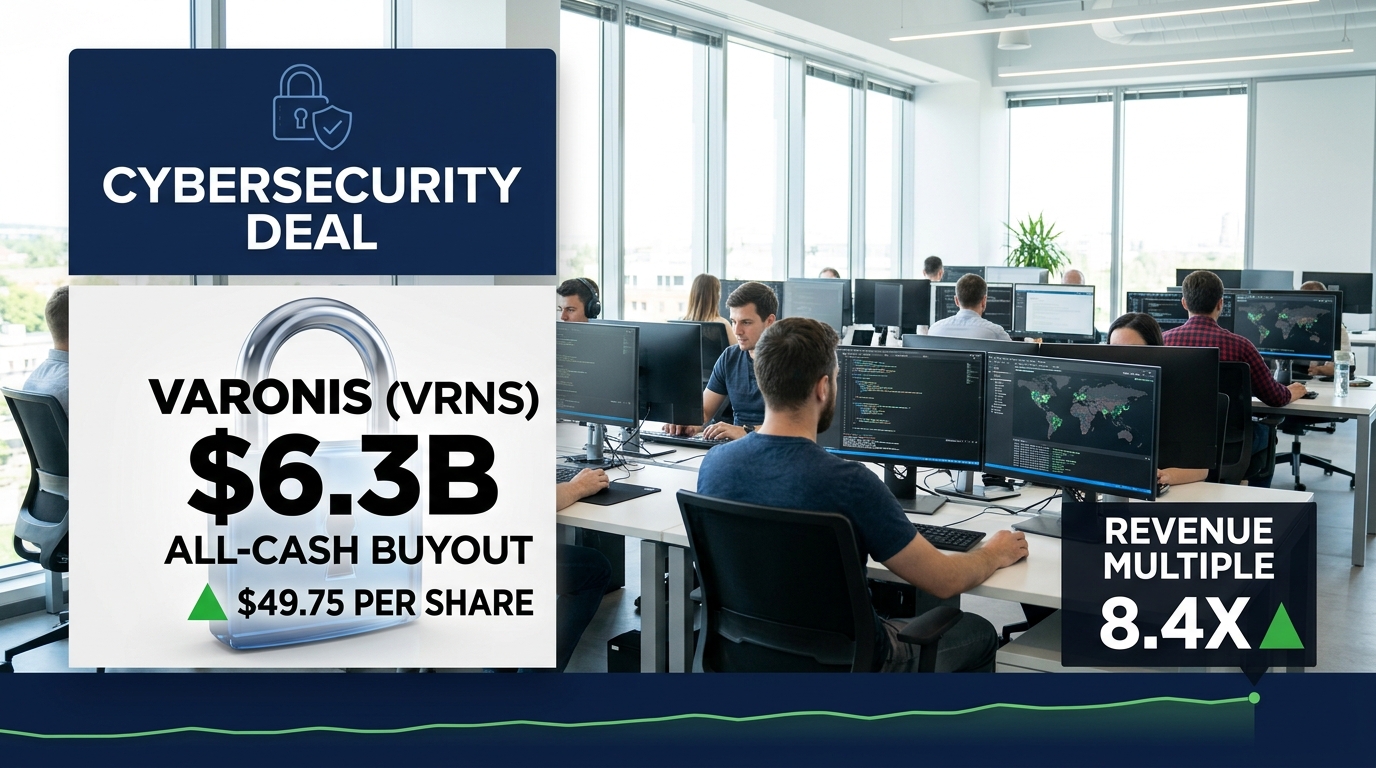
Varonis Systems agreed to be acquired by Proofpoint in an all-cash transaction valued at approximately $6.3 billion, the companies announced late Thursday, putting a fresh take-private deal in front of software and cybersecurity investors on Friday.
Under the terms, Varonis shareholders will receive $49.75 per share in cash. Proofpoint, a portfolio company of private equity firm Thoma Bravo, said the transaction values Varonis at about 53 times trailing free cash flow and 8.4 times trailing revenue, with multiples calculated as of June 30, 2026.
Until the deal closes, the two companies will continue to operate independently. When it is completed, Varonis common stock will stop trading on the Nasdaq and the company will become private. Varonis will not host an earnings call in light of the agreement, though it plans to publish third-quarter 2026 results. The deal is expected to close in the first half of 2027.
Shares of Varonis gained more than 2% in after-hours trading following the announcement. The offer price sits roughly 6% above the $46.76 close recorded on September 2, the day Bloomberg reported that Proofpoint was in talks to buy the company. Earlier in the year, reports that Varonis was exploring a sale had lifted the shares by roughly 30%.
Varonis provides data security and governance tools, including products for AI-native data protection, and describes its mission as securing AI and the data that powers it. Proofpoint, best known for email and user security, would gain data-protection depth that spans classification, access governance and insider-risk monitoring. The pairing reflects consolidation in cybersecurity as private-equity-backed platforms seek to broaden their offerings.
The transaction is also notable as one of the larger technology take-privates since the steep selloff in software stocks earlier this year, according to Bloomberg. With public-market valuations for many software companies under pressure and borrowing costs elevated, sponsors able to finance deals are finding targets with strong cash flow.
For investors, the stock now trades largely on deal mechanics. Merger-arbitrage spreads reflect the time to closing, regulatory and shareholder approvals, and financing risk, so upside beyond the $49.75 price is limited unless a competing bid emerges. Holders may also consider the read-through for other cybersecurity and data-security companies, where an 8.4 times revenue benchmark could shape expectations for sector valuations.
Macro conditions matter at the margin. With the 10-year Treasury yield near 5.09%, the cost of financing leveraged buyouts remains high, and the Fed Chair's remarks later Friday could influence appetite for further deals if they move rates meaningfully.
Traders should note that a pending cash deal typically dampens volatility, making the shares a poor vehicle for directional bets but a potential source of modest, lower-risk spread capture. Those looking for exposure to the consolidation theme may instead examine other software and security companies that could attract private-equity interest, while remembering that a takeover is never guaranteed.