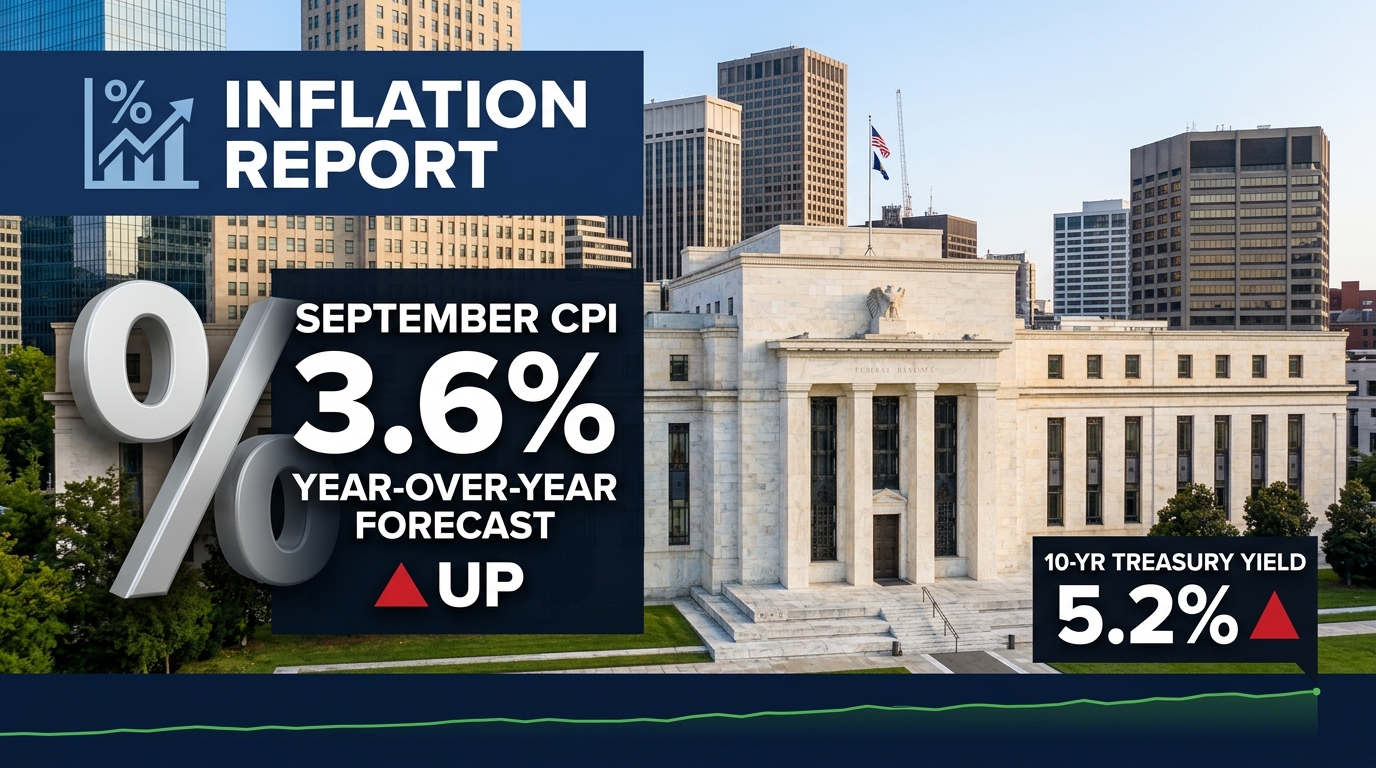
The most important scheduled event for U.S. markets this week arrives Wednesday at 8:30 a.m. Eastern, when the Bureau of Labor Statistics releases September consumer price data. Economists expect headline CPI to rise 0.6% from August and 3.6% from a year earlier, up from 3.4% in the prior annual reading, with some forecasts as high as 3.7%. Core CPI, which excludes food and energy, is expected to rise 0.2% on the month and 2.5% annually, versus 2.4% previously.
The expected split between a hotter headline and a calmer core points to energy as the main driver. Brent crude has hovered near $105 a barrel, and Tuesday it eased about 1.1% to roughly $105.50 as investors considered the prospect of more Russian diesel reaching global markets following a U.S.-brokered energy ceasefire between Russia and Ukraine. Middle East tensions, including missile launches intercepted by Saudi forces, continue to keep a risk premium in prices.
Treasury markets reopened Tuesday after the Columbus Day holiday. The 10-year yield fell more than 5 basis points to about 5.19% as energy prices pulled back, and the 2-year yield slipped to roughly 4.77%. Even so, long-dated borrowing costs remain near multi-decade highs, with some reports citing a 30-year yield around 5.70%, the highest since 2002. The dollar index is near 102.4, its strongest level since April 2025, while gold trades around $4,170 to $4,190 an ounce.
Policy expectations are delicately balanced. Markets assign roughly 81% odds to a hold at the October 28 meeting, though a further hike by year-end remains a live possibility. Cleveland Fed President Hammack has said fast, incremental tightening may be needed, and Fed Chair Warsh is scheduled to speak Friday at the IMF and World Bank meetings, where a hawkish tone could weigh on risk assets.
Equities have shown resilience despite the pressure. The S&P 500 sits near 7,800, just below its record of about 7,845, after finishing Monday essentially flat. Beneath the surface, however, the Nasdaq has been weaker as semiconductor stocks sold off, and Tuesday's early session featured mixed futures as banks and healthcare firms began reporting earnings.
Scenario analysis is straightforward. A core reading above 0.2% would likely push yields and the dollar higher and pressure growth stocks, undermining rate-cut hopes that have already faded. A soft core print would support a more dovish tone and benefit rate-sensitive sectors such as housing, small caps and utilities. A hot headline combined with a tame core might produce a muted reaction, since energy-driven inflation is often viewed as more transitory.
Thursday brings producer prices and retail sales, with core retail sales expected to rise 0.5% after a strong prior reading, so volatility is unlikely to fade after the CPI release. For portfolio managers, the priority is risk control into a data-heavy stretch: keep exposure to duration and high-multiple growth sized for a possible yield spike, hold dry powder for dislocations, and avoid leaning too heavily on any single outcome in a market where oil, yields and policy are all moving at once.