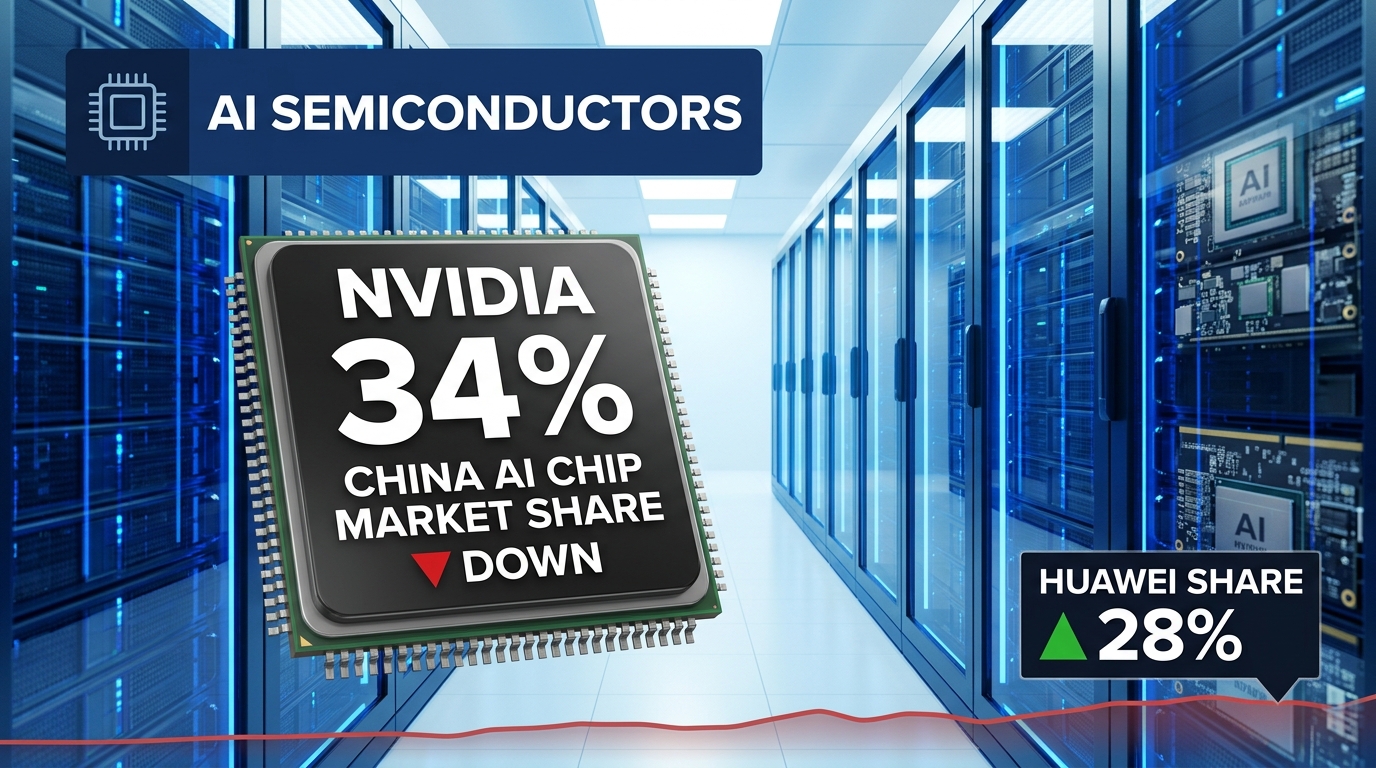
Nvidia's grip on China's data-center AI chip market is loosening. The company's share fell to 34% in the first half of 2026, while Huawei captured 28%, according to data from IDC cited in a Reuters report that circulated on Tuesday. The figures add a competitive and geopolitical dimension to a chip-sector selloff already driven by concerns over AI infrastructure financing.
The report describes a market shaped by policy on both sides of the Pacific. Washington has restricted Chinese access to Nvidia's most powerful processors, while Beijing has promoted domestic alternatives and required Chinese companies to seek approval before importing compliant Nvidia chips. The result is a market in which the world's most valuable AI chip designer competes with a handicap, and local rivals benefit from preferential demand.
The shift is even more pronounced outside the GPU category. Huawei, T-Head, Kunlunxin and Cambricon together accounted for 95% of the non-GPU segment, which government agencies, internet companies and telecommunications providers are adopting. That concentration suggests domestic suppliers are winning in architectures and customer groups where state priorities weigh heavily on purchasing decisions.
For Nvidia investors, the key question is how much of the company's growth depends on China versus the rest of the world. Management has previously treated China as a source of upside that is difficult to forecast because of export rules, so a lower share does not by itself rewrite the investment case. It does, however, narrow the range of recovery scenarios if rules are loosened, since the local ecosystem is now better established than it was a year ago.
The timing matters. Nvidia shares lost about 1.3% on Monday as semiconductor stocks fell, with the Philadelphia Semiconductor Index dropping 2.7% to its lowest level since mid-September. Reports said executives at Broadcom and Intel had warned about financing constraints around AI buildouts, which pressured sentiment across the sector. In Asia on Tuesday, Samsung and SK Hynix fell sharply on separate concerns about Chinese memory competition, reinforcing a theme of China-linked competitive risk.
Analysts who remain constructive on the group argue that global demand for AI compute, particularly from large cloud providers, still exceeds supply and that China represents a modest slice of current growth. Skeptics counter that valuations have priced in flawless execution and that any evidence of share loss, financing strain or customer digestion can trigger outsized declines.
Near-term catalysts include Wednesday's U.S. inflation report, results from ASML and TSMC later this week, and continued commentary on AI capital spending. Traders may view Nvidia as a bellwether for the entire complex, and moves in the stock are likely to influence sentiment toward memory, networking and equipment suppliers. Investors should watch for any change in export policy, since a loosening or tightening of rules would quickly alter the competitive picture described in the IDC data.