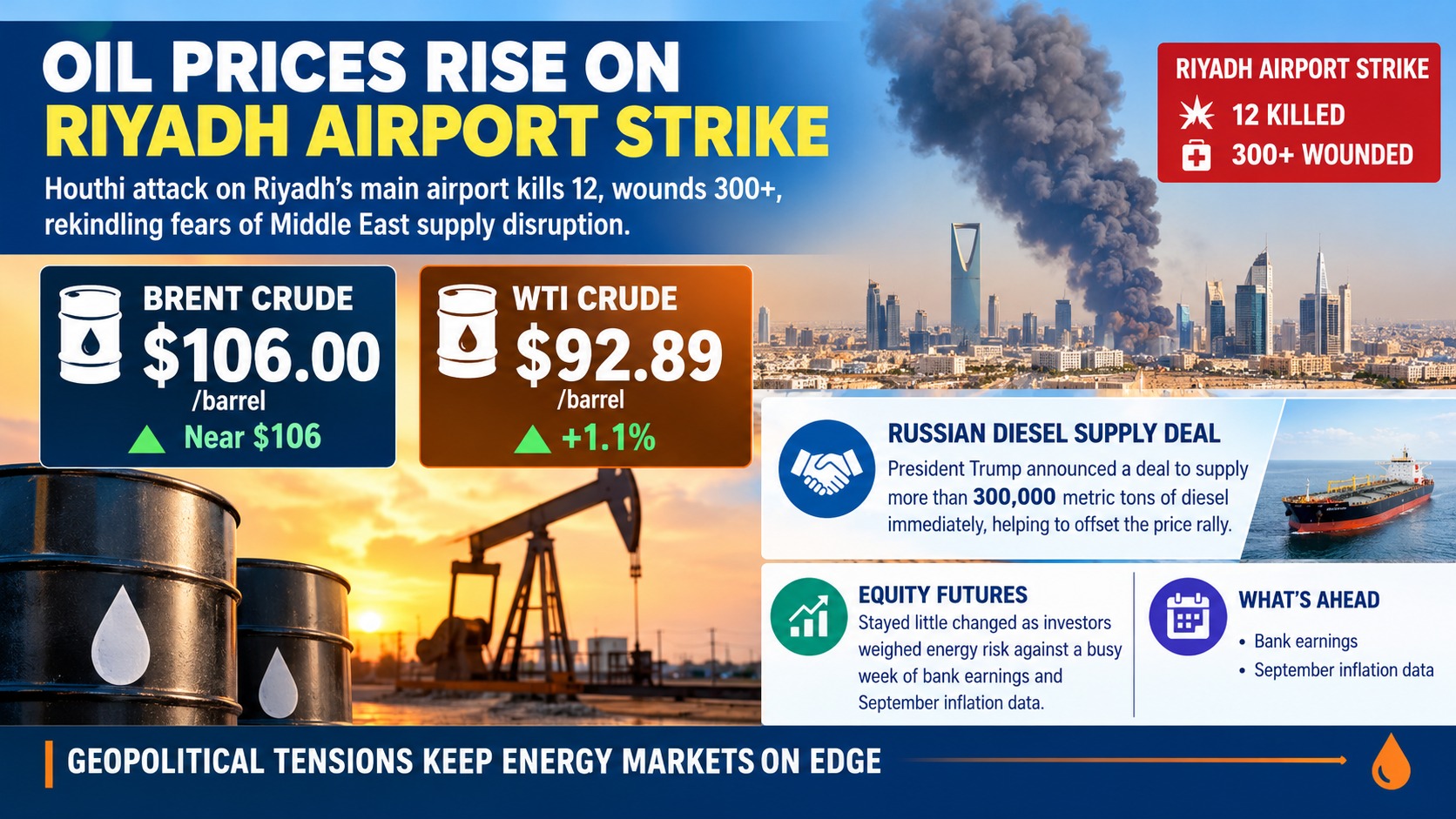
Oil prices stayed elevated on Monday as investors weighed a fresh escalation in the Middle East against an unexpected supply-side offset from Russia. West Texas Intermediate crude rose about 1.1% to $92.89 per barrel in early trading, while Brent gained roughly 1.2% to about $106, a two-week high reached amid rising regional tensions. Quotes swung through the morning, with some reports showing Brent easing toward $103 after the Russian announcement and others placing it just below $107 around the stock market open.
The immediate catalyst was violence in Saudi Arabia. The Iran-backed Houthis claimed responsibility for a Saturday strike on Riyadh's international airport that killed 12 people and wounded more than 300. A second attack on Sunday killed another person and injured 11. Since Thursday, thousands of flights to and from the airport have been canceled, roughly half of its scheduled service according to Flightradar24, and the Federal Aviation Administration urged US airlines to exercise caution in and around Saudi Arabia.
President Donald Trump is reportedly weighing whether the United States should join the Saudi-led campaign against the Houthis in Yemen, a step that would risk widening the regional war. The group also poses a potential threat to shipping through the Bab el-Mandeb Strait. Over the weekend, a tanker was struck by a drone near Oman's Sohar, and another was damaged while transiting the Strait of Hormuz, according to the United Kingdom Maritime Trade Operations.
On the diplomatic front, Iran said it is still reviewing a US response to its proposal for reopening the Strait of Hormuz and will reply through intermediaries once that review is complete. Qatar and Pakistan are among the mediators trying to end a war that began with US and Israeli strikes on Iran on February 28. A central disagreement is Washington's insistence on addressing Iran's nuclear program from the outset, while Tehran wants early talks to focus on restoring security in the waterway, which before the war carried about one-fifth of global oil and liquefied natural gas trade.
Offsetting some of the pressure, Trump said Russia will immediately supply more than 300,000 metric tons of diesel to US and global markets, followed by another 500,000 tons in November and a further 1 million tons thereafter. He also announced an energy ceasefire between Russia and Ukraine, although Ukrainian leader Volodymyr Zelenskiy said he was still waiting for details and Kyiv reported continued Russian attacks on energy facilities. A bipartisan group of six senators urged the administration to reverse course, arguing the diesel arrangement conflicts with US sanctions policy toward Russia.
Equity markets absorbed the headlines calmly. Futures on the Dow Jones Industrial Average and S&P 500 rose about 0.1%, while Nasdaq-100 contracts were little changed after a winning week that delivered record highs for the S&P 500 and Nasdaq. The Dow closed Friday at 51,654.95, up 423.31 points. The 10-year Treasury yield sat near 5.24%, gold traded around $4,195 an ounce and the VIX hovered near 15.5. The US bond market is closed for Columbus Day, which can thin liquidity.
The oil move matters because it feeds directly into inflation expectations. Diesel is at record prices, and the University of Michigan's preliminary October consumer sentiment reading fell to 46.3 from 48.1 in September. With September consumer prices due Wednesday and producer prices Thursday, traders are watching whether energy costs complicate the interest-rate outlook. Further escalation in Yemen or the Gulf could extend the oil rally, while a credible Hormuz deal could reverse it quickly.