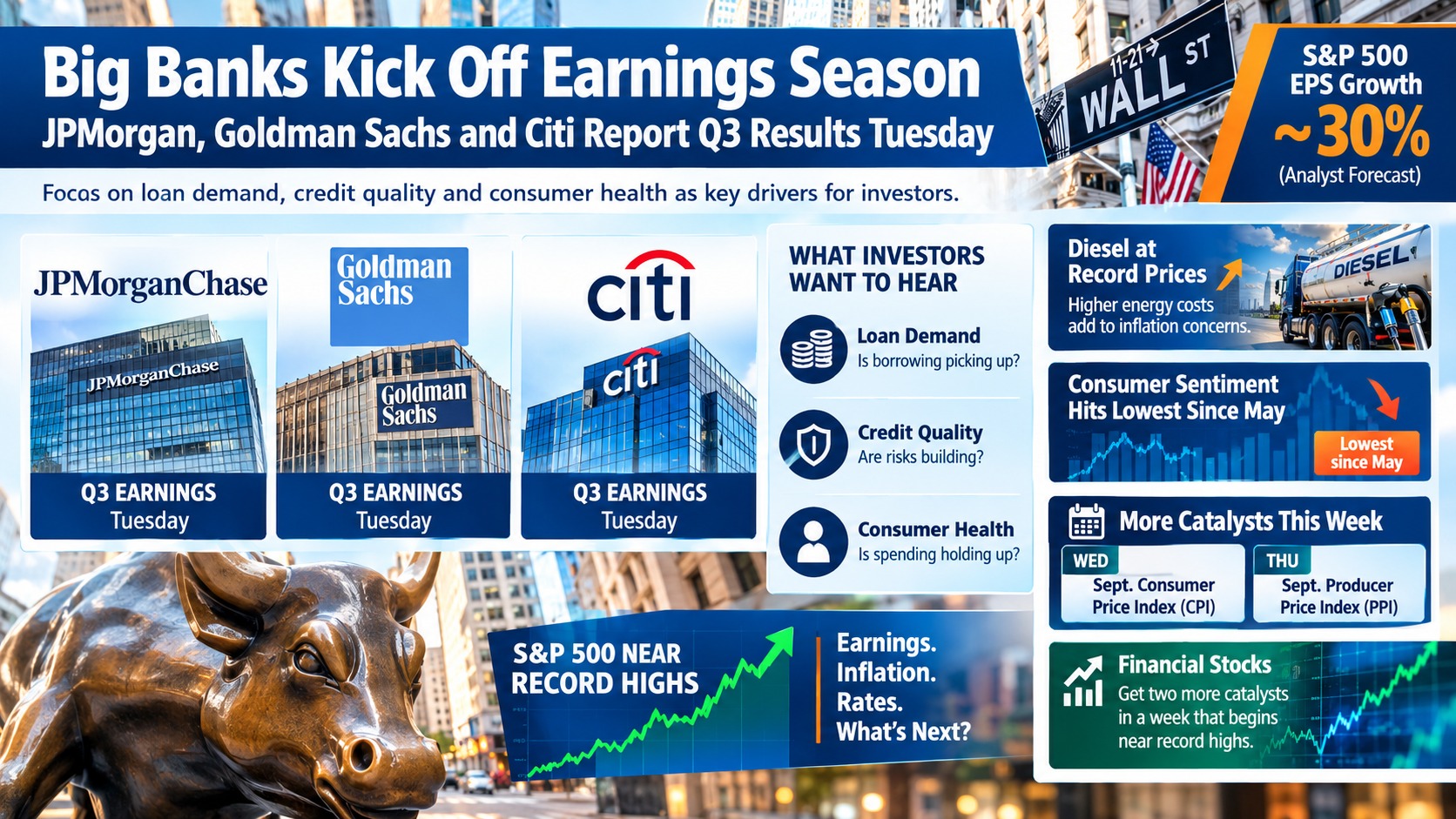
Wall Street's third-quarter earnings season formally gets underway on Tuesday, when JPMorgan (JPM), Goldman Sachs (GS) and Citi (C) are among the companies scheduled to report results. The banks arrive with US stocks near record highs: the S&P 500 and Nasdaq posted fresh records last week, the S&P 500 has gained roughly 13.5% since the start of the year, and the bull market turned four years old on Monday.
Capital.com senior financial market analyst Kyle Rodda said Wall Street remains around record highs thanks to extraordinary, though highly concentrated, earnings growth, with analysts tipping about 30% earnings-per-share growth for the upcoming quarter. Because the so-called Magnificent Seven do not report for several weeks, he said, the bank results will offer early color on whether corporate fundamentals remain strong enough to keep driving stocks higher.
The interest-rate backdrop makes this reporting period more nuanced than usual. TheStreet Pro contributor James DePorre noted that higher rates should help banks earn more on their loans, but also squeeze borrowers and slow loan demand. He also pointed to a recent Wall Street Journal report that commercial real estate buyers are walking away from deals unless they receive better terms, and said he wants to hear what executives say about loan demand, credit quality and how consumers are holding up with diesel at record prices and consumer sentiment at its lowest since May.
Sentiment data support the cautious read. The University of Michigan's preliminary October consumer confidence index came in at 46.3, down from 48.1 in September. Meanwhile, the 10-year Treasury yield was around 5.24% in early trading, and Yahoo Finance reported that bond yields are surging globally, with France singled out as a particular weak spot.
No economic data was scheduled for Monday, and the US Treasury market was closed for Columbus Day, though equities traded normally. The calendar fills up quickly after that: September consumer prices are due Wednesday and producer prices Thursday, with retail sales also expected Thursday. Brent crude near $106 a barrel adds a complicating factor for inflation expectations and for Federal Reserve policy.
Investors are also grappling with concentration risk. Yahoo Finance reported that an index of so-called old-economy US companies that strips out AI-related names has gained just 5.5% since January 1, roughly matching the 5.6% gain in Europe's STOXX 600. Concerns over an AI bubble, elevated Treasury yields and geopolitical uncertainty remain hurdles, even as many strategists argue the market has room to run.
For the banks, the key variables are guidance on net interest income, credit costs and capital markets activity, alongside commentary on consumer and commercial borrowers. A strong print could reinforce the earnings-driven rally, while cautious commentary on credit or loan demand could test valuations just as inflation data arrives.