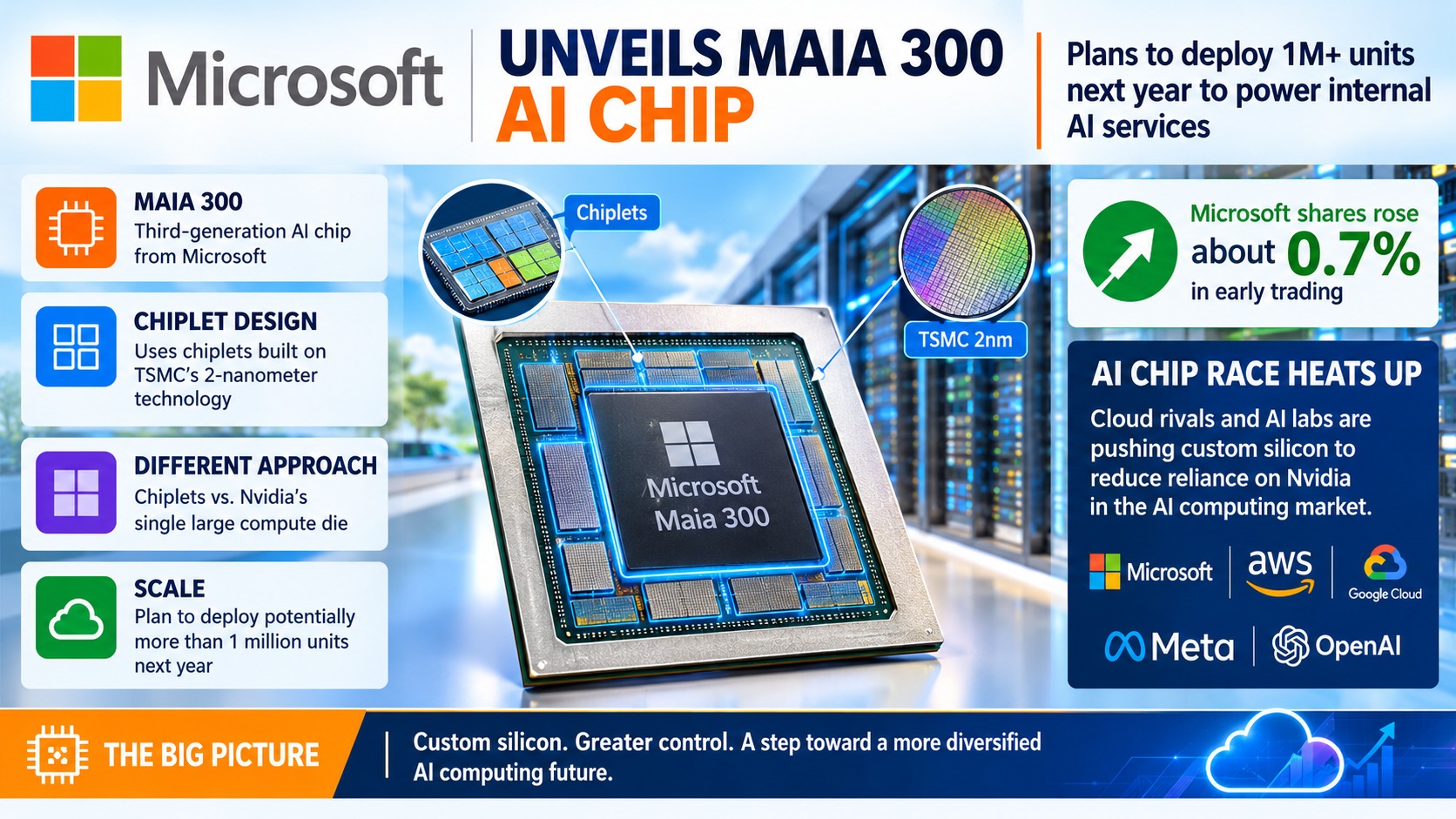
Microsoft (MSFT) unveiled the next generation of its custom artificial-intelligence chip on Monday and said it plans to deploy potentially more than 1 million units next year to support its internal AI services, Reuters reported. The chip, called Maia 300, is the third generation of Microsoft's custom silicon and is designed to handle AI workloads such as coding and carrying out complex business tasks on a user's behalf. Microsoft shares were up about 0.70% in early morning trading.
Its predecessor is already running Microsoft's in-house AI models, as well as models from OpenAI that are delivered to customers through Microsoft's Azure cloud computing service. The new chip arrives amid a flurry of custom-chip development by cloud computing rivals and AI firms such as OpenAI, as companies seek to reduce their reliance on Nvidia (NVDA) in the AI computing market.
Microsoft took a different technical approach from Nvidia, whose AI accelerators use a single large computing chip surrounded by high-bandwidth memory chips. The central computing processor in the Maia 300 is instead composed of chiplets, typically specialized chips bonded together. Key computing functions use 2-nanometer technology from Taiwan Semiconductor Manufacturing Co. (TSM), commonly known as TSMC, while other chiplets built on 3-nanometer technology handle tasks such as moving data within the system.
The announcement lands during a week when AI sentiment is under close watch. The Nasdaq slipped about 0.1% at the open, Nasdaq-100 futures were little changed, and Yahoo Finance noted that concerns over an AI bubble, elevated Treasury yields and geopolitical uncertainty are hurdles even as many strategists remain bullish. The S&P 500 has gained roughly 13.5% this year, with the technology sector's run lifting the entire index.
That concentration is the central debate. An index that excludes AI-related companies has gained only 5.5% since January 1, according to Yahoo Finance, compared with a 5.6% gain for Europe's STOXX 600. Investors therefore track every major AI infrastructure announcement for clues about spending intensity, supplier relationships and competitive positioning.
For Nvidia, the pivot toward in-house silicon at large cloud customers is a long-running risk, but the Maia 300 announcement does not by itself change near-term demand, and Reuters framed the broader trend as companies looking to lessen their dependence. For Microsoft, deploying its own chips at scale could lower the cost of running AI services, a point reflected in the way Reuters described the effort as aimed at saving costs.
The Magnificent Seven do not report earnings for several weeks, so product announcements like this one are likely to help drive AI-related trading until then, alongside bank earnings on Tuesday and inflation data later this week.