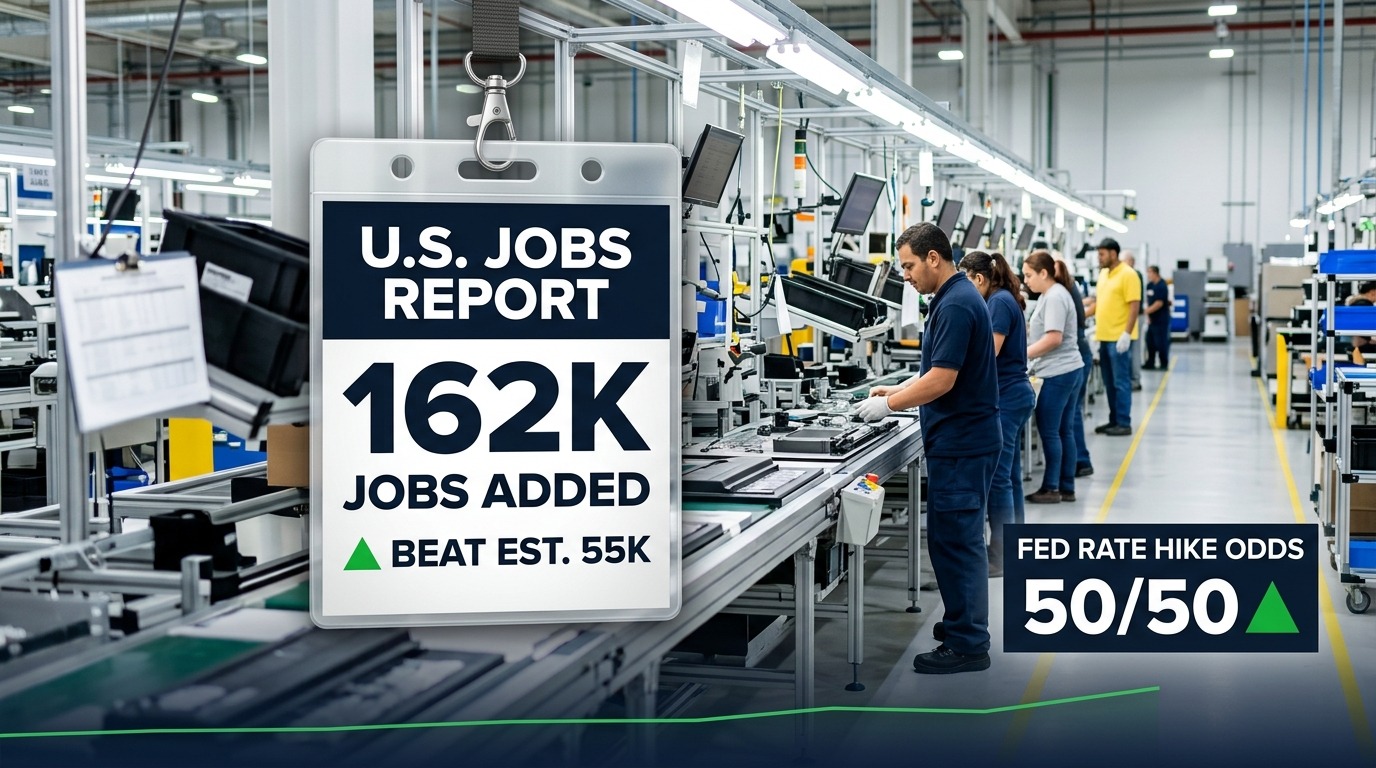
The U.S. labor market delivered a sharp upside surprise on Friday, with the Bureau of Labor Statistics reporting that nonfarm payrolls rose by 162,000 in August, nearly triple the 55,000 gain economists surveyed by Dow Jones had expected. The unemployment rate held steady at 4.1%, matching forecasts, while August's total marked the strongest monthly payroll gain since March, reversing a summer slowdown that had rattled investors just weeks earlier.
The report lands at a pivotal moment for monetary policy. Coming into Friday, futures markets had priced in roughly a 70% chance that the Federal Reserve would raise its benchmark rate at the September 15-16 meeting, a stance driven by persistent inflation concerns tied to tariffs and surging energy costs from the ongoing U.S.-Iran conflict. The stronger-than-expected jobs data, combined with remarks from Fed Governor Christopher Waller earlier in the week suggesting he would support holding rates steady if price pressures continue to ease, flipped that calculus. By Friday morning, rate futures had moved to price roughly even odds between a hike and a hold, a dramatic shift from just days prior.
Bill Adams, chief U.S. economist at Fifth Third Commercial Bank, said the strength of the August report keeps the Fed's attention squarely on inflation risk heading into its next meeting, adding that upcoming CPI and PPI releases will likely be the deciding factor in whether policymakers hike or hold. That view was echoed by market analysts who noted the central bank now faces a genuinely close call, a reversal from earlier in the summer when a run of weak job growth had markets leaning toward the Fed staying on hold or even cutting.
The jobs data followed a strong session for equities on Thursday, when all three major indexes rallied on the retreat in Treasury yields. The Dow Jones Industrial Average climbed 624.16 points, or 1.2%, to close at 53,686.11, its best day in weeks. The Nasdaq Composite advanced 1.4% to 26,584.06 on strength in technology shares, while the S&P 500 gained 1.1% to finish at 7,747.71. Nine of the S&P's 11 sectors closed higher, led by materials and communication services. The benchmark 10-year Treasury yield eased to 4.77% from 4.818% the prior day, pulling back from its highest level since November 2023.
Friday's session was more mixed as investors digested the jobs print alongside a volatile backdrop of rising oil prices tied to the Iran conflict and a weaker U.S. dollar. Analysts noted that a decline in rate-hike probabilities, paired with a stronger yen and Waller's more balanced tone on the path forward, had already sparked much of Thursday's rally before the payrolls data added a fresh, and somewhat contradictory, data point for traders to weigh.
Looking ahead, market participants are bracing for a data-dependent two weeks. The August Consumer Price Index and Producer Price Index reports, due before the Fed's September meeting, are now seen as the last major inputs before policymakers decide whether resilient hiring outweighs the inflationary pressure building from tariffs and elevated energy prices. With three FOMC members having already dissented in favor of a hike at the prior meeting, strategists say the September decision remains one of the most closely contested in recent memory, leaving both equity and bond markets on edge heading into the holiday-shortened week ahead.