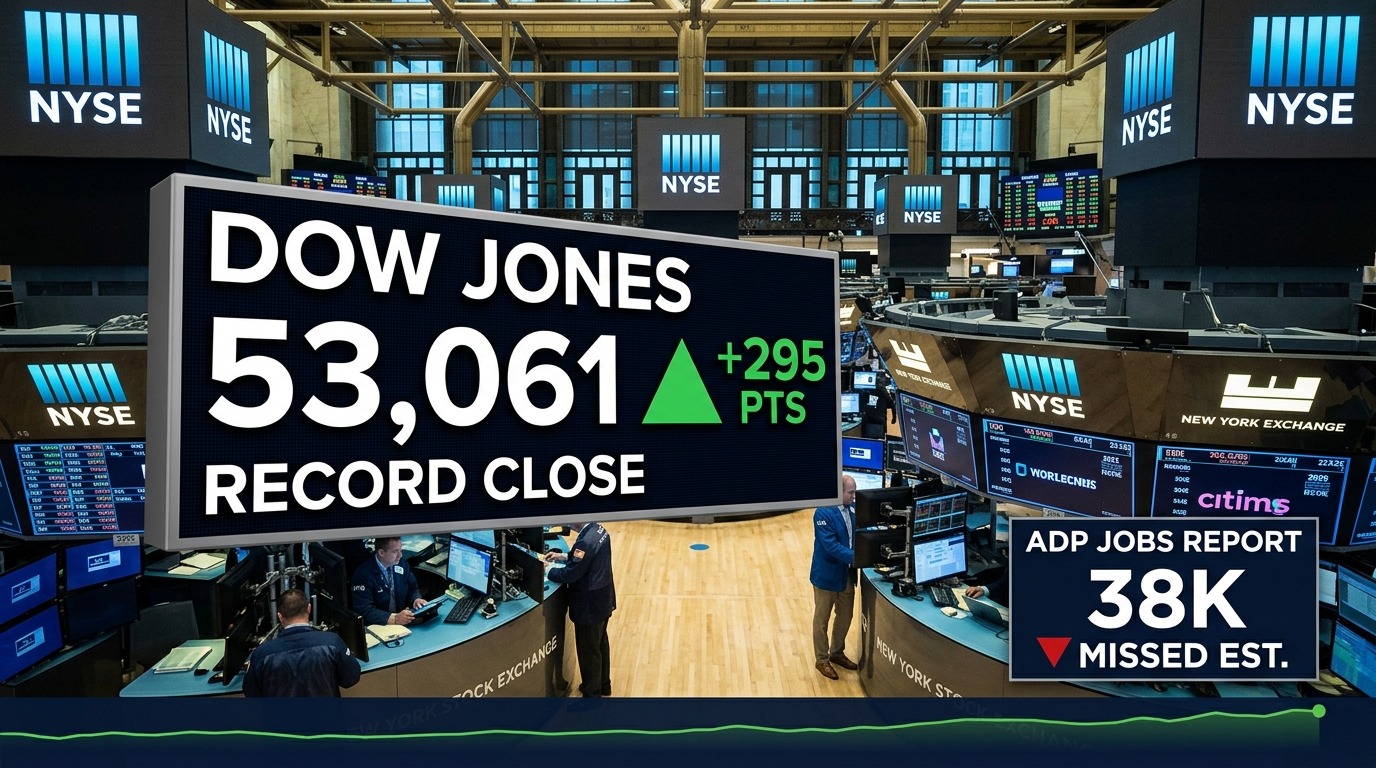
U.S. stocks closed higher on Wednesday, recouping a portion of the losses from the prior three trading sessions as strong corporate earnings offset pressure from rising oil prices and climbing government bond yields. All three major indexes finished in positive territory, snapping a losing streak that had weighed on sentiment to start the month.
The Dow Jones Industrial Average advanced 295.07 points, or 0.6%, to close at 53,061.95, with 22 of its 30 components ending the session higher. The S&P 500 gained 0.5% to finish at 7,666.60, even though seven of the index's 11 sectors closed lower, underscoring how concentrated the day's gains were in a handful of large-cap names. The Nasdaq Composite rose 0.5% to end at 26,217.83, powered largely by strength in artificial-intelligence-linked technology stocks.
Nvidia and Johnson & Johnson were cited as the two biggest contributors to the Dow's advance, helping offset softness elsewhere in the index. The narrowing of sector participation even as the overall market advanced suggests investors continued to favor a relatively small group of large-cap growth and defensive names.
The session's gains came despite a weaker-than-expected reading on the labor market. Payroll processor ADP reported that private employers added just 38,000 jobs in August, below both the 47,000 consensus estimate and the upwardly revised 46,000 figure for July. The reading marked the smallest monthly gain since January and reflected job creation concentrated heavily in healthcare and a small number of other industries, with several sectors posting outright declines. Separately, the Commerce Department reported that new orders for manufactured goods rose 0.9% in July, ahead of the 0.7% consensus estimate, while durable goods orders increased 1.1% and nondurable goods orders rose 0.7%.
Bond markets remained a focal point for investors. The benchmark 10-year Treasury yield touched a high of 4.818% during the week, its highest level since November 2023, as traders weighed the combined effects of persistent inflation pressure, elevated oil prices tied to the ongoing conflict between the U.S. and Iran, and expectations for the path of Federal Reserve policy. The 30-year Treasury yield climbed to just below 5.3%, with the rise in long-term borrowing costs not confined to the U.S., as government bond yields in Japan and other developed markets also moved higher.
Separately, weekly data showed commercial crude oil inventories, excluding the Strategic Petroleum Reserve, fell 4.5 million barrels for the week ending August 28, a decline that came against the backdrop of renewed fighting in the Middle East that has kept energy markets on edge. Strategists at several major wealth managers said they continue to favor equities over fixed income on a 12-month view, citing strong corporate profit growth and resilient economic activity, even as they acknowledged the potential for near-term consolidation after a strong year-to-date advance for major indexes. Seasonally, August and September have historically been softer months for stocks, though 2026 has so far bucked that pattern.