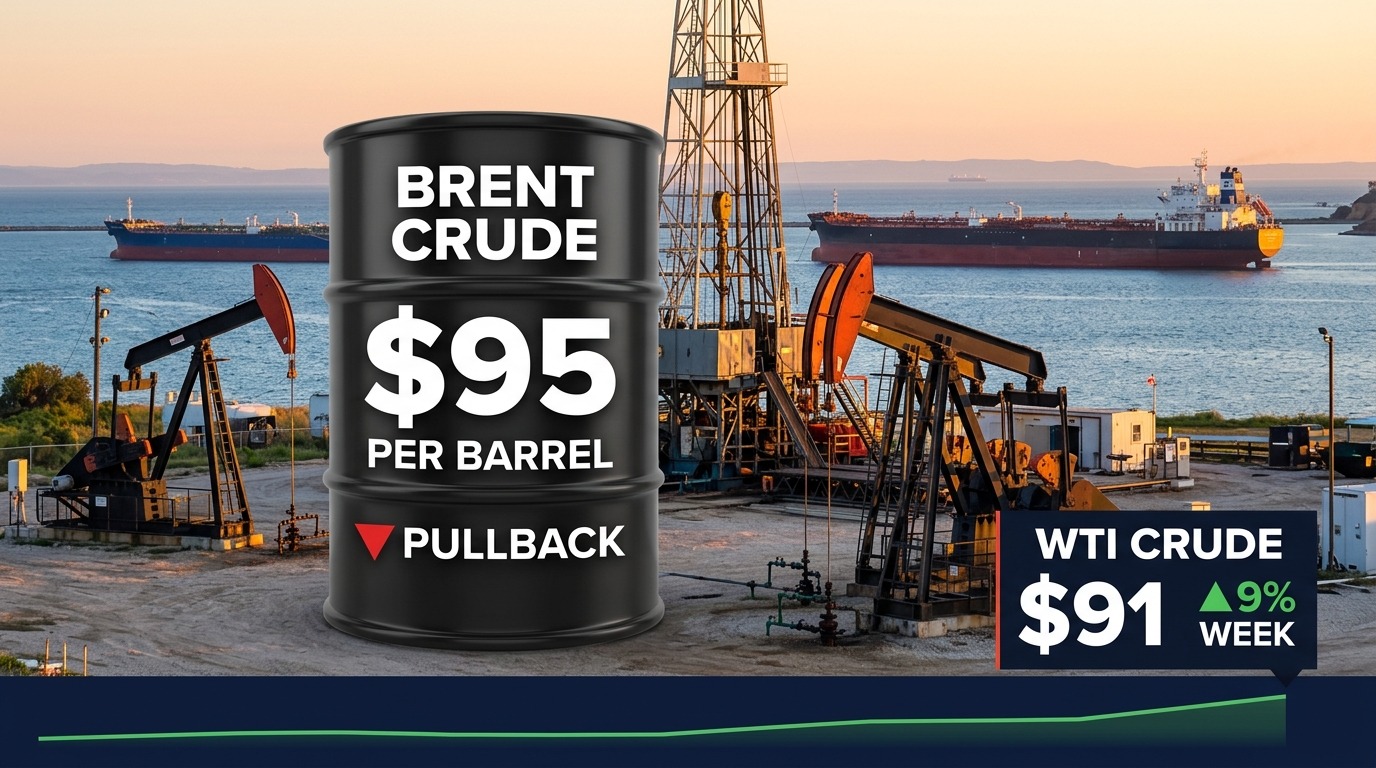
Brent crude eased to around $95 a barrel on Thursday, snapping a three-day rally as markets digested renewed fighting between the United States and Iran alongside signs that oil flows through the Strait of Hormuz have remained largely intact despite the escalation. The pullback came after a sharp two-session surge earlier in the week that had pushed both major benchmarks to their highest levels since late July.
The latest flare-up began when the U.S. military completed a wave of strikes against Iran's Islamic Revolutionary Guard Corps, targeting air defense systems, radar installations, maritime assets, mine-laying capabilities, and communication infrastructure, according to U.S. Central Command. Iran's Revolutionary Guard responded by targeting American military positions in Jordan, Kuwait, Bahrain, Iraq, and the United Arab Emirates, Iranian state media reported. The exchange marked the first significant fighting between the two countries since July, following roughly a month of relative calm in the broader conflict.
Despite the renewed hostilities, oil traders have so far avoided pricing in a worst-case supply disruption scenario. More than 17 million barrels of oil transited the Strait of Hormuz on Monday, a record since the conflict began in late February, and crude shipments have continued moving through the waterway at an estimated average of roughly 8 million barrels per day even amid the fighting. U.S. Energy Secretary Chris Wright noted that roughly 20 million barrels per day of crude and refined products had moved through Hormuz before the war began, underscoring how much of that flow has persisted despite the ongoing conflict.
West Texas Intermediate, the U.S. benchmark, settled near $91 a barrel earlier in the week before easing alongside Brent, with the U.S. price up roughly 9% over the past week as markets repriced geopolitical risk. President Donald Trump indicated he was not currently interested in negotiating with Iran, instead signaling that Washington would continue relying on economic pressure through a naval blockade and expanded sanctions targeting Tehran. He also said the latest round of strikes on Iran would likely be short-lived, even while suggesting the U.S. remains prepared to conduct further attacks if necessary.
Commodity strategists at Commonwealth Bank of Australia said they continue to expect Brent to trade in a $70-to-$100 range through the second half of the year, adding that prices could drift toward the lower end of that band if oil flows through Hormuz recover even modestly from current levels, a scenario the bank estimated would only require 50% to 60% of pre-war transit volumes to meaningfully dent the market's current risk premium.
For equity investors, the oil market's relative stability despite active fighting is a meaningful signal. A sustained spike in crude prices would raise input costs across the economy and complicate the inflation outlook just as Treasury yields sit near multiyear highs, a combination that has weighed on risk assets in recent sessions. Thursday's pullback in Brent, even amid ongoing strikes, suggests traders are for now betting that the conflict will remain contained rather than escalate into a broader disruption of global energy supply.