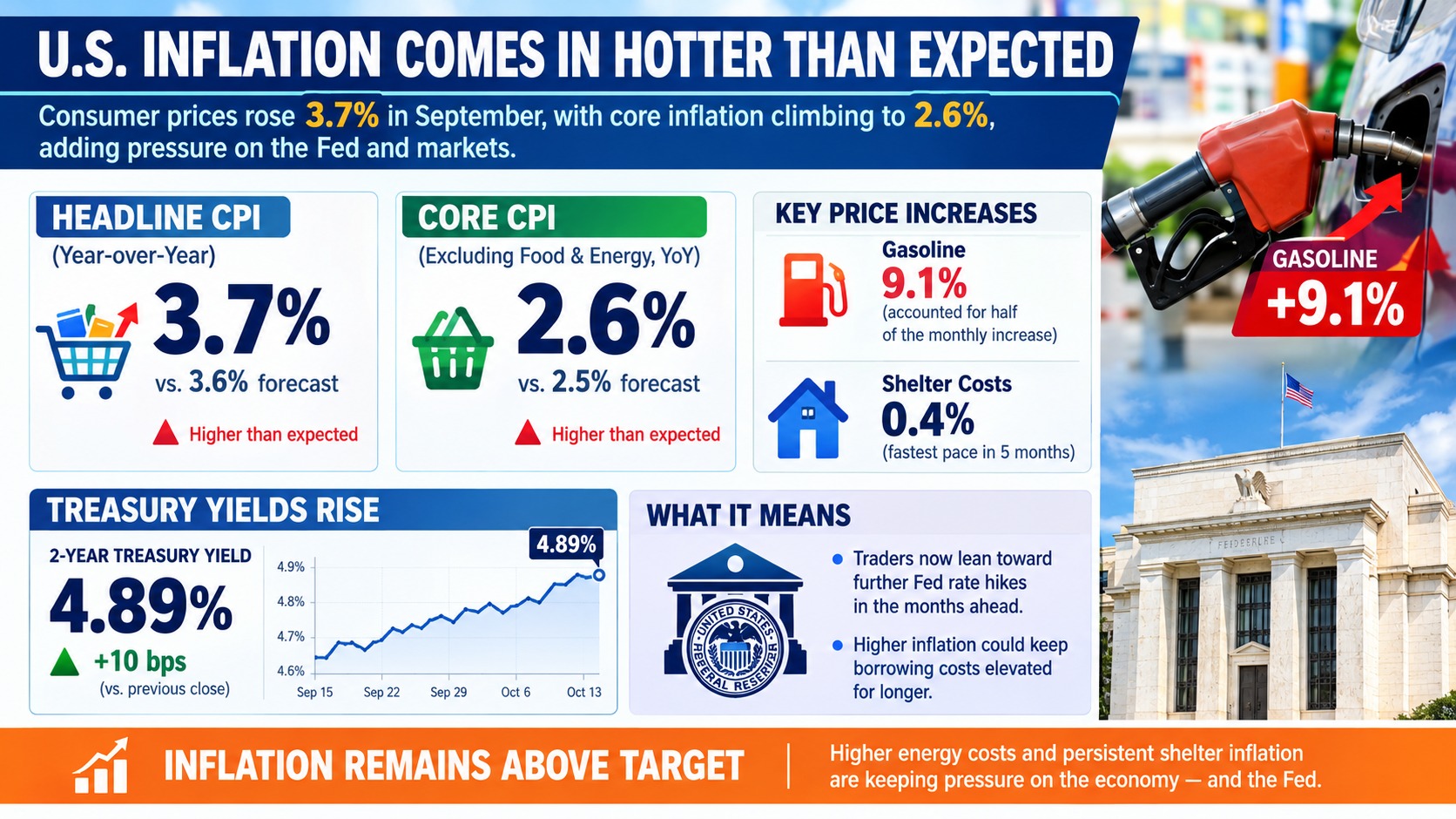
Consumer prices accelerated in September, with the Bureau of Labor Statistics reporting Wednesday that the Consumer Price Index rose 0.6% from August and 3.7% from a year earlier, up from 3.4% in the prior month. Economists had expected a 0.6% monthly gain and a 3.6% annual rate, so the headline was close to forecast. The surprise came in the underlying data.
Core CPI, which excludes food and energy, increased 0.3% on the month and 2.6% year over year. Forecasters had penciled in 0.2% and 2.5%, and the annual reading reversed a slide that had taken core inflation to a five-year low of 2.4% in August. According to Bloomberg's survey, only 11 of 73 economists had anticipated a monthly core gain that large.
Energy again did much of the work. Gasoline prices rose 9.1% and accounted for roughly half of the monthly increase in the index, with Brent crude trading above $100 a barrel. But analysts stressed that the pressure was not confined to the pump. Shelter costs rose 0.4% for the month, the fastest pace in five months, and toy prices jumped 4.2% from August and 6.6% from a year ago, the largest annual increase since 1988.
Market reaction was swift. Stocks joined bonds lower, the S&P 500 opened down 0.4%, and the Bloomberg Dollar Spot Index touched its highest level since May 2025. Short-dated Treasuries led the losses, with the two-year yield rising 10 basis points to 4.89% as traders added to bets that the Federal Reserve will keep raising interest rates. The S&P 500 closed Tuesday at 7,805, just 0.2% below its October 6 record.
The data arrive two weeks before the Fed's October 27-28 policy meeting and are the last major inflation reading before it. Bloomberg's market wrap noted that wagers on further tightening extended even if policymakers decide to pause this month. Seema Shah of Principal Asset Management said the figures lock in a December hike, adding that more than half of the CPI basket is running at an annualized pace above 3% and that further increases are likely in early 2027. Capital Economics projects a 0.32% rise in core PCE, the Fed's preferred gauge, which is due just after the meeting and would lift the three-month annualized rate to 2.8% from 2.0% in August.
Sonu Varghese, chief macro strategist at Carson Group, said the report showed inflation was broad-based rather than a pure fuel story. For investors, the implications are mixed across sectors. Rate-sensitive areas such as long-duration growth stocks, housing-linked names and small caps face higher discount rates, while banks with floating-rate loan books may benefit from a higher path for short-term rates even as trading and credit conditions are tested. Energy producers continue to benefit from elevated crude, but consumer discretionary companies face squeezed household budgets.
The report is also the last snapshot of consumer prices before the November 3 midterm elections, adding a political dimension to the affordability debate that has dominated the campaign.
What to watch next: producer price data, the PCE release that follows the Fed meeting, and the October CPI due November 10. A core reading at or above 0.3% would reinforce the case for tightening, while any easing in gasoline prices could soften the headline and give bond markets room to stabilize.