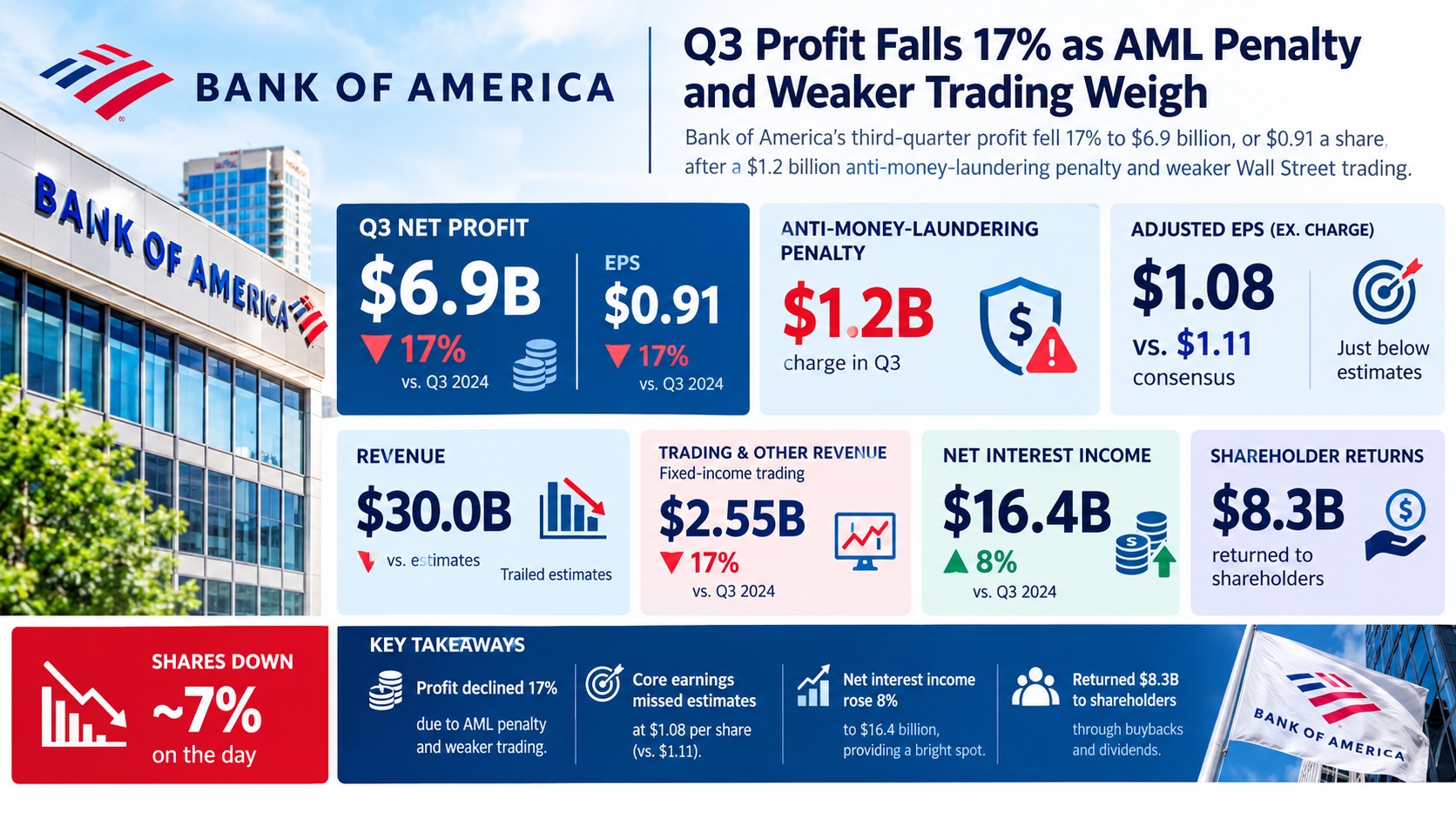
Bank of America reported third-quarter 2026 net income of $6.93 billion, or $0.91 per diluted share, a 17% decline from $8.3 billion, or $1.04 a share, a year earlier. The result was weighed down by a $1.2 billion regulatory settlement tied to anti-money-laundering and sanctions failures, announced by U.S. regulators on Tuesday, the eve of the earnings report.
Excluding the charge, which reduced earnings by 17 cents a share, adjusted EPS was $1.08, compared with a consensus of about $1.11. Revenue rose 3.2% to $30.12 billion on a fully taxable-equivalent basis but fell short of the roughly $30.69 billion LSEG estimate. The quarter ended a stretch of earnings beats for the lender.
The shortfall came largely from Wall Street. Fixed-income trading revenue fell 17% to $2.55 billion on weakness in mortgages, municipal bonds and credit, while equities trading revenue rose 10% to $2.51 billion but still missed expectations by nearly $300 million. Investment banking fees dropped 11% to $1.8 billion, roughly in line with guidance from CEO Brian Moynihan in September. Combined, the trading misses totaled about $750 million, CNBC reported.
Underneath the headline, the lending franchise performed. Net interest income rose 8% to about $16.4 billion, loans grew for a tenth straight quarter, and the credit card charge-off rate improved for the sixth consecutive quarter on a year-over-year basis. Consumer banking earned $3.5 billion on $11.6 billion of revenue, while global wealth and investment management earned $1.5 billion with client balances reaching $5.1 trillion.
The penalty package is the larger strategic story. The Office of the Comptroller of the Currency assessed a $750 million civil money penalty and judged the bank's compliance program inadequate, according to Benzinga, while the Financial Crimes Enforcement Network imposed a $1.2 billion penalty with the OCC payment credited toward it. The package, the third-largest in Treasury history, comes with a consent order requiring the bank to work with a third party to identify and report suspicious transactions that went undetected. It follows a 2024 consent order from the OCC.
Analysts said the penalty would likely add to negative sentiment and raise questions about expenses and how long the order will last. Shares dropped roughly 7% on Wednesday, extending a decline that began after Tuesday's close, after trading at a four-month low in premarket action.
The bank still returned $8.3 billion to shareholders in the quarter through dividends and buybacks and said more than 200,000 employees now use its AI tools, signaling confidence in the balance sheet. Results arrived the same morning as a hotter-than-expected inflation report that pushed two-year Treasury yields higher. Rising rates tend to support net interest income, but they also raise credit and valuation risks for the financial sector.
For investors, the key questions are how long the consent order constrains growth, whether trading revenue rebounds in the fourth quarter, and whether the 8% growth in net interest income can hold if the Federal Reserve tightens further. Morgan Stanley, which reported the same day, posted stronger equities trading, highlighting the divergence among large Wall Street franchises.