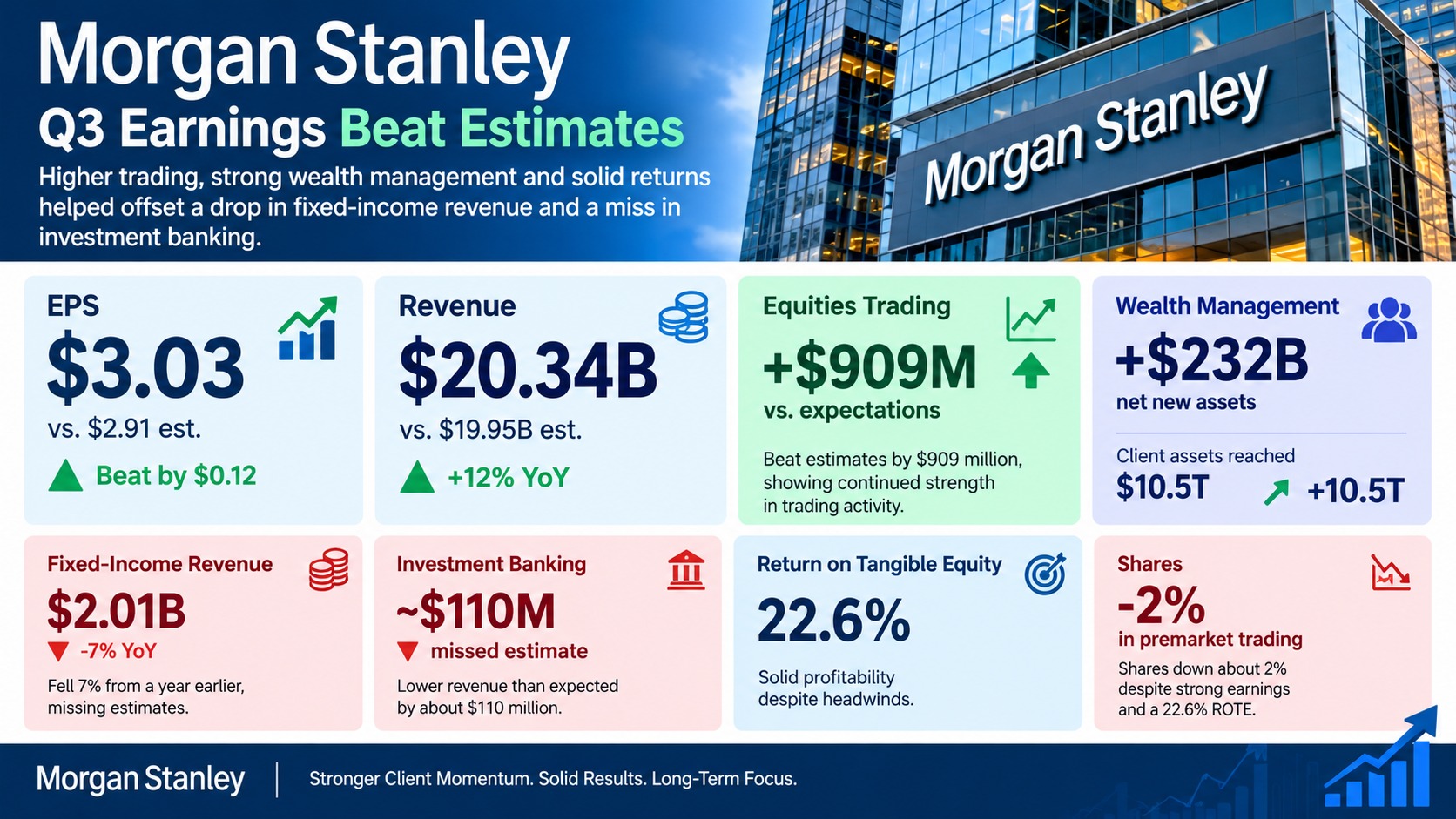
Morgan Stanley posted third-quarter net revenues of $20.34 billion and earnings of $3.03 per diluted share on Wednesday, topping Wall Street forecasts and extending a year of strong trading and wealth results. Net income applicable to the firm rose 6.5% to $4.91 billion, compared with $4.6 billion, or $2.80 a share, a year earlier, and return on tangible common equity reached 22.6%.
Consensus estimates varied by data provider. LSEG expected earnings of $2.91 per share on $19.95 billion in revenue, while five analysts polled by Zacks Investment Research had forecast $2.83 and $19.74 billion. By either measure, the bank cleared the bar.
Equities trading was the standout, beating expectations by $909 million. Institutional Securities generated $10.03 billion in revenue, led by the equity franchise. Chairman and CEO Ted Pick said the unit benefited from global strength and that the integrated firm continues to connect the breadth of the bank for clients.
Wealth management delivered record revenues and added $232 billion in net new assets, including $80 billion in fee-based flows, pushing total client assets across wealth and investment management to $10.5 trillion. Positive long-term net flows were $15.8 billion in the quarter. The wealth segment's pre-tax margin held at 30.4%, according to FinanceFeeds. That compares with $148 billion of net new assets in the second quarter, when the firm reported record earnings of $3.46 per share.
Not every line was strong. Fixed-income trading revenue fell 7% to $2.01 billion on declines in credit and commodities, roughly $260 million below expectations, and investment banking revenue rose 2% to $2.16 billion, about $110 million short of forecasts. Advisory revenue increased on more completed mergers, but equity underwriting fell on lower IPO activity, as did fixed-income underwriting.
Veteran bank analyst Mike Mayo called the results good but not great, noting that some business metrics showed slower improvement in the quarter. Shares of Morgan Stanley declined about 2% in premarket trading, reflecting how high the bar had been set after a record second quarter. Sequentially, revenue slipped from $21.3 billion in the second quarter and EPS from $3.46.
The report landed alongside Bank of America's results, which were hit by a $1.2 billion penalty and a fixed-income slump, and a September inflation report showing consumer prices up 3.7% from a year earlier. CNBC noted that Pick was expected to address the outlook for mergers and IPOs given the backdrop of rising interest rates.
The strength of equities trading also suggests clients remained active despite volatility from energy prices, the chip-sector selloff and the inflation surprise, a theme that could support trading desks across Wall Street if volatility persists.
For investors, Morgan Stanley's mix of record wealth flows and resilient equities trading offers a counterweight to weaker fixed-income and deal-making, though a hawkish Federal Reserve path could pressure valuations and capital-markets activity into the fourth quarter.