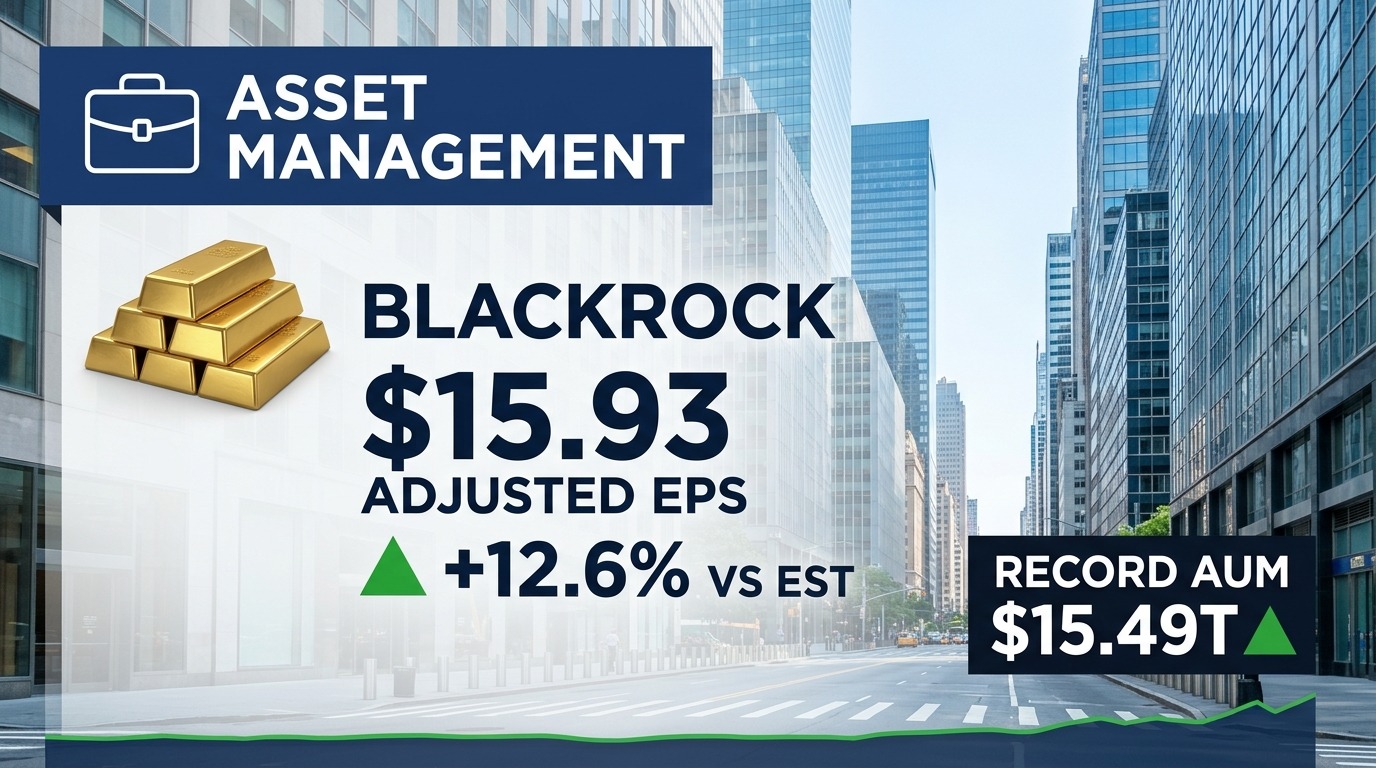
BlackRock reported third-quarter adjusted earnings of $15.93 per share on Wednesday, well above the $14.15 analysts expected, as record inflows and market gains pushed assets under management to $15.49 trillion. Adjusted net income was $2.62 billion, while GAAP net income rose to $1.66 billion, or $10.57 per share, from $1.32 billion, or $8.43, a year earlier.
Revenue climbed 19% to $7.75 billion, compared with expectations of roughly $7.4 billion. Performance fees were $630 million, far above the $431 million forecast, and the firm's adjusted operating margin reached 47.8%, according to the earnings call. BlackRock said it delivered record revenue, operating income and EPS in what executives described as more uneven markets.
Net inflows totaled $205.5 billion in the quarter, beating the $171.5 billion analysts projected. Fixed income attracted $78.2 billion and equities $52.4 billion. Exchange-traded funds generated $135 billion of inflows, including $22 billion into active ETFs, while the cash management platform added $31 billion.
Private markets drew $15.3 billion, ahead of the $12.2 billion expected, driven by deployment across infrastructure and private credit and the onboarding of a real estate mandate. Systematic equity strategies produced nearly $30 billion of inflows in the quarter and more than $60 billion so far in 2026, and active investments are approaching $500 billion in assets.
Organic base fee growth was 11%, and assets under management have risen by more than $2 trillion over the last year, up 15% from $13.46 trillion. One blemish: AUM of $15.49 trillion fell short of analyst expectations of $15.57 trillion, a reminder that market levels, not just flows, drive the headline figure.
Shares jumped about 4% in premarket trading, outperforming a financial sector under pressure. Large banks reporting the same day stumbled on penalties and trading misses, while the September CPI report showed inflation at 3.7%, lifting two-year Treasury yields and reviving bets on Federal Reserve rate hikes.
For investors, the quarter underscores the resilience of fee-based asset managers relative to trading-dependent banks. BlackRock's revenue mix of base fees, technology services such as Aladdin, and growing private markets provides recurring income that is less exposed to the trading swings that hurt peers this week. Technology services and subscription revenue rose 14% year over year, and base fees rose 19%.
The results build on a record first half in which net inflows totaled $321 billion, according to the company's second-quarter release, and on an iShares franchise that crossed $6 trillion in assets, roughly doubling in three years. Technology services and subscription revenue, anchored by the Aladdin platform, grew 13% in the second quarter and accelerated to 14% in the third.
The risks are straightforward. Persistent inflation and higher rates can pressure bond and equity valuations, which would reduce AUM-linked fees, and a sharper AI-related equity correction would hit the equity ETFs that drive much of the firm's flows. Still, with $205.5 billion of quarterly inflows and a 47.8% margin, BlackRock enters the fourth quarter with momentum.