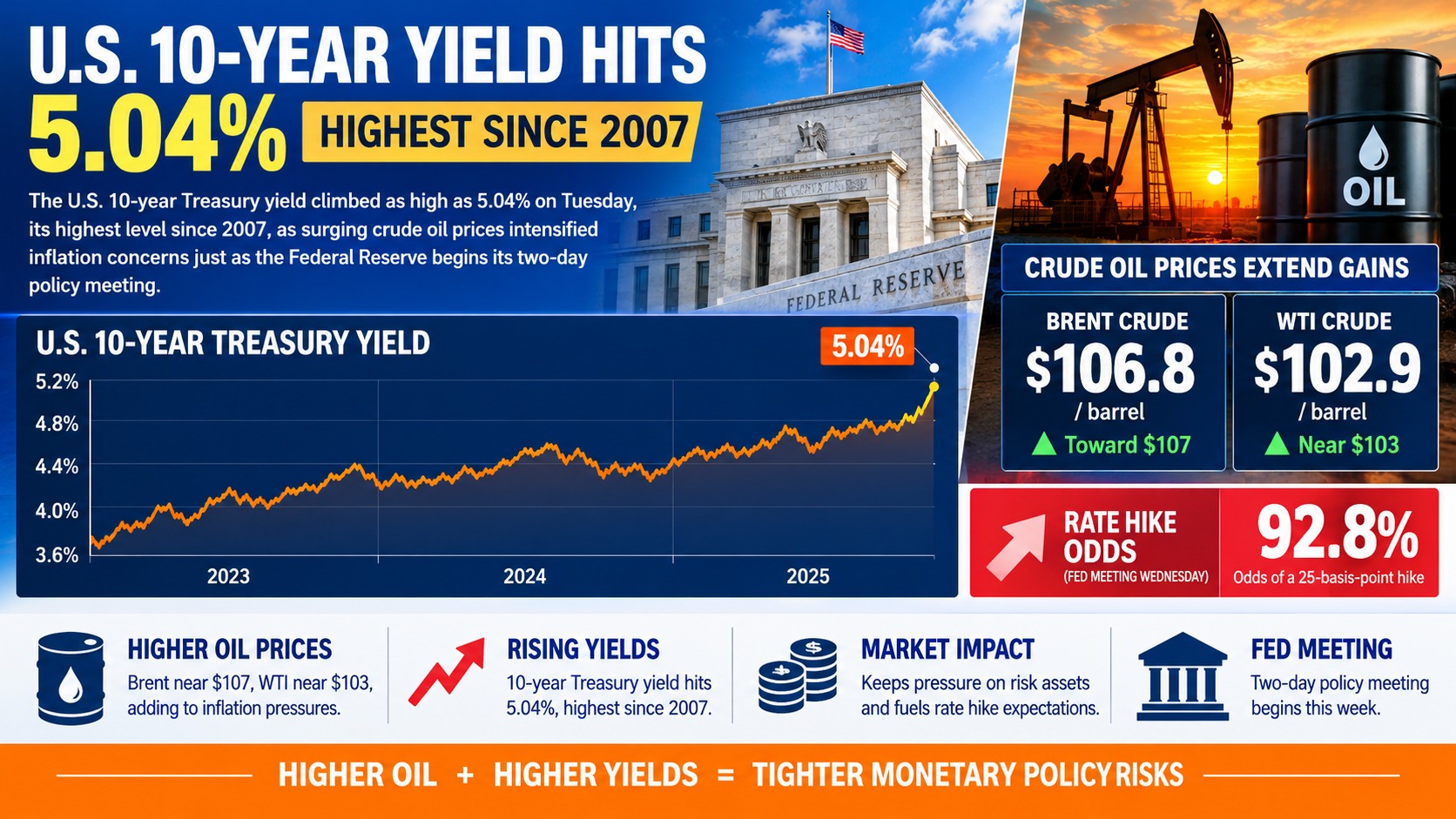
The benchmark U.S. 10-year Treasury yield surged to 5.04% early Tuesday, marking its highest level in nearly two decades and intensifying pressure on equity valuations ahead of the Federal Reserve’s critical policy decision. The move came as Brent crude futures climbed toward $107 a barrel and West Texas Intermediate hovered near $103, extending a multi-week rally driven by Middle East supply disruptions that have already pushed diesel prices in the United States to record highs near $6.27 per gallon.
Saudi Arabia’s East-West pipeline remained offline following drone attacks attributed to Iran-backed militias, threatening up to 4% of global oil supply and forcing additional volumes toward the already constrained Strait of Hormuz. Traders and analysts warned that a prolonged outage could push Brent toward $130 if inventories at the Red Sea port of Yanbu are exhausted within days. Goldman Sachs and other firms have noted repair assessments ranging from a few days to as long as eight weeks depending on the extent of damage to pumping stations.
U.S. stock-index futures pointed lower at the open, with the Dow, S&P 500 and Nasdaq all indicating modest declines after major indexes closed lower for the fifth time in six sessions on Monday. Elevated yields reduce the relative attractiveness of equities while higher energy costs feed directly into inflation metrics that the Fed is closely monitoring. CME FedWatch data showed roughly 93% probability of a 25-basis-point rate increase on Wednesday, which would lift the federal funds target range to 3.75%–4.00% — the first hike in more than three years under Chair Kevin Warsh.
The combination of sticky inflation readings, geopolitical supply shocks and a hawkish policy path has kept risk appetite subdued across global markets. Bitcoin also slipped as regulatory uncertainty weighed on crypto-related shares, with hopes fading for imminent progress on a U.S. regulatory bill. Asian equities were mixed to lower overnight while European futures pointed to further weakness at the open.
Market participants are now focused on the Fed’s updated economic projections, commonly known as the dot plot, and Chair Warsh’s post-meeting press conference for signals on the pace of further tightening. Any indication of multiple additional hikes over the coming year could further compress equity multiples, particularly in rate-sensitive growth sectors. Energy and financial sectors are likely to remain in focus as investors reassess the impact of higher borrowing costs and rising input prices across the broader economy.
The 10-year yield’s climb above the psychologically important 5% threshold also coincides with multiyear highs in German and Japanese government bond yields, underscoring a synchronized global selloff in fixed income. Mortgage rates in the United States have already pushed higher in response, with the average 30-year fixed rate approaching levels that could further cool housing activity. Corporate borrowing costs are rising in tandem, potentially squeezing margins for companies unable to pass through higher expenses.
Analysts at major firms have highlighted that the current environment rewards caution. With the Federal Open Market Committee meeting already underway and the rate decision due Wednesday afternoon, many portfolio managers are reducing exposure to high-duration assets and maintaining elevated cash levels. The simultaneous pressure from energy prices and yields creates a challenging backdrop for risk assets, leaving little room for error ahead of the policy announcement.
In premarket trading, several technology names attempted modest recoveries from Monday’s losses, yet the broader tone remained defensive. The dollar extended gains against major currencies, adding another headwind for multinational corporations that report overseas earnings. Commodity markets beyond oil also showed signs of stress as inflation expectations adjusted higher.
Investors will continue to monitor any official updates from Saudi authorities on the pipeline restoration timeline, as well as additional economic data releases scheduled for later in the week. The interplay between energy supply risks and monetary policy remains the dominant narrative driving price action across asset classes on Tuesday.