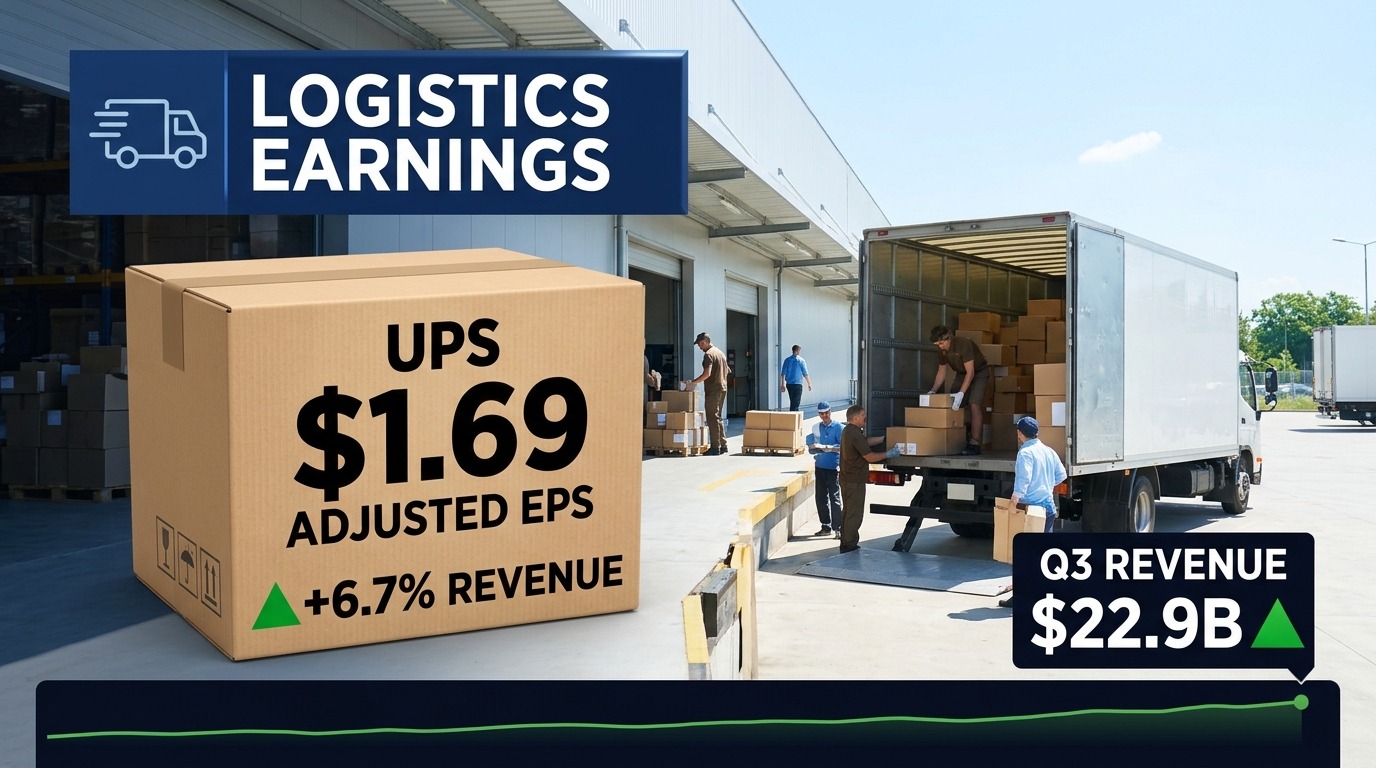
United Parcel Service reported third-quarter 2026 results before the bell on Tuesday, beating Wall Street estimates as its network efficiency initiatives continued to show progress. Adjusted earnings per share were $1.69, ahead of the $1.63 consensus, while revenue rose 6.7% year over year to $22.9 billion, above the $22.28 billion analysts expected.
Adjusted operating profit totaled $2.1 billion, equal to a 9.0% adjusted operating margin. All three business segments posted revenue growth: Supply Chain Solutions led with an 18.2% increase, followed by International at 7.1% and U.S. Domestic at 4.5%.
Segment profitability was more nuanced. The U.S. Domestic segment generated adjusted operating profit of $1.03 billion at a 7.0% margin, and International delivered a 14.9% operating margin. Supply Chain Solutions, however, posted adjusted operating profit of $274 million, down from $536 million in the prior-year period, even as its revenue surged. That divergence suggests growth in the unit may be coming at lower margins, a point investors are likely to probe on the earnings call.
Premarket price indications were mixed. Investing.com described the shares as trading higher, while other quote feeds early in the session showed a small decline of less than 1%, a reminder that initial moves after earnings can reverse as volume builds and management discusses the outlook.
UPS is widely read as a barometer of U.S. consumer demand and industrial activity, so its results carry weight beyond the stock itself. Higher fuel costs are a recurring risk for the sector; with Brent crude near $115 and WTI above $100, delivery networks face elevated diesel and jet fuel expenses, though fuel surcharges typically offset part of the burden. Shifts in trade policy and consumer caution also bear on parcel volumes and mix.
The beat on both earnings and revenue supports the thesis that cost discipline can drive earnings growth even when volume growth is modest. The 9.0% adjusted operating margin shows the efficiency program is translating into profit, while the 6.7% revenue increase indicates demand has not weakened despite elevated energy prices. Investors will want to hear guidance commentary on the fourth quarter, the peak holiday season, when network capacity and labor costs are most tested.
From a portfolio perspective, a clean beat from an industrial bellwether on the same morning that several other blue chips report gives traders a broad read on the economy ahead of Wednesday’s Federal Reserve decision. Sizing should remain moderate, since a hawkish surprise or a spike in oil could quickly change the tone for transport stocks, and the profit decline in Supply Chain Solutions is a detail that could draw scrutiny from analysts in the days ahead.