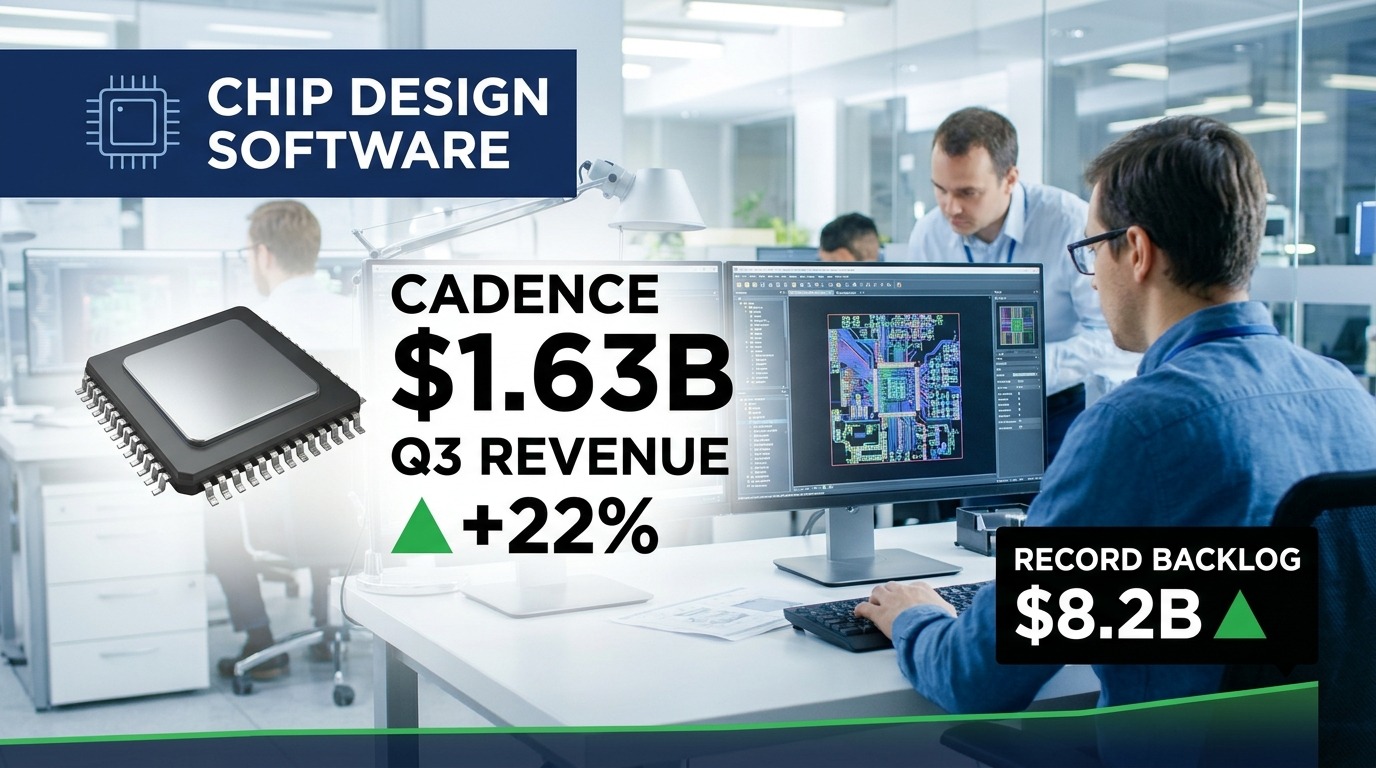
Cadence Design Systems beat third-quarter expectations and raised its full-year guidance, reinforcing demand for chip-design software as AI hardware development accelerates. Revenue was $1.63 billion, up 22% from a year earlier and above analyst expectations of $1.61 billion. Adjusted earnings per share were $2.11, beating the $2.04 estimate.
Backlog, a forward-looking measure of contracted work, reached a record $8.2 billion. A record backlog suggests customers continue to commit to multi-quarter design cycles, which supports revenue visibility into 2027 and helps explain why management felt comfortable lifting its outlook.
Cadence increased its 2026 adjusted EPS forecast to a range of $8.37 to $8.43, from $8.05 to $8.15. The midpoint rises by about $0.30, or roughly 3.7%. For the fourth quarter, the company expects adjusted EPS of $2.19 to $2.25, compared with the $2.03 analysts had projected, a midpoint roughly 9% above consensus.
Share reaction was mixed in early trading. Benzinga reported the stock up about 3% at $331.99 premarket, while CoinCentral noted a decline of 0.6% at a different point in the session. The shares had gained 23% over the year through Monday’s close, so expectations were already elevated going into the print.
Electronic design automation software is used to design and verify advanced semiconductors, so Cadence results often act as an early read on chip development activity. In a month when investors have sold chip stocks and bought defensive names, a beat-and-raise from a supplier tied to chip design suggests underlying engineering demand remains healthy even as semiconductor share prices have been volatile.
That divergence is useful for portfolio construction. Companies that sell tools and services to chip designers can behave differently from the chip makers themselves, since their revenue depends on design activity and long-term contracts rather than on the swings of end-market inventory. Traders looking for AI exposure with potentially less cyclicality may find that distinction worth monitoring, though valuation after a 23% annual gain leaves less margin for error.
Risks include a slowdown in semiconductor design starts, export-control constraints and the premium multiple investors pay for software with strong visibility. Macro events also loom: the Federal Reserve decides on rates on Wednesday, and higher yields tend to pressure high-multiple software names. Traders may prefer to wait for post-earnings call commentary on AI-related design demand before sizing positions, and to watch whether the early premarket divergence resolves higher once regular trading begins.