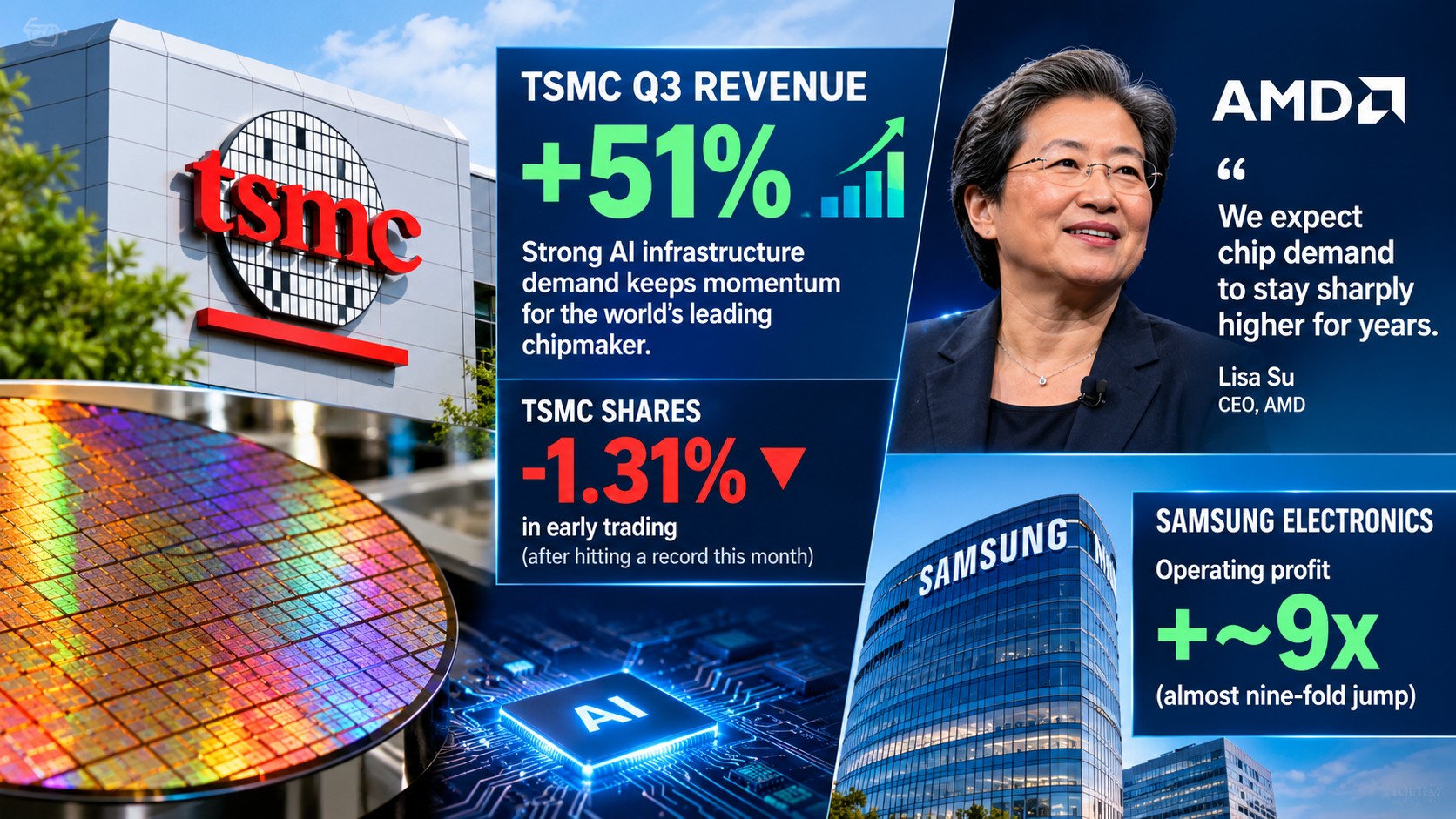
Taiwan Semiconductor Manufacturing Co. reported a 51% increase in quarterly revenue on Thursday, giving investors fresh evidence that spending on artificial intelligence infrastructure remains strong. The result, reported by Bloomberg, arrives as the market debates whether the AI buildout can be sustained.
TSMC serves as a barometer for the sector because it is the go-to contract chipmaker for Nvidia and Apple, fabricating the advanced processors that power AI accelerators and premium devices. Its shares reached a record earlier this month, reflecting investor confidence in its leading-edge products. Even so, the stock slipped 1.31% in early U.S. trading as the broader market turned defensive on rising oil prices and Treasury yields.
Other data points this week point in the same direction. Advanced Micro Devices CEO Lisa Su said chip demand should remain sharply higher over the next few years. Samsung Electronics reported an almost nine-fold jump in operating profit, a record result, while AI server assembler Hon Hai Precision Industry beat quarterly sales estimates. Together, the reports suggest that demand across the semiconductor supply chain, from memory to foundry to server assembly, is still accelerating.
Funding of the buildout is also in focus. Bloomberg reported that SpaceX is looking to issue $40 billion in new debt, including $10 billion in bank loans and $30 billion in investment-grade debt, to buy Nvidia chips for its data centers. Such financing illustrates how much capital AI customers are willing to raise, but it also underlines a growing reliance on credit at a time when borrowing costs are elevated, with the 10-year Treasury yield trading near 5.3%.
The cautionary side of the story appeared in the same reports. Bloomberg noted that investors are grappling with rising debt levels and regulatory setbacks, as well as calls from OpenAI and Anthropic PBC to pace the development of the technology. A London strategist warned Thursday that an AI bubble could burst in 2027 or 2028 and trigger the worst S&P 500 drawdown since 2008, arguing that hyperscalers' free cash flow is largely depleted while borrowing costs climb. That view is an outlier among strategists tracked by Bloomberg, who on average see roughly 14% upside for the index.
For traders, the TSMC report supports the fundamental case for AI-linked semiconductors but does not remove near-term macro risk. Brent crude above $100 a barrel, hawkish Federal Reserve signals and narrow market leadership leave the group vulnerable to sharp swings if yields rise further. The muted share reaction also suggests that a 51% growth rate was largely anticipated, so investors may prefer to focus on guidance and capital-spending commentary in the company's next earnings report rather than chase a single revenue figure.
The read-through extends beyond chips. Strong foundry revenue supports the outlook for suppliers and customers further along the chain, from server assemblers to cloud operators, and any slowdown would likely be felt first in those same places. For now, the data from Taiwan, South Korea and the United States aligns, and that alignment underpins the case for staying selectively long AI hardware while hedging macro exposure. This is analysis, not investment advice.