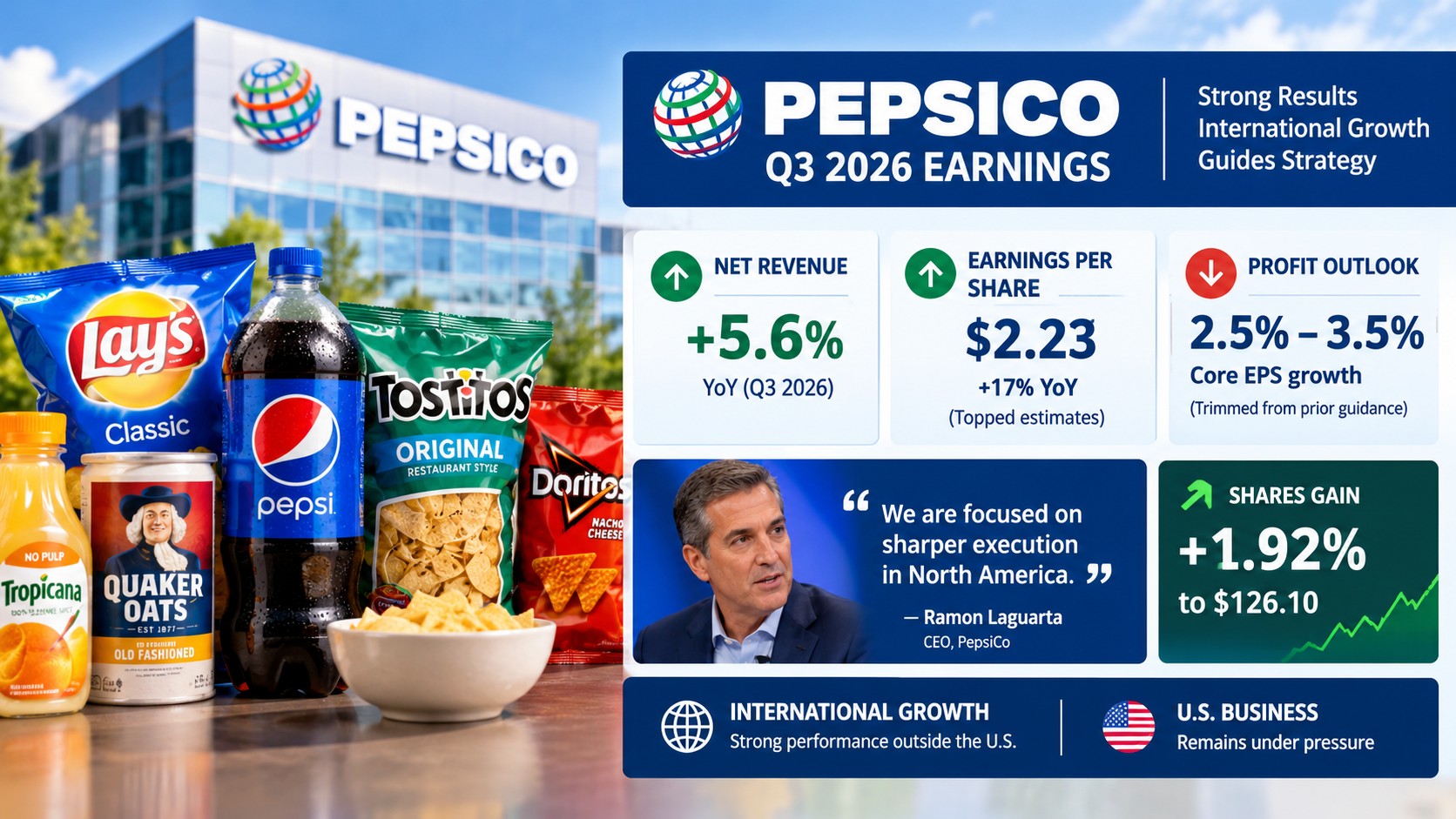
PepsiCo reported third-quarter 2026 results on Thursday that beat Wall Street estimates, with net revenue up 5.6% and earnings per share up 17%, even as the company lowered its profit outlook for the year. The quarter ended Sept. 5, and the results were released before the market opened.
Net income was $3.05 billion, or $2.23 per share, compared with $2.6 billion, or $1.90 per share, a year earlier. Organic revenue, which strips out currency and acquisitions, rose 3.1%, an acceleration from the 2.7% pace for the year to date. Core EPS, which excludes certain items, increased 2%, and core constant-currency EPS rose 1.5%, a reminder that the headline 17% gain reflects items outside the core business.
Management said organic volume grew in both global beverages and convenient foods, and credited the scale and resilience of its international business. Chairman and CEO Ramon Laguarta said the company is acting with urgency to improve performance in North America through more investment in innovation, effective brand building and sharper execution by sales channel. The comments acknowledge that the U.S. business remains the main drag on results.
Guidance was the sticking point. PepsiCo now expects core earnings per share to increase 2.5% to 3.5%, a reduction from its prior projection, while it sees net revenue growth of about 6%, at the high end of its previous 4% to 6% outlook. In other words, sales momentum is running ahead of expectations while profit conversion is not, which points to cost pressure and ongoing reinvestment in brands, innovation and marketplace execution.
The market reaction was mildly positive. Shares rose 1.92% to $126.10 in premarket trading, even as the S&P 500 opened down 0.34% on rising oil prices and Treasury yields. Investors appeared to give credit for the top-line and earnings beats and for evidence that international markets are offsetting weakness at home, while looking past a guidance cut that many had arguably anticipated after a long stretch of underperformance versus the broader market.
Macro context matters for consumer staples. Brent crude jumped to about $105 a barrel on Thursday, and diesel prices have reached record highs during the Iran war, which raises transportation, packaging and ingredient costs for packaged food and beverage makers. The 10-year Treasury yield near 5.3% also makes defensive, income-oriented equities less attractive relative to bonds, a headwind for the group's valuation multiples.
For portfolio positioning, the report argues for treating PepsiCo as a defensive holding whose upside depends on a North American recovery that management has promised but not yet delivered. Investors may want to watch volume trends, pricing and margin commentary in coming quarters, as well as whether international strength can keep offsetting domestic softness. A stock that rises on a guidance cut is signaling relief more than conviction, so position sizing should remain measured. This is analysis, not investment advice.