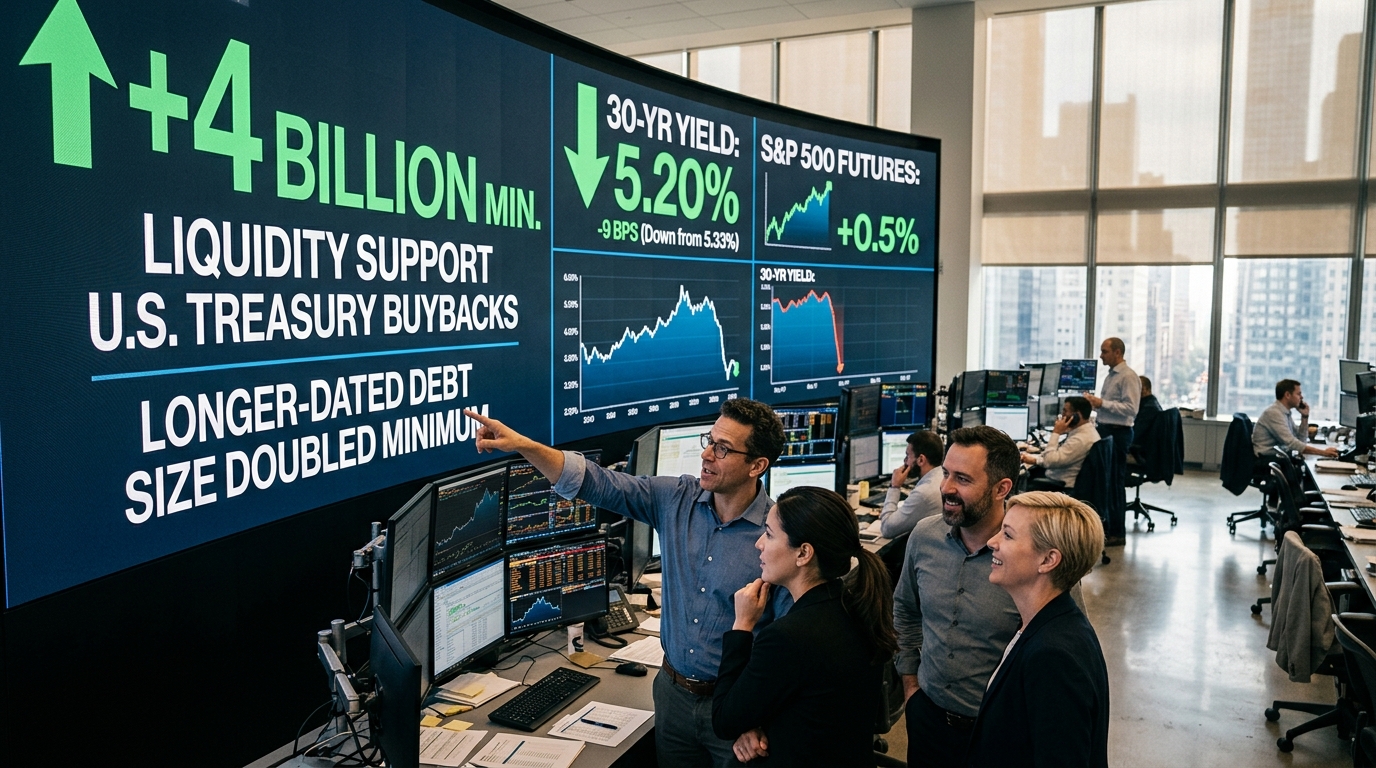
The U.S. Department of the Treasury said Tuesday it will at least double the size of its liquidity support buyback operations for longer-dated nominal coupon securities, increasing the maximum per-operation size from $2 billion to at least $4 billion. The change, covering both the 10-year to 20-year and 20-year to 30-year maturity sectors, takes effect September 9 and will remain in place through the end of the current refunding quarter on November 4.
The move helped send stocks and bonds higher Wednesday, with S&P 500 futures climbing 0.5% and the yield on 30-year Treasury bonds falling nine basis points to 5.20%. The yield had touched a fresh 19-year high of 5.33% earlier in the week, part of a broader selloff in long-dated government debt that has also pushed 30-year yields in France and Germany to multi-decade highs and lifted UK gilt yields toward 6%.
Treasury officials said the increase in buyback sizes reflects a desire to provide greater liquidity support in longer-dated sectors where the agency has consistently seen strong demand, as evidenced by a heavy volume of high-quality offers it regularly receives in longer-dated buyback operations. The department will provide further detail on future buyback sizes at its next quarterly refunding announcement, scheduled for November 4.
The recent bond selloff has been driven by investor concern that inflation remains above target and that the federal government's widening fiscal deficits will be difficult to contain, forcing Washington to issue ever-larger volumes of long-dated debt into a market with waning demand from traditional buyers. Interest on the public debt has become a growing driver of the deficit itself, with fiscal-year-to-date interest costs reaching $1.17 trillion, up 15% from a year earlier, due partly to higher yields.
Adding to the pressure on long-term rates, a surge in corporate bond issuance tied to the artificial intelligence buildout has also weighed on the market, with estimates suggesting AI-related companies could issue as much as $1.5 trillion in debt this year. That wave of corporate supply has compounded concerns about a broader glut of dollar-denominated fixed-income issuance, prompting investors globally to demand a higher term premium for holding long-dated bonds.
The 10-year Treasury yield, the benchmark most closely tied to mortgage rates, auto loans and credit card borrowing costs, eased toward 4.70% Wednesday as investors also looked ahead to the release of minutes from the Federal Reserve's July policy meeting, at which the central bank held rates steady but saw three officials dissent in favor of a hike.
Wednesday's Treasury announcement marked one of the more concrete policy responses yet to the run-up in borrowing costs, which has become a political headache for the administration ahead of November's midterm elections. Investors will be watching upcoming Treasury auctions, including a 20-year note sale later this week, for further signs of whether the buyback expansion succeeds in stabilizing demand for long-dated government debt.