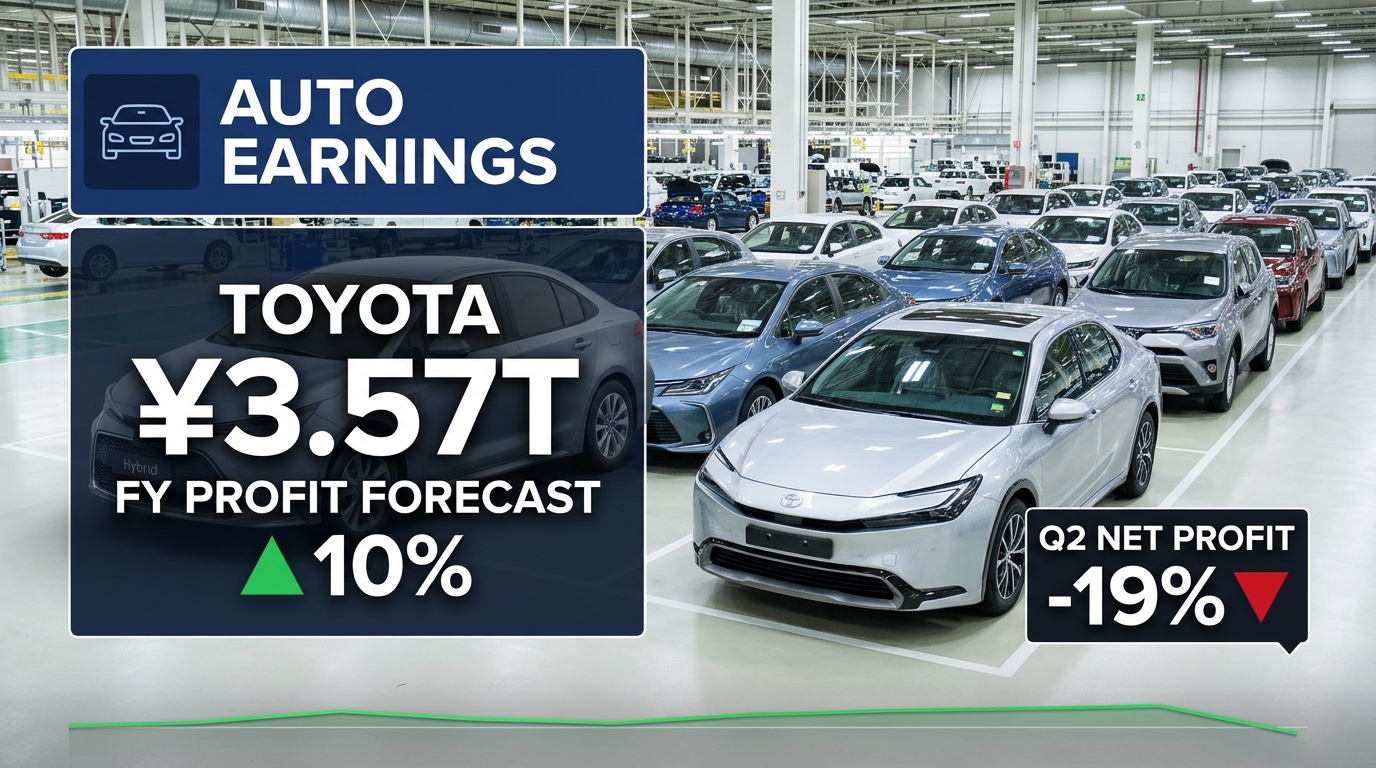
Toyota Motor raised its full-year profit forecast on Thursday even as quarterly earnings declined, reporting a 19% drop in July-September net profit to 759.4 billion yen, or about $4.8 billion, from 932 billion yen a year earlier, the Associated Press reported. The Japanese automaker now expects net profit of 3.57 trillion yen for the fiscal year through March 2027, up from an earlier forecast of 3.25 trillion yen, though below the 3.8 trillion yen earned in the previous year.
Revenue was the bright spot. Quarterly sales rose to 13.4 trillion yen from 12.4 trillion yen despite headwinds from US tariffs, supply disruptions and rising raw material costs caused by the war in the Middle East. For the first half, Toyota reported net profit of 2.2 trillion yen, up from nearly 1.8 trillion yen, on revenue of 26.96 trillion yen compared with 24.6 trillion yen a year earlier.
Volume held up. Toyota sold 4.76 million vehicles in the first fiscal half, marginally lower than 4.78 million a year earlier, and it expects to sell 9.7 million vehicles globally for the full year, up from nearly 9.6 million. Sales stayed strong in the United States, where Camry and RAV4 hybrids were popular, and held up in Japan and Europe, while Asia was flat. China was the weak spot, with sales hurt partly by surging gasoline prices.
Currency also helped. Like other Japanese exporters, Toyota benefits from a weak yen, which lifts the value of overseas revenue when translated into yen. The dollar traded near 158 yen, up from 154 a year ago. Management said it offset higher raw material prices by optimizing its global supply network and maintaining strong sales.
Investors responded favorably. Toyota shares jumped in Tokyo after the results, rising to about 3,500 yen from about 3,200 yen. Dow Jones Newswires, which published a correction clarifying that the net profit forecast is 3.570 trillion yen rather than billion, headlined its report as a higher earnings forecast following higher operating profit. The US-listed shares, which trade under the ticker TM, were among the names in focus in Thursday's pre-market coverage from Benzinga.
For US investors, the result illustrates how a diversified global automaker can absorb tariff and commodity pressure better than feared. Toyota said it mitigated rising material costs and continued to benefit from demand for hybrids, a segment where it has a long lead. The risks are clear, however: a cooler Chinese market, persistent tariff friction in North America and an energy shock that could dent consumer demand if fuel prices stay elevated. Cheaper crude, which fell for a fourth session on Thursday, could ease some of that pressure on both costs and demand.
What to watch next: whether Toyota's guidance proves conservative given the yen's weakness, how US dealer inventories and pricing evolve as the holiday season approaches, and whether Japan's currency policy shifts. The ADR's reaction when US markets open will show whether the Tokyo rally carries over to American trading.