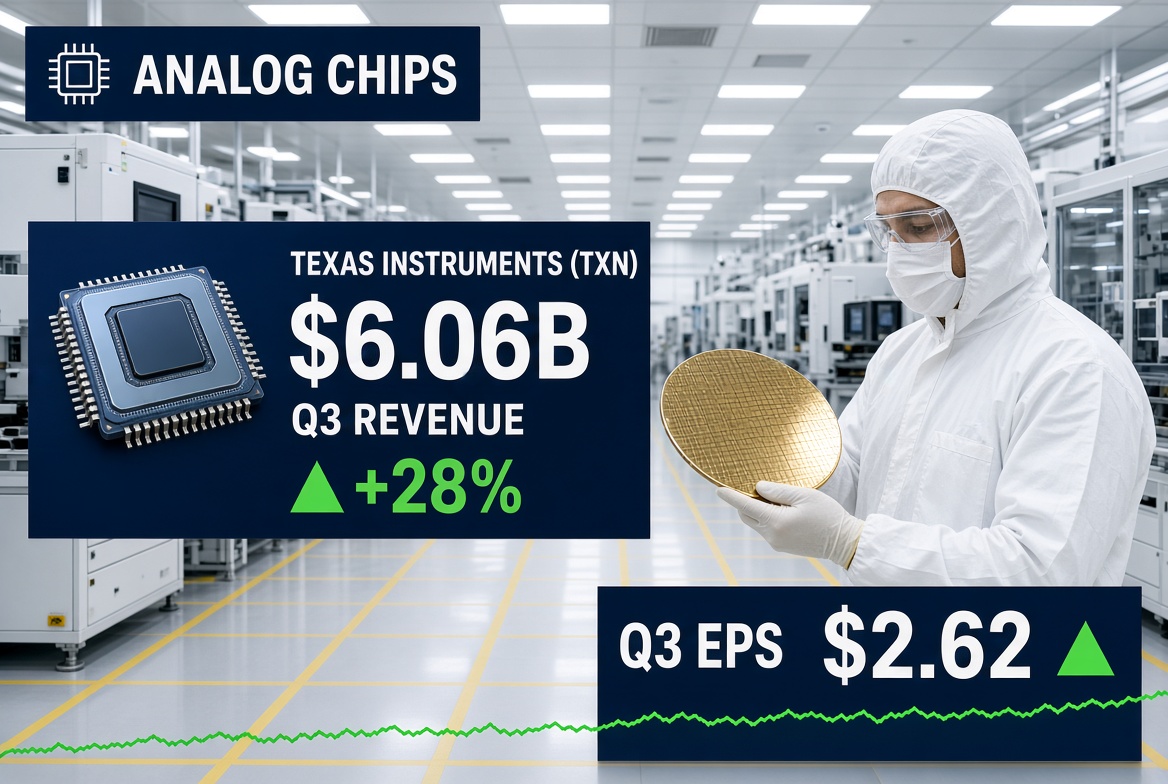
Texas Instruments delivered a third-quarter 2026 report that exceeded expectations on revenue, earnings and guidance, offering a counterpoint to a weak start for semiconductor shares on Thursday. The analog and embedded chipmaker posted revenue of $6.055 billion, up 28% from a year earlier, against a consensus estimate of $5.92 billion. Earnings were $2.62 per share, ahead of the $2.44 analysts expected.
Profitability and cash generation were strong. Operating income was $2.87 billion, operating cash flow reached $3.42 billion and free cash flow totaled $2.96 billion. The figures show the company converting a cyclical recovery in demand into substantial cash, an important consideration for investors who prize its capital return policies.
The outlook was the more important element. Texas Instruments guided fourth-quarter earnings to a range of $2.45 to $2.79 per share, with the entire range above the $2.30 analyst consensus. Revenue is expected between $5.8 billion and $6.3 billion, versus a Street estimate of $5.73 billion. A range that sits fully above expectations suggests management sees improving order patterns rather than merely meeting seasonal norms.
Analog chips are widely used in industrial equipment, vehicles, personal electronics and data center power systems, so the company’s results are often read as a barometer for broad economic activity rather than only the artificial intelligence cycle. A 28% year-over-year increase suggests demand is rebounding across several end markets, although year-over-year comparisons can exaggerate momentum when the prior-year period was depressed.
Despite the strong report, semiconductor stocks were under pressure. Nasdaq-100 futures fell about 1.7% on Thursday as oil climbed to a five-month high and the 10-year Treasury yield rose above 5%, reversing gains from Wednesday’s session. Another chip-industry supplier also beat third-quarter estimates but gave a revenue outlook of $8.2 billion to $9.0 billion against an $8.533 billion consensus, a reminder that guidance, not the quarter itself, is driving reactions.
That divergence illustrates the dilemma for chip investors. Fundamentals are improving, but valuations leave little room for macro shocks, and higher yields reduce the present value of future earnings. The VIX rose about 9% to roughly 18, signaling that volatility is returning. Traders may treat early weakness in high-quality names as an opportunity, while others will wait for energy prices and Treasury yields to stabilize.
From a portfolio perspective, the results support a view that industrial and automotive end markets are recovering. Risks include a sustained oil-driven slowdown in consumer spending, tariff or export-control developments, and the possibility that expectations have already moved ahead of the cycle. Position sizing should account for the volatility surrounding semiconductor shares in a headline-driven session.
Investors will also monitor guidance from industrial bellwethers in coming days. Several industrial companies raised outlooks on Thursday, offering evidence that demand holds up despite higher energy costs, though fuel and financing costs remain a risk into 2027.