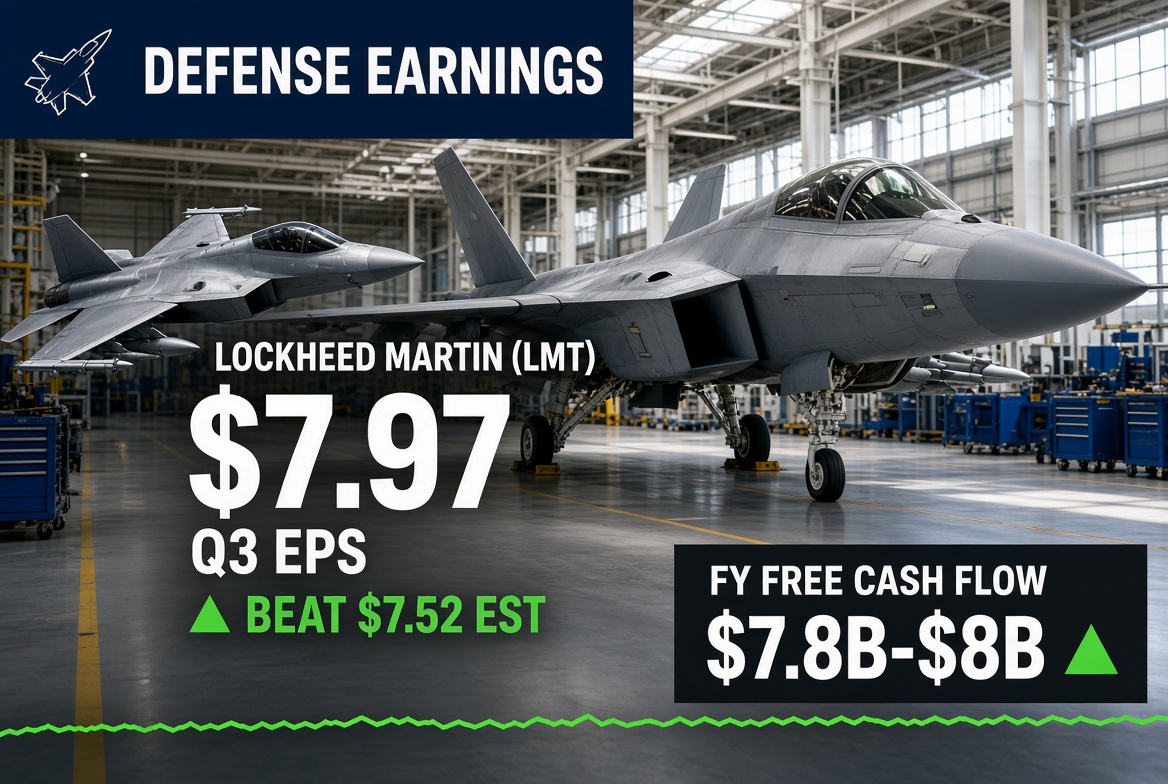
Lockheed Martin raised its full-year 2026 financial outlook after reporting third-quarter results that beat Wall Street estimates, giving defense investors a bright spot in a session dominated by oil-driven selling. Earnings were $7.97 per share compared with the $7.52 consensus, and revenue was $20.7 billion versus the $20.46 billion analysts had forecast.
Management lifted full-year earnings guidance to a range of $30.35 to $30.75 per share, from about $29.95 to $30.65 previously, with the midpoint above a $30.45 consensus estimate. Revenue guidance rose to $80 billion to $82 billion from $79.75 billion to $81.75 billion, in line with the $81 billion Street estimate. Free cash flow expectations saw the largest change, rising to $7.8 billion to $8 billion from $7 billion to $7.2 billion.
The cash flow upgrade stands out because free cash flow underpins dividends, share repurchases and the capacity to invest in new programs. The midpoint moved from $7.1 billion to $7.9 billion, an increase of roughly 11% in a single quarter, which may reflect improved working capital and execution.
The report arrived amid heightened geopolitical risk. The New York Times reported that U.S. and Israeli militaries have developed specific plans for renewed strikes on Iran after the American midterm elections, citing U.S. officials and others briefed on the deliberations. Planning is described as focused on a short but intensive operation, with exercises stepped up in the region. Brent crude rose 2.8% to $111.88 a barrel after more Houthi attacks in Saudi Arabia.
Defense stocks often act as a partial hedge in such periods because government demand for aircraft, missiles and munitions is less sensitive to economic cycles and can rise when conflicts intensify. Even so, the sector is not immune to market-wide selling, rising yields or budget politics, and investors should distinguish between company-specific execution and sentiment around headlines.
Other industrial reports on Thursday were generally constructive. A diversified industrial group raised its 2026 adjusted EPS outlook to $8.40 to $8.45 from $8.05 to $8.35, and an equipment-rental company lifted its 2026 revenue view to $18.0 billion to $18.2 billion. Both suggest industrial demand remains resilient despite higher energy costs.
Risks to the bullish defense case include program delays, cost overruns on fixed-price contracts, supply chain constraints and a political environment in which spending priorities can shift quickly. A geopolitical de-escalation could also reduce the premium investors assign to defense shares in the short term. Traders should therefore size positions carefully and use defined risk levels.
In sum, Lockheed Martin’s report combined a clean earnings beat with raised guidance across earnings, revenue and cash flow. In a market where technology shares are falling and energy costs are rising, that combination makes the stock one of the more defensible long ideas for the session, although macro volatility could still dominate price action.