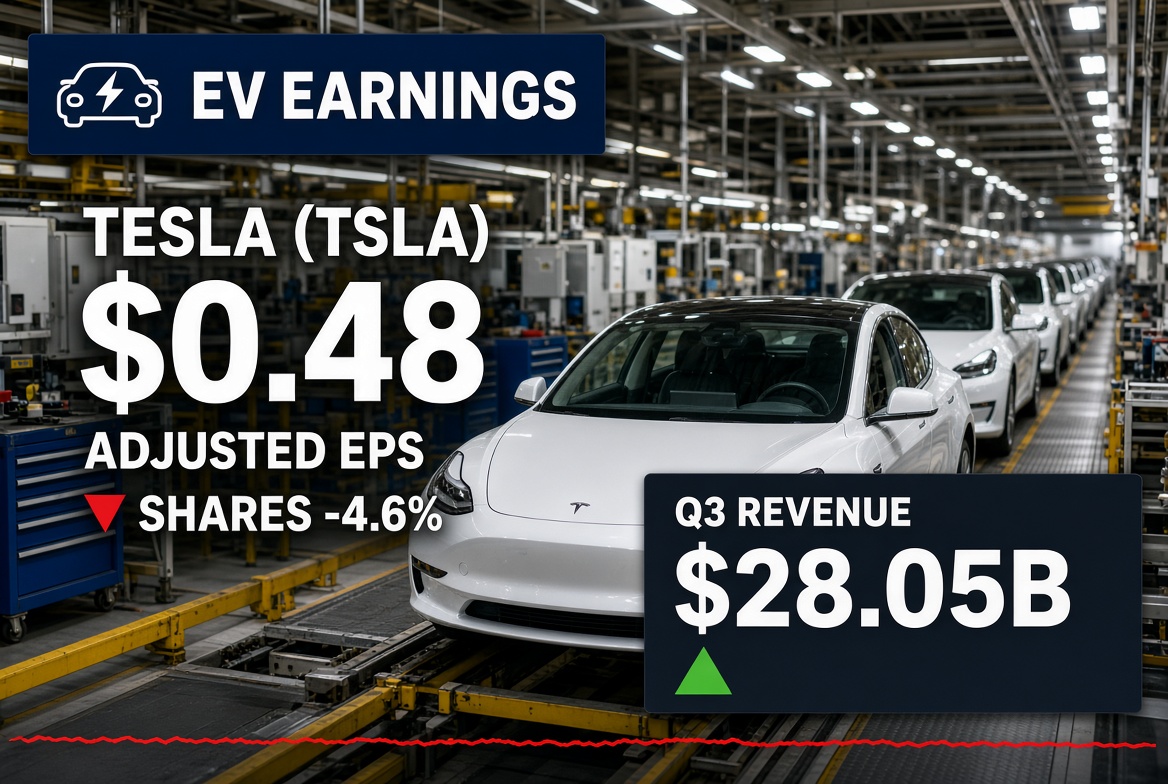
Tesla delivered a third-quarter 2026 earnings beat that failed to hold investor enthusiasm. The electric-vehicle maker reported adjusted earnings of $0.48 per share, above the $0.43 consensus, on revenue of $28.05 billion compared with the $27.88 billion analysts expected. Shares fell about 4.6% in early trading on Thursday, according to one market tracker, as investors focused on the company’s capital spending plans rather than the quarter’s headline results.
The central issue is the trajectory of investment. Tesla signaled lower capital expenditures in 2026 but higher spending in 2027 and 2028 on its Optimus humanoid robot program, the Cybercab robotaxi and a project called Terafab. Investors who had welcomed positive free cash flow and better-than-expected capital spending in the quarter now face a longer period of heavy investment before those initiatives can be expected to contribute meaningful revenue.
Vehicle data gave a more mixed picture. Tesla delivered 486,532 vehicles in the quarter, beating expectations of about 461,100, though deliveries were down roughly 2% from a year earlier. Deliveries outpaced production of 464,391 vehicles by more than 22,000 for a second straight quarter. The Model 3 and Model Y accounted for nearly all deliveries, while Cybertruck deliveries totaled 8,295, down from 12,364 in the second quarter.
The inventory drawdown can flatter near-term results because the company is selling vehicles it has already built, but it also means production would need to rise to sustain current delivery levels. The weakness in Cybertruck volumes highlights the challenge of broadening the lineup beyond the two mainstream models that dominate sales. Analysts will likely press management for details on how much of the 2027 and 2028 increase is tied to each program and when each is expected to generate revenue.
Macro conditions are not helping. U.S. stock futures were lower on Thursday, with Nasdaq-100 contracts down roughly 1.7%, as oil prices rose to their highest level since May after fresh Houthi attacks in Saudi Arabia. The 10-year Treasury yield near 5.1% adds pressure to high-multiple growth shares, and Tesla’s valuation has long depended on investors’ willingness to pay for future autonomy and robotics revenue rather than present earnings.
Higher fuel prices cut both ways for electric-vehicle makers. Elevated gasoline costs can improve the relative appeal of battery-powered cars, but a spike in rates raises financing costs for car buyers and a risk-off tape tends to hit the most richly valued stocks hardest. Traders will be watching whether buyers step in after the early decline or whether the stock continues to trade with the weak semiconductor and technology group.
For portfolio managers, the takeaway is that the market is now treating Tesla as a capital-intensive technology story, where the pace and payoff of spending matter more than a quarterly EPS beat of a nickel. A disciplined approach would wait for the stock to find support and for clarity on 2027 spending targets before adding exposure.