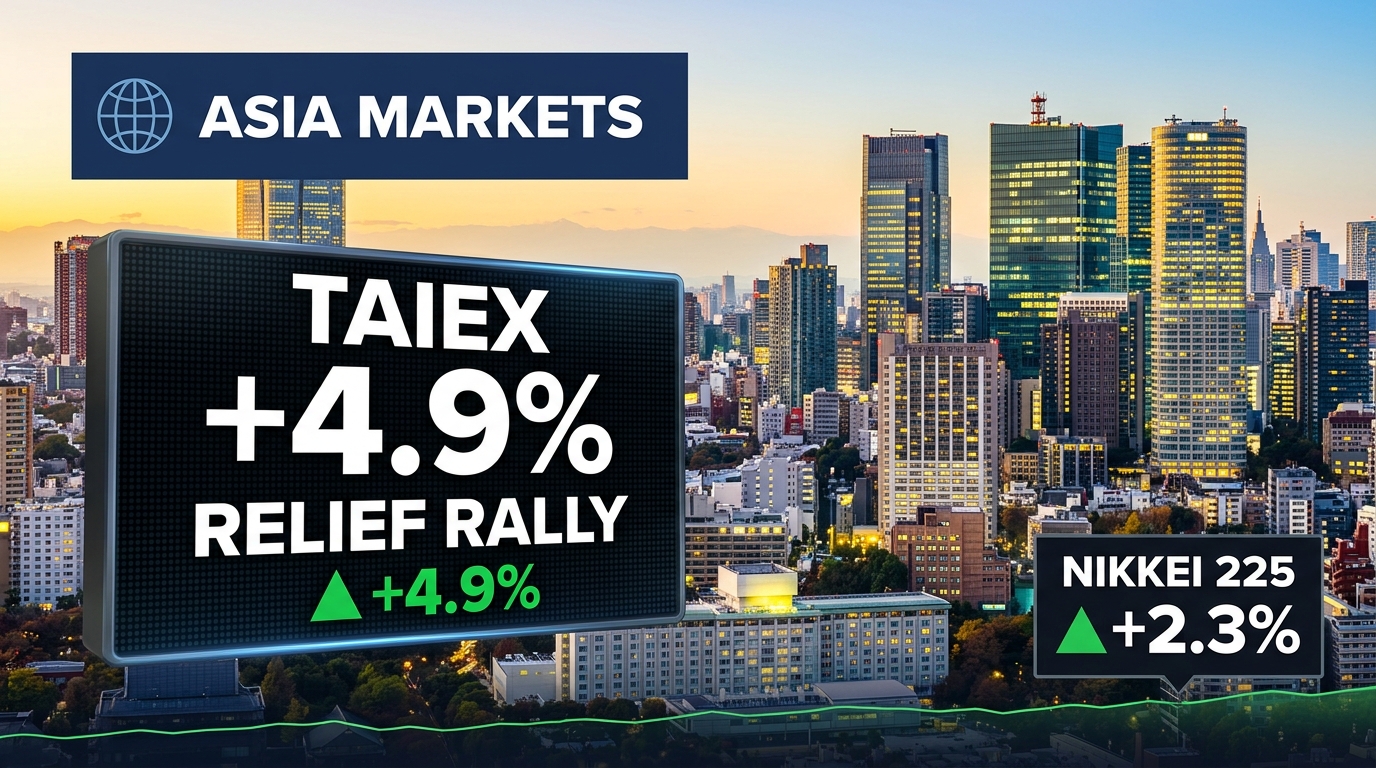
Global equities staged a relief rally on Monday after last week’s brutal technology selloff, with Asia-Pacific markets leading the rebound as dip buyers stepped in. The MSCI Asia Pacific Index rose 1.9% following its steepest weekly liquidation in eighteen months, Taiwan’s Taiex surged 4.9%, and Japan’s Nikkei 225 gained 2.3%, giving investors a first sign of stabilization after days of forced selling.
The Taiex rebound pulled Taiwan’s benchmark back from bear-market territory after authorities rolled out targeted market-stabilization measures. Semiconductors dominate Taiwan’s market, so the index is a sensitive gauge of sentiment toward artificial intelligence hardware, and its sharp swings in both directions show how crowded and leveraged that trade had become. Japan’s market, also heavy in technology and chip-related shares, followed a similar pattern.
The catalyst for the selloff was largely political. Democrats won control of Congress in the November 3 midterm elections, and investors worried that the new majority could target power permitting and data center buildouts, the physical backbone of the AI boom. On Thursday the S&P 500 fell 4.36% to 7,353.73, its largest one-day loss since April 2025, while the Nasdaq Composite dropped 5.52% and the Dow Jones Industrial Average lost 3.44%. The Cboe Volatility Index jumped about 70% in the session and, although it has eased, remains above 25.
Friday brought only a partial recovery. The S&P 500 gained about 0.3% and the Nasdaq rose 1.3%, but the Dow shed 237 points, and market breadth was poor: of 74 large stocks tracked by one market newsletter, only 11 rose while 63 fell. October’s strong payrolls report, with 165,000 jobs added, lifted Treasury yields and raised the odds of a December Fed rate hike, which limited the appetite for risk.
U.S. stock futures were higher early Monday, with Dow and S&P 500 contracts up while Nasdaq 100 futures were volatile as AI-related names stayed under pressure. The S&P 500 stood near 7,400, against an all-time high of 7,844.67 set in October, leaving it roughly 5.6% below its peak and about 5% lower over the past month.
Strategists are split on what comes next. One investment bank noted that 21 of the last 23 midterm years produced positive fourth-quarter returns, averaging about 7% for the S&P 500, and others argued that a divided Washington makes fiscal policy more predictable. Skeptics point to forced selling, systematic deleveraging and lingering doubts over whether AI data center capital spending will pay back, a three-part overhang that has not yet been resolved.
The week’s calendar is dense. Tuesday’s October CPI report and Friday’s producer price index will test December rate-hike pricing at roughly 76%, while earnings from AI-exposed companies later this week will show whether spending plans remain intact. The U.S. dollar also bounced, with the Dollar Index up almost 1% on Friday from the week’s lows, a sign that cross-asset volatility has not yet normalized.
For paper-trading purposes, the message from Asia is that selling pressure eased but did not disappear. A one-day bounce after a drop of more than 4% is common, and sustained gains typically need confirmation from improving breadth, calmer volatility and a benign inflation print. Until those arrive, smaller positions and defined risk look more sensible than chasing the rebound.