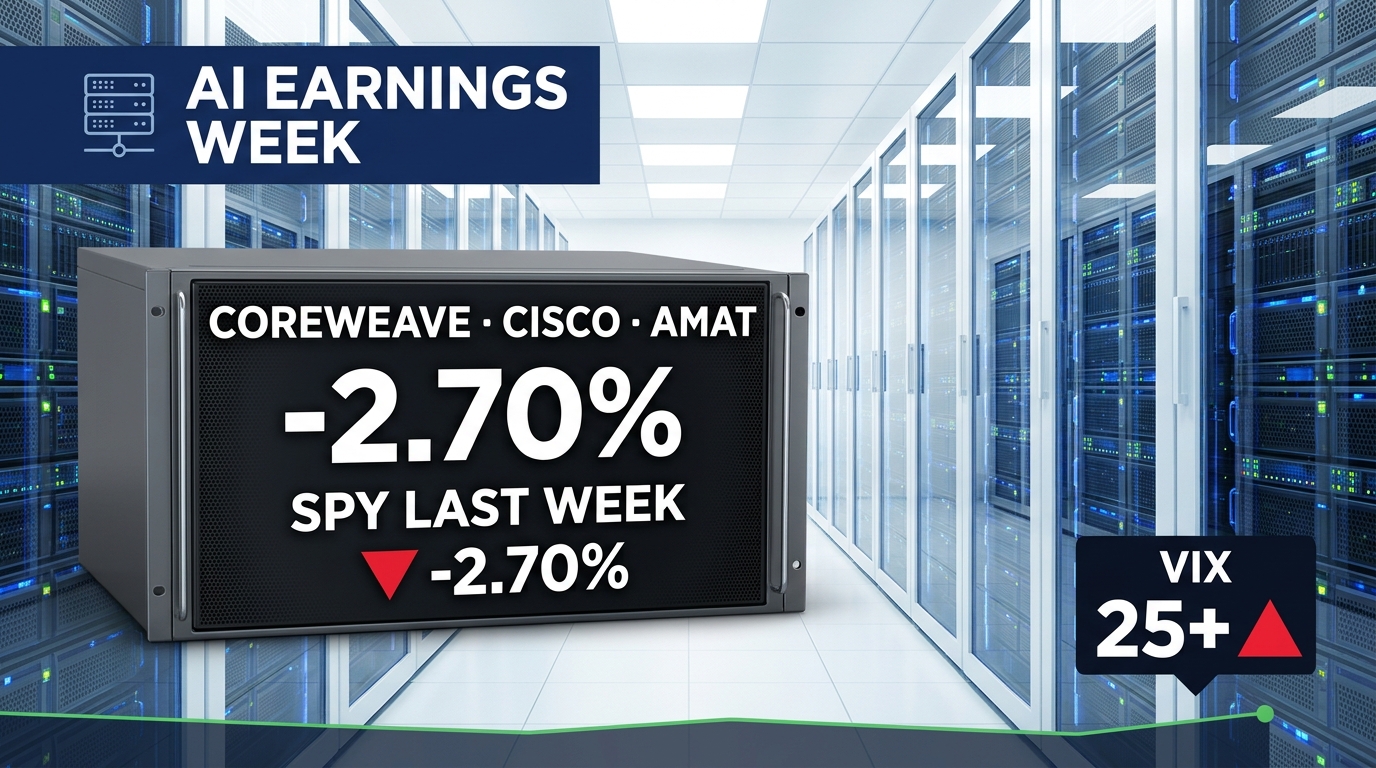
Three companies at the center of the artificial intelligence infrastructure trade, CoreWeave, Cisco and Applied Materials, are scheduled to report earnings this week, and the timing could hardly be more sensitive. Major index funds enter the week down four straight sessions, the VIX is above 25, and the S&P 500 ETF SPY lost 2.70% last week, leaving investors looking for evidence that AI spending plans are still intact.
Last week’s selloff began with fears that Democratic control of Congress after the November 3 midterm elections could slow data center construction, then spread through chip, networking and infrastructure stocks. Investors now want proof from the companies that sell the picks and shovels of AI that orders, backlogs and capital budgets remain healthy, and that last week’s drop reflected positioning rather than a change in underlying demand.
CoreWeave, which rents AI computing capacity, is the most financially sensitive of the three. One market strategist flagged a possible funding scare at the company as a downside scenario that could reignite the AI infrastructure unwind. Investors will likely look for commentary on financing, capacity coming online and how demand is holding up as the broader market questions whether AI data center investments will pay back.
Cisco is tied to the theme through data center networking, so its results will help show whether large cloud and enterprise customers are still ordering at the pace the market assumed. The stock was already weak going into the report, having fallen about 1.95% on Friday and been flagged as technically oversold by some chart watchers, which raises the stakes for any guidance change.
Applied Materials supplies chip manufacturing equipment, so its outlook offers a read on how much capital chipmakers plan to spend after a long run of AI-related demand. Taiwan, whose market jumped 4.9% on Monday after sliding to the edge of bear-market territory, is a key node in that supply chain, and any commentary on orders from Asian customers will be closely parsed.
Nvidia’s drop of about 5% in premarket trading on news of a board investigation into CEO Jensen Huang adds headline risk to the group, while Tuesday’s October CPI report and Friday’s producer price index could swing rate-hike expectations, currently about three-in-four for December. Strategists have noted that equity declines and rate-hike pricing have moved together, so a hot inflation print could compound any AI disappointment, with the 10-year yield potentially testing 5%.
Wide ranges are expected. One options-based estimate puts the S&P 500 ETF’s one-standard-deviation move through Tuesday’s close at about 1.77%, and the Nasdaq Composite is testing its 52-week simple moving average, a technical line traders watch for trend breaks. Position sizes are being cut as a result; one newsletter recommends half-size trades on both longs and shorts while market breadth remains poor.
The upside case is straightforward. If the three reports show resilient spending and stable guidance, the group could extend Monday’s global bounce, and seasonal data show midterm years have tended to deliver gains in the fourth quarter. Until the results arrive, volatility is likely to remain the main feature, and disciplined risk management matters more than conviction in any single AI name.