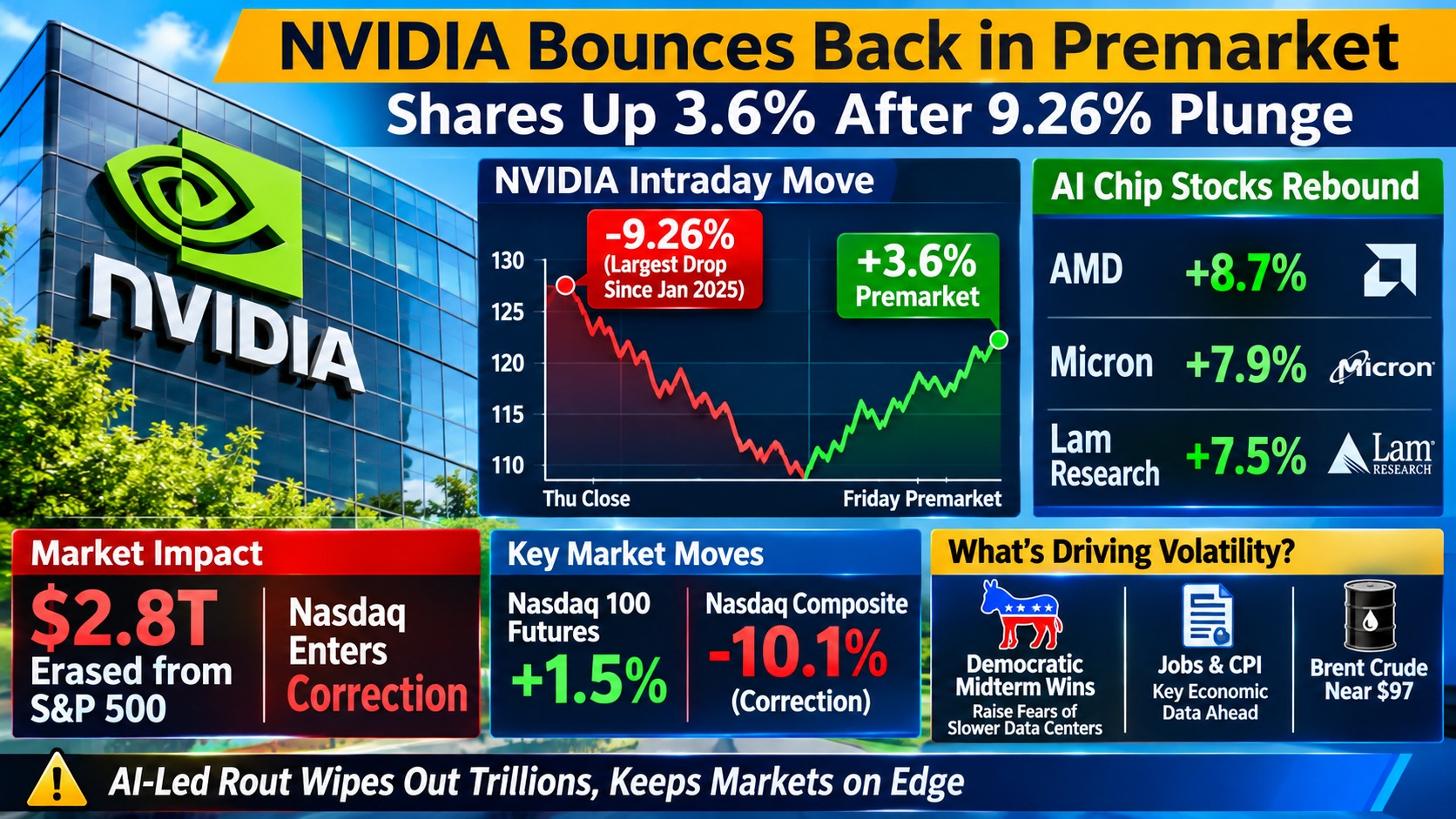
Nvidia shares rose about 3.6% in premarket trading on Friday, November 6, after the chipmaker suffered its biggest one-day drop since January 2025, falling 9.26% to $181.60 on Thursday. Nasdaq 100 futures gained roughly 1.5% ahead of the opening bell, while S&P 500 futures added about 0.3% and Dow futures slipped between 0.6% and 0.9%, signaling a tentative bounce after a technology-led rout.
Thursday's session was the worst for U.S. equities since April 2025. The Nasdaq Composite fell 5.52% to 24,315, entering correction territory, the S&P 500 dropped 4.36% to 7,353.73 and the Dow Jones Industrial Average lost 3.44% to 51,523.06. All 11 S&P 500 sectors finished lower, and roughly $2.8 trillion of market value was erased from the S&P 500. The Nasdaq is on track for a fourth straight weekly decline.
The catalyst was political. Democrats' midterm victories, including in several states with large data center pipelines, raised fears that local opposition and tougher oversight could slow the AI infrastructure buildout. One market newsletter tallied restrictions winning in 40 of 41 local data center votes this week. Credit-default swap prices on CoreWeave debt rose about 50%, and one major hyperscaler reportedly stepped back from data center projects it judged too risky.
Chip stocks led the damage. The semiconductor index fell about 12% on Thursday, AMD plunged 17.26% to $404.40 and Micron, Marvell Technology and Lam Research sold off sharply. Overnight, selling spread to Asia, where the Nikkei and Kospi each fell about 6% and Taiwan's benchmark dropped 4.5%, reflecting those markets' heavy exposure to memory chips and advanced processors. Samsung Electronics and SK Hynix fell more than 6% and 10%, respectively.
Friday's bounce is broad. AMD rose about 7% premarket, Micron 7.5%, Marvell about 7% and Lam Research more than 9%, while Intel and Broadcom added between 4% and 6%. Data center names such as CoreWeave rebounded roughly 6%. The bull case is that third-quarter S&P 500 earnings are growing above 31%, so the debate has shifted from demand to financing costs, power availability and political risk, with capital spending now scrutinized company by company.
Macro crosscurrents add risk. October nonfarm payrolls are due at 8:30 a.m. ET, with consensus near 65,000 jobs and a 4.2% unemployment rate, and futures markets price roughly 65% to 70% odds of a Federal Reserve rate hike in December. Brent crude near $97 keeps inflation fears alive, and October CPI arrives Tuesday. Traders should watch whether the premarket bounce holds into the close; a fade in the hardest-hit names would suggest the selling is not finished.
For a paper portfolio, the posture is selective. Several names are gapping higher on company-specific catalysts rather than index beta, while the planned Anthropic public listing faces investor pushback on valuation. Position sizes should reflect elevated volatility, and traders should avoid chasing the first hour of a rebound that may reverse if payrolls surprise. Gold, near $4,076 an ounce, has gained 4.5% this week as investors sought shelter.