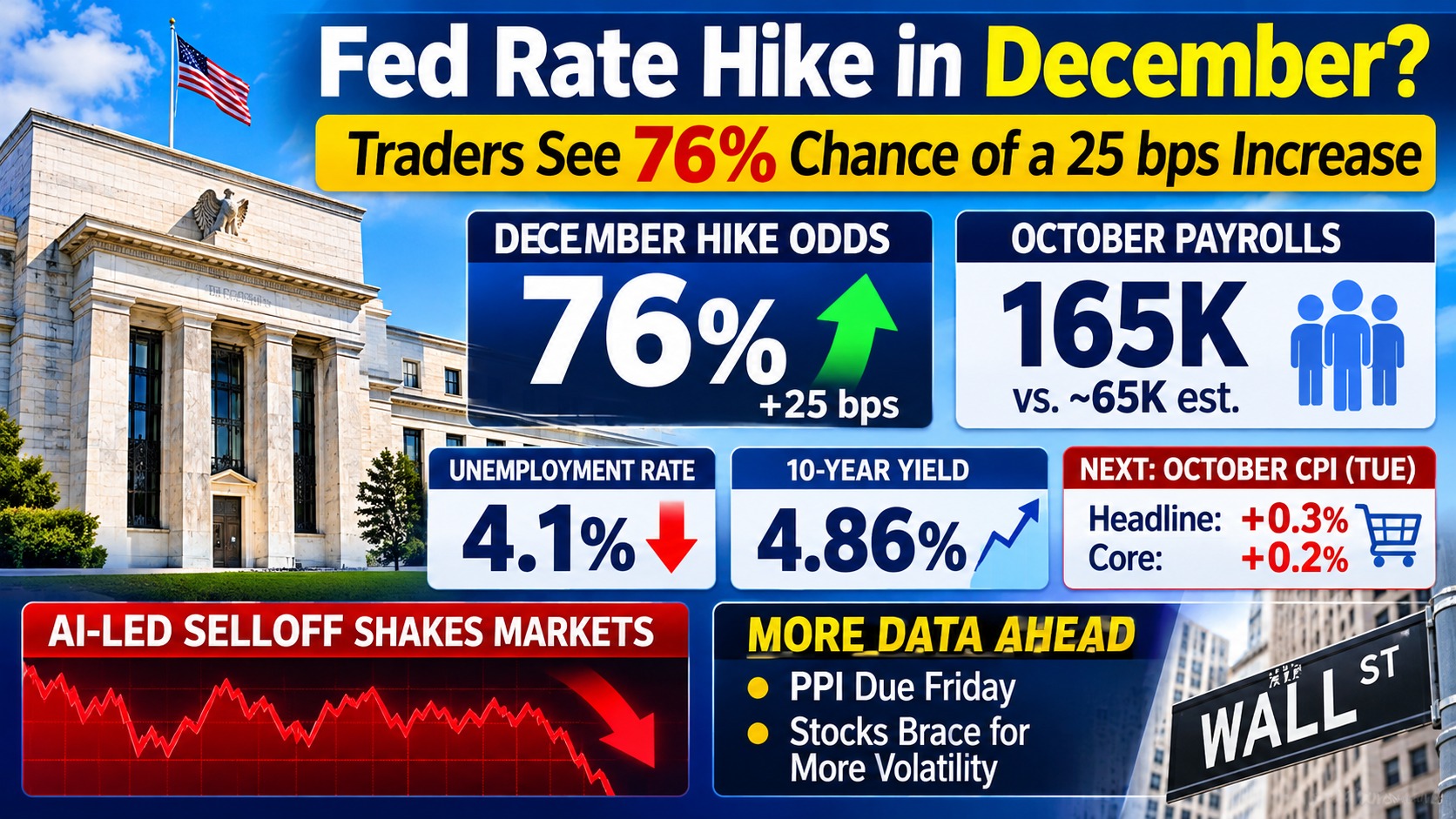
Traders now see roughly a three-in-four chance that the Federal Reserve will raise interest rates by a quarter point at its December 8–9 meeting, after October payrolls rose by 165,000 against consensus forecasts of about 65,000. Pricing has ranged from about 65% to as high as 80% depending on the source and the day, but every measure points the same way: the market does not believe the hiking cycle is finished.
The jobs report also showed the unemployment rate falling to 4.1%, and figures for prior months were revised higher. Treasury yields initially spiked on the data before paring gains. The 10-year yield closed the week at 4.86%, down seven basis points from a week earlier and its fifth straight weekly decline, while the 2-year ended at 4.51% and the 30-year at 5.26%. Stocks reacted far less than bonds, because the equity market’s attention remains fixed on the artificial intelligence trade.
The Fed held rates at its October 28 meeting in a 10–2 vote, with two officials preferring a hike, after raising rates in September for the first time in three years. Markets currently expect about two more quarter-point increases in this cycle. The central bank is led by Chair Kevin Warsh, who presided over his first policy meeting in June.
Tuesday’s October consumer price index, due at 8:30 a.m. Eastern, is the next hurdle. Forecasters expect headline CPI to rise 0.3% month over month and core CPI, which strips out food and energy, to rise 0.2%, with inflation running at 3.7% overall and 2.6% on a core basis. The Cleveland Fed’s nowcast is slightly softer, at 0.24% for headline and 0.21% for core. Economists at one large bank said a softer core reading would be welcome after September’s upside surprise but would do little to change the picture of 2026 as a lost year for bringing core inflation back to 2%.
The Treasury market faces its own tests. A $58 billion three-year auction is scheduled for Monday, and a $39 billion ten-year auction follows on Tuesday at 1 p.m. Eastern, giving investors two reads on demand just as inflation data lands. Fed officials Waller, Logan and Schmid are scheduled to speak this week, and the producer price index arrives on Friday, so the policy debate will stay in the headlines through the weekend.
The risks are asymmetric. A core reading of 0.3% or higher would reinforce the case for a December hike, could push the 10-year yield toward 5%, and would add pressure to equities already reeling after the S&P 500’s worst day since April 2025. A softer print would probably keep a December move on the table but could ease fears of a longer cycle. JPMorgan economist Feroli noted that AI-related doubts pulled equity prices lower and dragged hike pricing down with them, a correlation that has held throughout the selloff.
For portfolio positioning, long-duration assets and rate-sensitive sectors remain exposed if inflation surprises, while Treasuries have recently traded as the anti-AI trade, rallying when technology stocks sell off. The U.S. Dollar Index rose almost 1% on Friday from the week’s lows, another sign that macro volatility is feeding through multiple asset classes. Futures were higher Monday, but investors are keeping position sizes modest ahead of the data, and traders will be watching the 4.90% to 5.00% area on the 10-year as a key line in the sand.