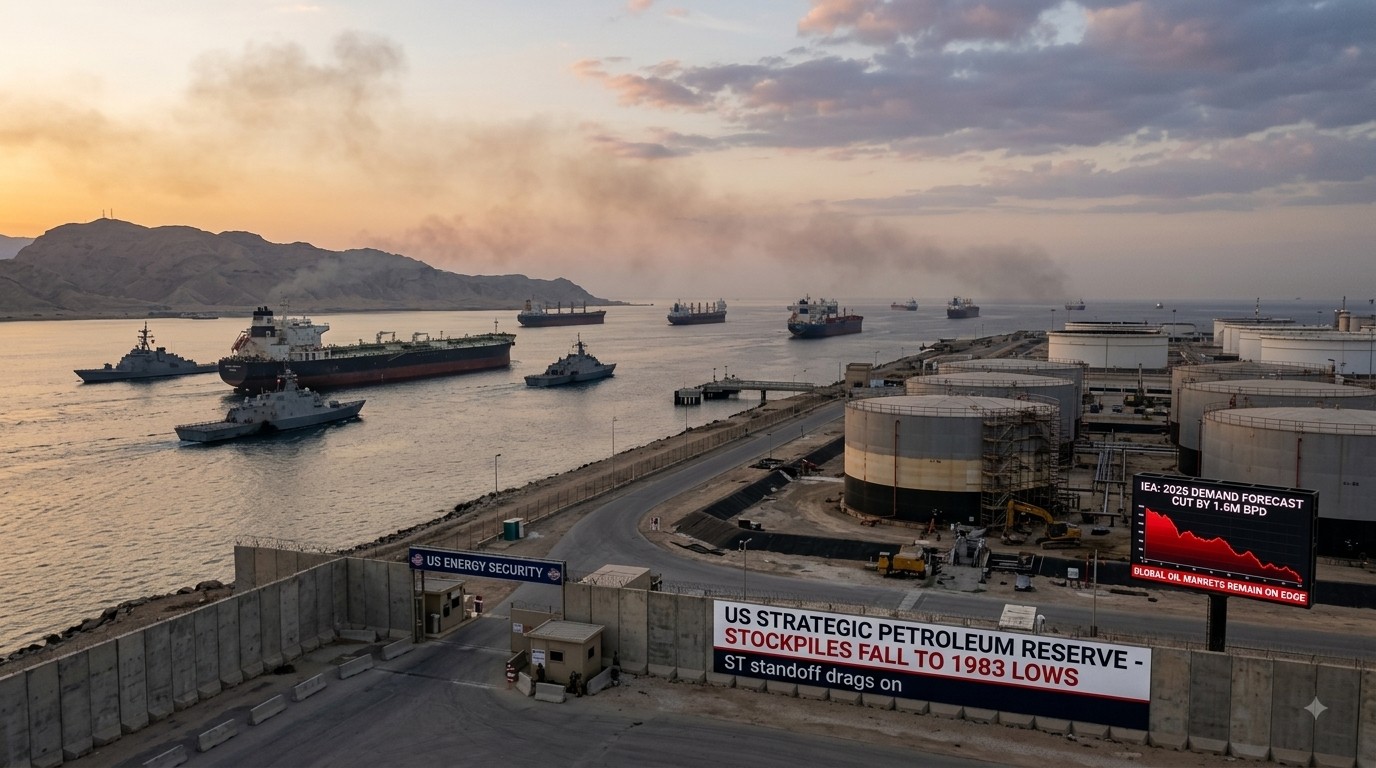
Oil markets remained on edge Thursday as vessel traffic through the Strait of Hormuz stayed depressed nearly six months into the ongoing US-Iran conflict, with the International Energy Agency sharply cutting its 2026 global oil demand forecast by 1.6 million barrels a day, a larger downgrade than its previous monthly estimate issued in July.
President Trump wrote on Truth Social that the United States has "total control" over the strait and suggested it might "keep it," a claim Iran continues to dispute. The comments come as ships remain hesitant to transit the waterway, through which roughly one-fifth of global daily oil production has historically flowed. The U.S. naval blockade of Iranian ports and vessels, in place since mid-April, has reportedly cost Iran hundreds of millions of dollars per day, according to U.S. officials, while Tehran maintains it has effective control over passage through its self-declared Persian Gulf Strait Authority.
Compounding the uncertainty, an attack by Iranian-backed Houthi rebels on a vessel in the Bab el-Mandeb strait near Yemen's southern tip has raised fresh concerns that violence could spread to another critical regional shipping route, threatening to further disrupt global energy logistics at a moment when inventories are already stretched thin.
The U.S. Strategic Petroleum Reserve has fallen below 300 million barrels, its lowest level since January 1983, as the government has drawn down stockpiles to manage the prolonged disruption. Energy Secretary Chris Wright said this week that oil exports from the Middle East have returned to pre-war levels, a claim that outside observers say is not clearly supported by observable shipping traffic data.
An oil spill from a sanctioned tanker carrying Russian crude has also reached beaches in Oman and Iran's Qeshm island, adding an environmental dimension to the crisis as authorities in both countries work to contain the damage. The IEA warned that reopening the waterway is becoming increasingly urgent as the world burns through emergency stockpiles at a rapid pace.
For investors, the prolonged disruption continues to inject volatility into energy markets, with crude prices swinging sharply on any headline suggesting progress — or setbacks — in reopening the strait to normal traffic.