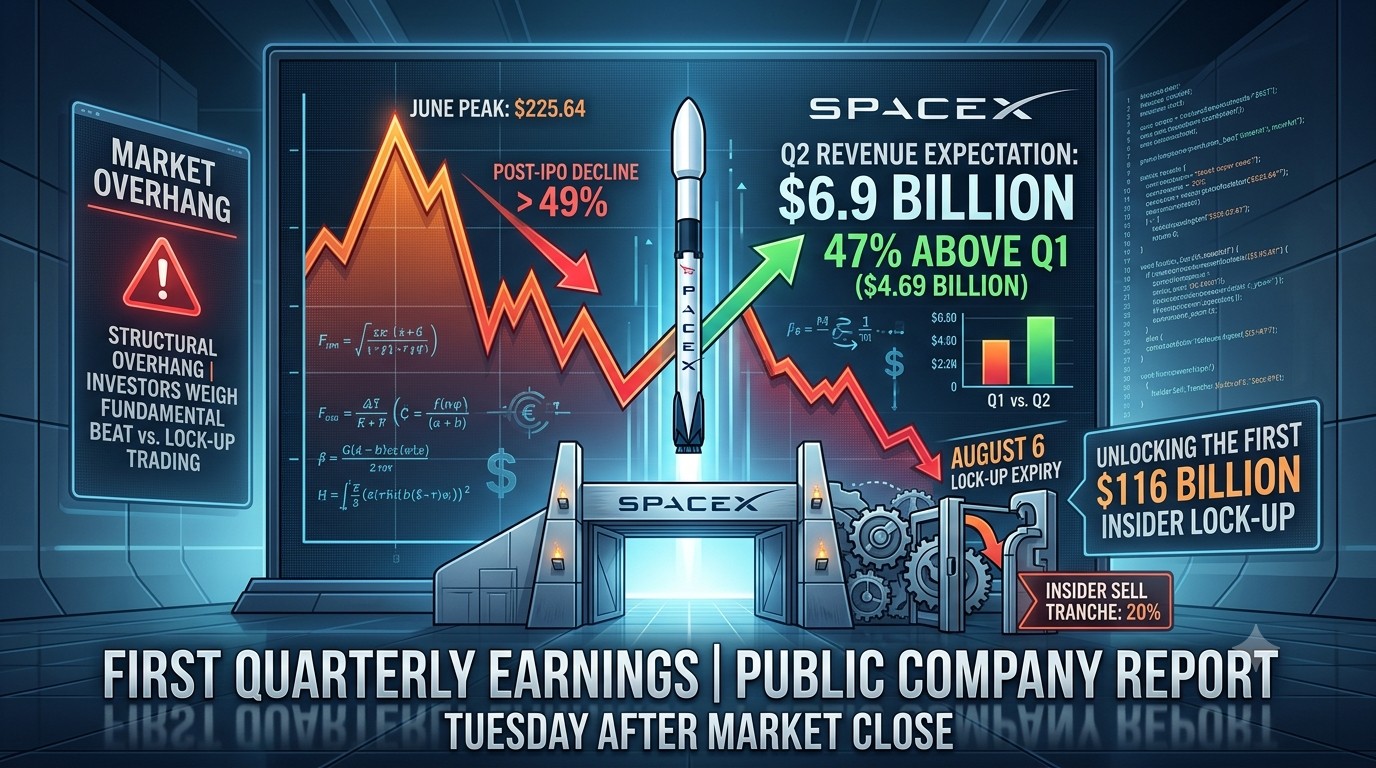
SpaceX will deliver its first quarterly earnings report as a publicly traded company on Tuesday after market close, marking the most consequential test of investor confidence since the company's $85.7 billion IPO priced at $135 per share on June 11, 2026 — the largest initial public offering in stock market history. The stock climbed to an intraday high of $225.64 on June 16, before declining more than 49% to approximately $114.53 as of Monday's close, erasing approximately $500 billion in market capitalization and creating a dramatically lower re-entry point for investors willing to look through the near-term selling pressure.
Wall Street expects Q2 2026 revenue of approximately $6.9 billion, according to analyst estimates compiled by LSEG and StreetAccount — a figure that, if accurate, would represent meaningful acceleration from the $4.69 billion posted in Q1 2026 and set the stage for what analysts project could be $39 billion in full-year 2026 revenue and $80 billion in 2027. At the current share price of approximately $114, SpaceX trades at roughly 39 times its 2026 revenue consensus — a premium multiple that requires the company not just to meet but to credibly extend its growth narrative across all three business segments: Space (launch services), Connectivity (Starlink), and AI infrastructure.
Starlink is the most important number analysts will pull from the report. As of March 31, 2026, Starlink had 10.3 million subscribers across 164 countries, up 105% from a year earlier, generating $11.4 billion in revenue in 2025. Q2 subscriber growth and margin data will determine whether the service is expanding profitably at scale. Launch services revenue fell to $330 million in Q1 2026 from $566 million in Q1 2025, a sequential decline that Deutsche Bank attributed to the slippage of some launches and expects to recover in the second half of the year as Starship Flight 13 progress converts into commercial deployment milestones.
The earnings report simultaneously triggers the first unlock tranche of SpaceX's post-IPO lock-up schedule. Under lock-up terms, the first earnings report opens a window for insiders — not including Elon Musk — to begin selling up to 20% of their restricted holdings starting August 6, the second full trading day after the release. The aggregate insider lock-up is estimated at approximately $116 billion in value at IPO pricing, making the August 6 window one of the largest potential insider selling events in market history. How much selling actually materializes will be the market's focus for the remainder of the week.
Wall Street analysts remain broadly constructive on the long-term thesis. Deutsche Bank maintained its buy rating and $255 price target, implying 135% upside from Monday's close, citing Starship Flight 13 progress and the potential for large government and sovereign AI deals. Morgan Stanley holds an Overweight rating with a $300 target. Both firms acknowledge that near-term risk is elevated, but argue the post-IPO selloff has created a materially better entry point for investors with a 12- to 24-month time horizon. The earnings call begins at 4:30 p.m. ET.