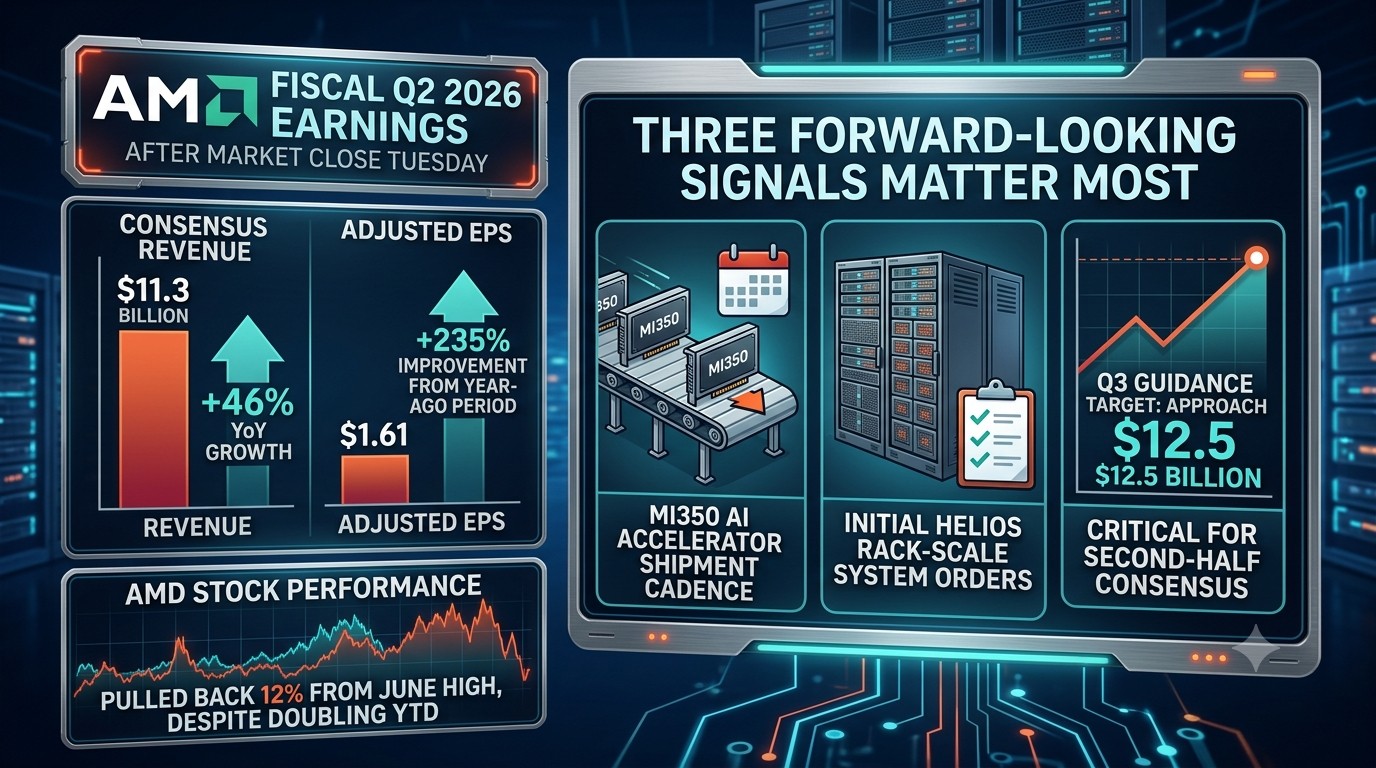
Advanced Micro Devices will report fiscal second-quarter 2026 results after the U.S. market close Tuesday at 5:00 p.m. ET, delivering what many analysts expect to be another strong quarter — but one where the headline revenue and EPS figures will matter far less to the stock's direction than the forward-looking signals embedded in management's Q3 guidance and commentary on the Helios rack-scale AI system ramp.
The consensus estimate compiled by LSEG and Visible Alpha sits at approximately $11.3 billion in revenue — 46% above the $7.68 billion posted in Q2 2025 — with adjusted EPS of $1.61, implying a 235% year-over-year improvement. AMD's own guidance, issued alongside Q1 results on May 5, called for approximately $11.2 billion plus or minus $300 million, meaning consensus sits slightly above the company's own midpoint. AMD has topped revenue estimates in each of its last several quarters, with an average EPS surprise of 6.5% over the trailing four periods — setting a meaningful but not extreme bar for a beat.
The Data Center segment is the critical focal point. Analysts expect approximately $6.5 billion of data center revenue in Q2, including roughly $4 billion from server CPUs — where AMD's EPYC Venice processors captured a record 46% server market share in Q1, per management commentary — and approximately $2.5 billion from AI accelerators including the MI350 GPU line. Server CPU margins run structurally higher than GPU margins at AMD's current scale, making the segment mix within Data Center as important as the segment total for gross margin modeling.
The more consequential test is Q3 guidance and any quantifiable update on Helios. The full-year 2026 consensus compiled by MarketScreener implies approximately $12.5 billion of Q3 revenue and $15.7 billion in Q4 — an average of $14.1 billion per quarter in the second half versus approximately $10.8 billion in the first half. That acceleration requires the Helios rack-scale system — AMD's answer to Nvidia's GB200 NVL72 — to ramp from initial volume in Q3 to a significant Q4 deployment. Management said on the Q1 call that Helios is in production and claimed up to 30% better inference performance per dollar versus competing architectures, though no major customer orders have been publicly disclosed. Any quantifiable Helios order announcement Tuesday would be a meaningful positive surprise.
AMD's stock closed Monday at approximately $476, down roughly 12% from its June high but still more than 100% above its year-end 2025 close. Options pricing implies approximately 8.5% post-earnings volatility in either direction, with a call-heavy near-term flow but a slightly put-heavy open interest structure indicating mixed institutional positioning ahead of the print. The Anthropic agreement and Core Scientific partnership disclosed in recent months improve long-term AI revenue visibility but contribute minimally to Q2 numbers. Investors entering the print should focus on Q3 guidance versus the $12.5 billion consensus, gross margin versus the 56% full-year target, and any specific Helios customer or volume commentary as the three variables most likely to define the stock's direction through August.