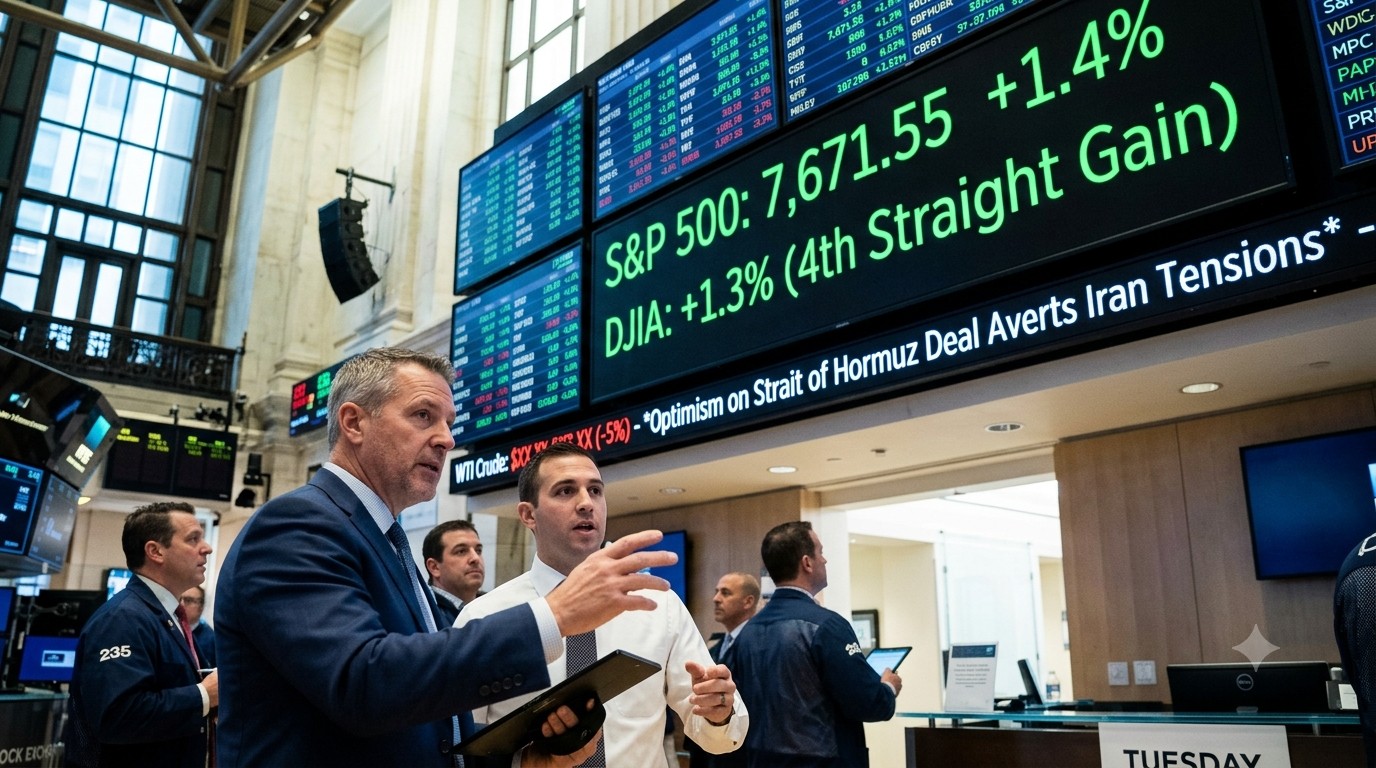
U.S. equity markets extended a powerful four-session rally on Tuesday, with the S&P 500 trading above 7,671 and eclipsing its June closing record as investors responded to a trio of positive catalysts: blowout earnings from Caterpillar and Palantir, renewed optimism about a U.S.-Iran agreement to reopen the Strait of Hormuz, and a sharp decline in oil prices that eased the inflation and rate-hike pressures that had weighed on markets through much of July.
West Texas Intermediate crude fell approximately 5% in Tuesday's session on reports that mediators had made meaningful progress toward brokering an agreement between the United States and Iran that could restore commercial navigation through the Strait of Hormuz to pre-war levels. Brent crude followed, declining toward the $90 range intraday. The oil decline is significant not only as a direct input cost reducer across the consumer, industrial, and transportation sectors, but also because it lowers the near-term probability of a Federal Reserve rate hike — the outcome that had most alarmed equity investors through the summer.
The Dow Jones Industrial Average gained 1.3% to extend its winning streak to four consecutive sessions, while the Nasdaq Composite climbed 1.1% and the Russell 2000 — often viewed as a proxy for domestic, rate-sensitive economic confidence — rose 1.7%, outpacing large-cap benchmarks and suggesting the rally is broadening beyond mega-cap technology leadership. The S&P 500's recovery above its June record is particularly notable because it comes after the index's July volatility, which had briefly raised concerns about a summer correction.
The Caterpillar earnings print — Q2 revenue of $20.54 billion and a record $72 billion backlog — directly rebutted one of the market's central anxieties: that AI data center capital expenditure growth was peaking. The Palantir result — 93% revenue growth, 149% U.S. commercial surge, and a Rule of 40 score of 155% — provided equally powerful validation that enterprise AI software demand is accelerating, not plateauing. Together, the two reports sent a consistent message across the infrastructure and application layers of the AI stack: the cycle is not over, it is deepening.
Investor attention Tuesday afternoon focuses almost entirely on the two after-market reports: SpaceX's debut earnings — the first public financial disclosure by the company since its $85.7 billion IPO — and AMD's Q2 results, where $11.3 billion in consensus revenue and Q3 guidance will determine whether the chip sector broadens its leadership or concentrates further in Nvidia. The $116 billion SpaceX insider lock-up unlocking on August 6 adds a structural complexity to the market's near-term calculus that no current earnings beat fully resolves.
Bank of America's summer pullback warning from May now looks premature relative to the week's catalysts, but the structural risk factors it identified — stretched valuations, high insider selling potential from recent IPOs, and the binary geopolitical risk of Iran negotiations — remain live. The most prudent framing for the current market is that today's earnings and geopolitical developments are necessary but not sufficient conditions for a sustained breakout above 7,700 on the S&P 500.