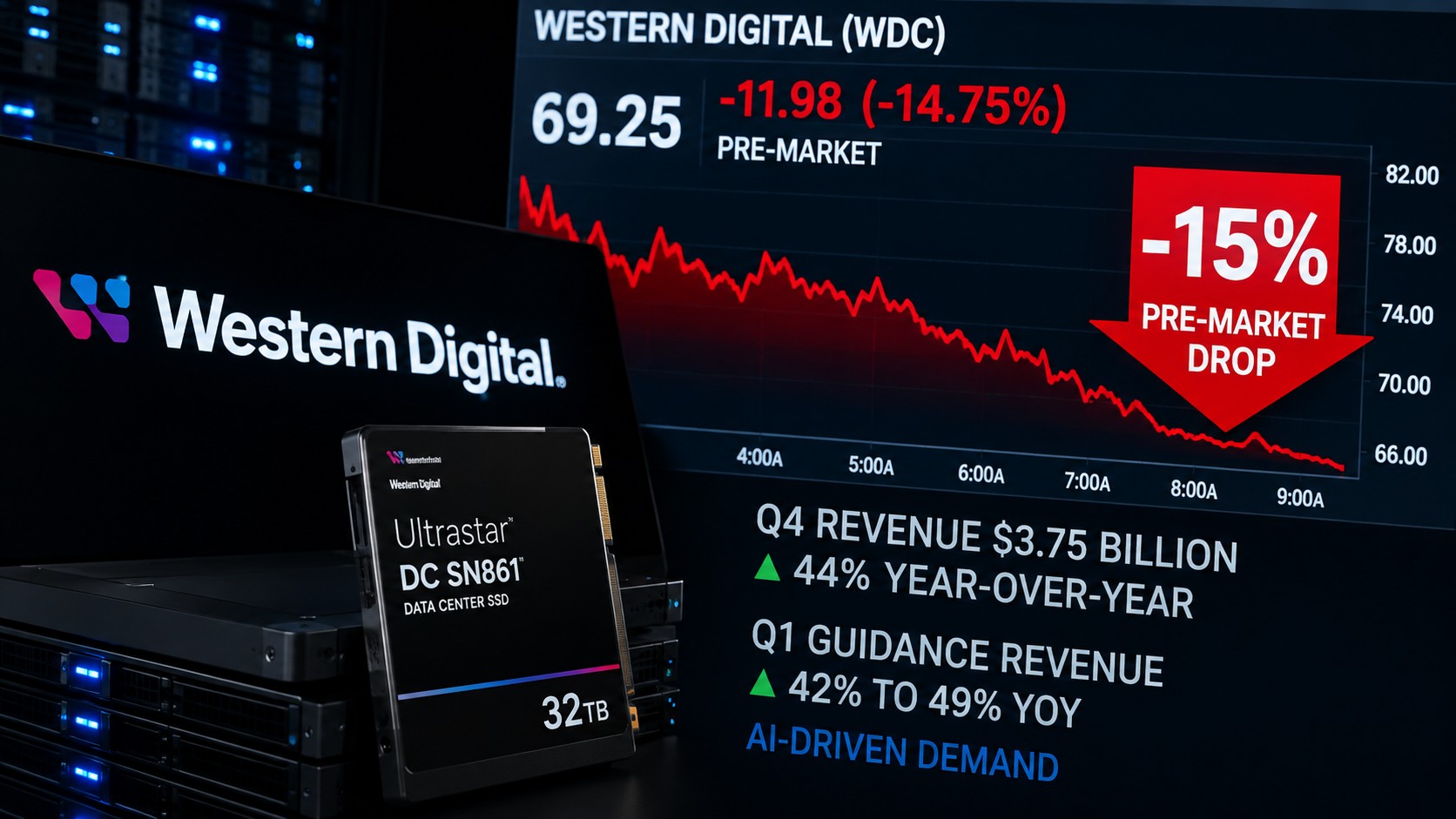
Western Digital delivered strong fiscal fourth-quarter 2026 results driven by AI and cloud storage demand, yet the stock faced heavy selling pressure as elevated expectations proved difficult to satisfy. Revenue reached $3.75 billion, a 44% increase from the year-earlier period, while non-GAAP diluted earnings per share came in at $3.56, exceeding analyst forecasts. GAAP diluted EPS stood at $8.21. Gross margin expanded sharply to 54.1% on a GAAP basis and 54.4% non-GAAP, reflecting favorable pricing and mix.
Free cash flow was robust at $1.28 billion for the quarter. Management pointed to broadening demand across cloud and data-intensive workloads. For the fiscal first quarter of 2027 the company expects revenue of approximately $4.1 billion plus or minus $100 million, implying 42% to 49% year-over-year growth at the midpoint, with non-GAAP gross margin guided to 55% to 56% and non-GAAP EPS of $4.00 plus or minus $0.15.
Despite the beat and constructive outlook, shares dropped roughly 15% in premarket trading. The reaction mirrored broader caution toward AI-related names that have already delivered outsized gains this year. Western Digital stock had advanced more than 200% in 2026 prior to the report, leaving little room for anything short of a blowout guide.
Peer Sandisk, which separated from Western Digital in 2025, also reported robust results with fourth-quarter revenue of $8.97 billion and data-center revenue more than doubling sequentially to $2.98 billion. Sandisk guided first-quarter revenue of $10.3 billion to $10.8 billion, yet its shares declined about 9% to 11% as the midpoint of profit guidance failed to fully clear the highest expectations.
The dual reactions underscored investor sensitivity to valuation and capital-intensity concerns in the AI storage and memory complex. Nasdaq futures traded lower while Dow and S&P 500 futures held steadier, reflecting a rotation away from high-expectation technology names. Memory-focused vehicles such as the Roundhill Memory ETF also declined.
Market participants continue to weigh strong corporate profit trends against the risk that AI infrastructure spending may not translate into commensurate free-cash-flow returns at the pace previously priced in. Western Digital and Sandisk results confirmed healthy underlying demand while highlighting how difficult it has become for even solid reports to satisfy the market after large prior advances.
Investors will watch subsequent commentary on pricing sustainability, customer commitments, and capital returns. Both companies emphasized long-term structural growth from data-center and AI workloads, yet near-term share-price action remains dominated by positioning and expectation resets rather than the absolute quality of the numbers.