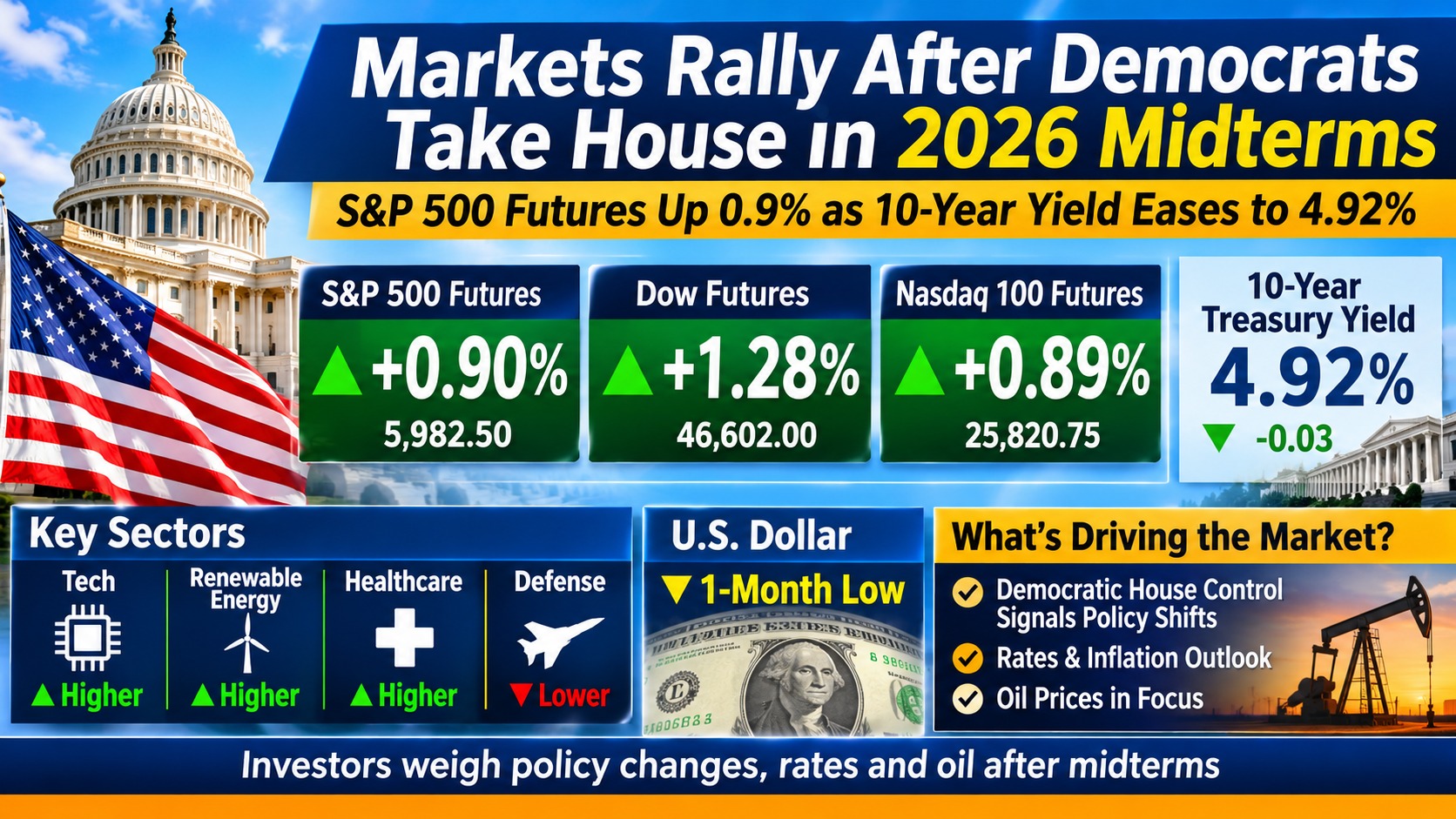
U.S. stock index futures climbed ahead of Wednesday’s open, reversing earlier losses, after Democrats won control of the House of Representatives in the 2026 midterm elections. As of 5:25 a.m. EST, Dow Jones Industrial Average futures were up 1.28%, S&P 500 futures were up 0.90% and Nasdaq 100 futures were up 0.89%, according to TipRanks.
The 10-year Treasury yield fell to 4.92%. Democrats are winning the House, and the Senate was described as leaning their way as well, though the final balance of power may take time to settle. A divided or Democratic-led Congress would constrain the administration’s ability to pass major legislation without bipartisan agreement, a point strategists had highlighted before the vote.
Tuesday’s regular session closed mixed. The S&P 500 gained 0.4% to 7,569 and the Nasdaq rose 0.8%, while the Dow slipped 0.4% to 51,787, according to NordFX’s Market Pulse. Overseas, Asian markets opened with a sharp technology selloff before recovering as U.S. yields eased. Japan’s Nikkei finished 1.5% lower after touching a low near 60,030, South Korea’s Kospi reversed an early drop of more than 3% to gain 0.6%, and Australia’s ASX 200 fell 0.6% after the central bank raised its cash rate to 4.85%.
Sector moves in premarket trading reflected investors’ early read on policy. Big Tech and AI shares rose, as did renewable energy and healthcare stocks, on expectations of a potential shift in U.S. policy, while defense stocks declined. The dollar fell to a one-month low on fears of tighter AI regulation, according to Market Pulse.
AI oversight had been flagged as the key risk heading into the vote. Before Election Day, strategists said Democrats were expected to push for stricter regulation of the technology, and some Wall Street professionals were positioning for selling pressure in stocks and demand for safer government bonds. The muted-to-positive futures reaction suggests markets may have largely priced in that outcome, though the policy path remains uncertain, with analysts noting that state-level action could matter more than federal rules.
Rates remain the other pillar of the story. Treasury yields have been near their highest levels since 2002, with the 10-year touching 5.34% in late September, according to Wright Research. Wednesday’s move to 4.92% offers some relief to growth stocks, but large federal deficits and heavy Treasury issuance are expected to keep upward pressure on longer-term yields. A Treasury refunding update scheduled for Wednesday is another catalyst some analysts are watching.
Geopolitics also keeps volatility elevated. Oil prices stayed choppy as investors tracked efforts to end the U.S.-Israeli war with Iran, with Qatar stepping up mediation to prevent further escalation. Energy costs feed directly into inflation expectations, which in turn shape the rate path that equity valuations depend on.
For portfolio positioning, the early evidence points to leadership from technology, healthcare and renewables, with defense lagging. Investors may want to keep risk controls tight, since October nonfarm payrolls are due later this week and a Senate outcome still has to be confirmed. This article is informational and does not constitute investment advice.