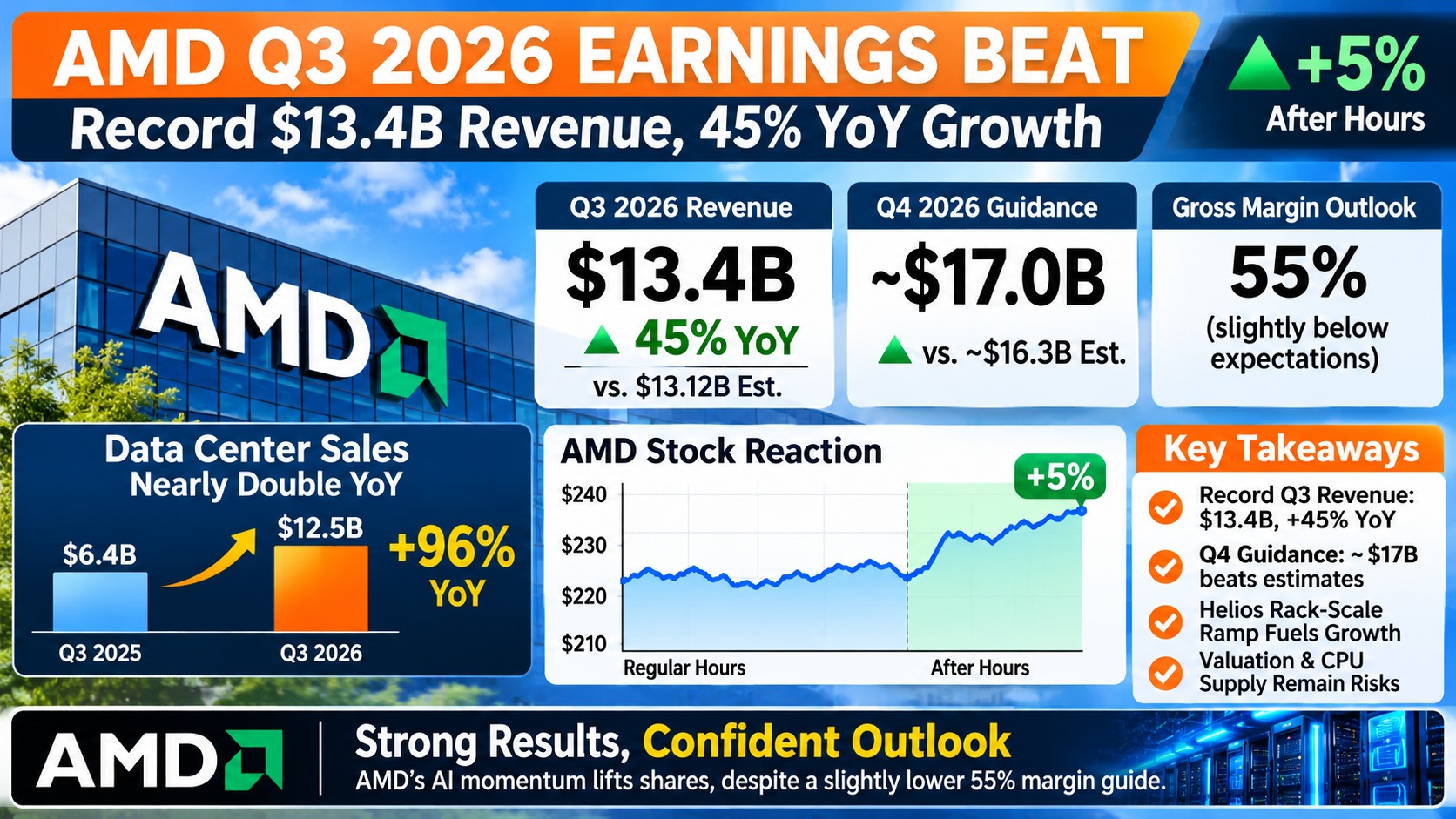
Advanced Micro Devices closed out its third quarter of 2026 with record results, reporting revenue of $13.4 billion, a 45% increase from a year earlier and ahead of the roughly $13.12 billion analysts had expected. Non-GAAP earnings per share reached $2.09, up 74% year over year, while GAAP net income came to $2.4 billion, or $1.46 per diluted share.
The Data Center segment drove the outperformance. According to the company’s earnings release, segment revenue grew 97% year over year on record sales of Instinct GPUs and EPYC server processors. Non-GAAP gross margin was 56% and non-GAAP operating income totaled $3.9 billion. Chair and CEO Lisa Su said revenue exceeded the high end of company guidance and that demand for both product lines continued to strengthen.
The bigger market catalyst was the outlook. AMD guided fourth-quarter revenue to about $17 billion, compared with expectations of roughly $16.3 billion, according to investingLive. That would represent growth of about 27% from the third quarter, a sharp sequential step-up for a company of AMD’s size. Management attributed the acceleration to scaling production of Helios, its rack-scale AI system, and of its Venice server processors.
Margin guidance was the only soft spot. AMD expects a fourth-quarter adjusted gross margin of 55%, slightly below Street expectations of 55.5% and a touch lower than the third quarter. Analysts had flagged that AI accelerators carry lower margins than the company average, so a faster Helios ramp may dilute profitability even as revenue climbs. Shares rose about 5% in after-hours trading, TipRanks reported, and the move came as broader U.S. futures pointed higher ahead of Wednesday’s open.
Context matters for positioning. Before the report, AMD stock had pulled back roughly 19% from a record close of $649.42 on October 6, according to a pre-earnings analysis, which noted that the fourth-quarter outlook was where the shares were most exposed. The company has also topped the high end of its own revenue guidance range in recent quarters, and the latest print extends that pattern.
Valuation and supply remain the debate. An analysis published in late September noted AMD traded at about 154 times trailing earnings versus 21.9 for the S&P 500, and management has said its server processor supply chain is tight. Investors will also compare Helios directly with Nvidia’s rack-scale systems, since AMD is pitching the product as a direct rival, and the size of the fourth-quarter step-up sharpens that comparison.
The macro backdrop adds a layer of risk. Democratic gains in the midterm elections have raised questions about future AI oversight, and the 10-year Treasury yield sits near 4.92%. Strong AI-chip earnings offer a fundamental counterweight, but high-multiple growth names remain sensitive to both regulation headlines and interest rates, so position sizing should reflect that volatility.
For traders, the key questions are whether AMD holds its after-hours gains through the opening bell, whether volume confirms the move, and how peers respond. A sustained reversal of the kind seen the day after the August report, when shares fell 7%, would suggest the market is demanding even more from the Helios story. This article is informational and does not constitute investment advice.