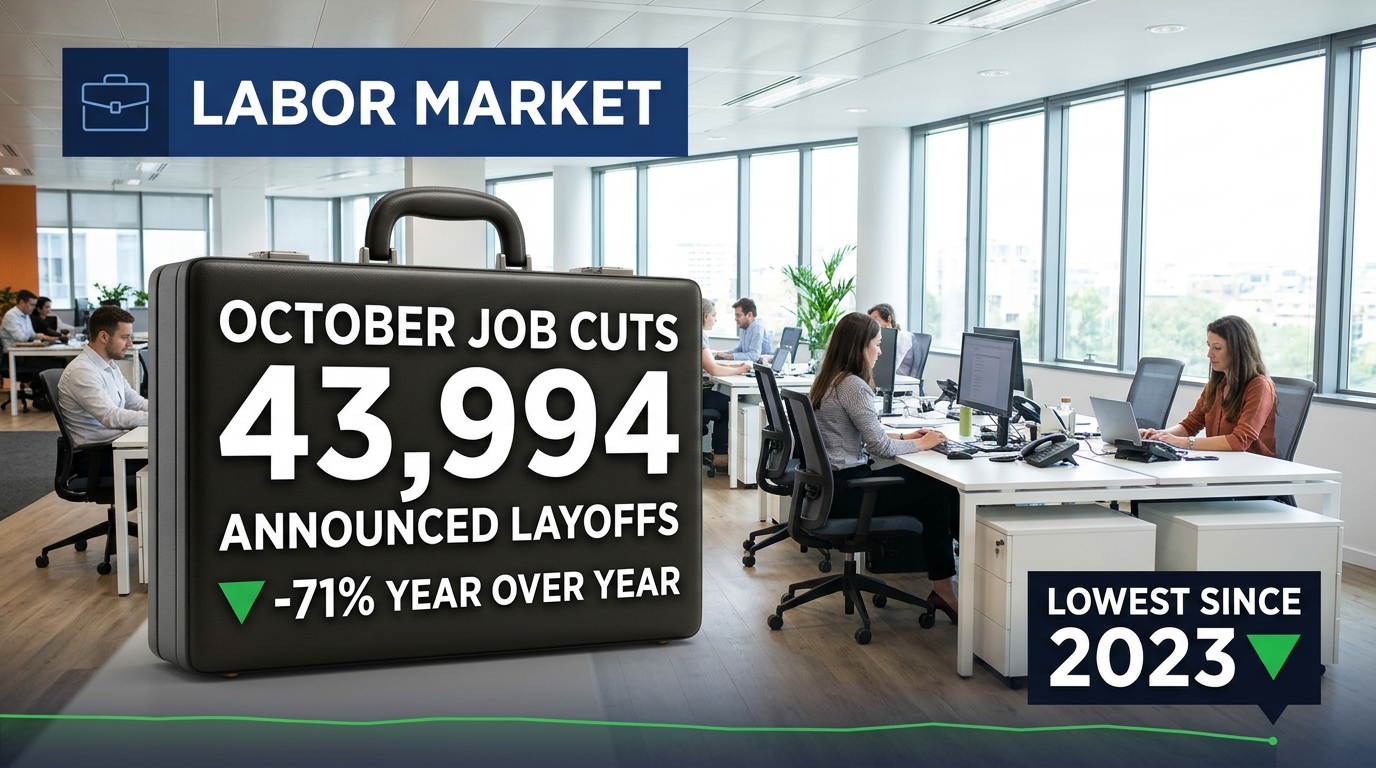
US employers announced 43,994 job cuts in October, up slightly from September but down 71% from a year earlier, according to outplacement firm Challenger, Gray & Christmas, as reported by Yahoo Finance. Layoff plans fell to their lowest level since 2023 as companies turned their attention to retaining existing employees and adding seasonal help ahead of the holidays.
Announced cuts in the first ten months of 2026 are at their lowest level since 2022, as the labor market stays in a low-hire, low-fire mode. Andy Challenger, the firm's chief revenue officer, described the environment as low-fire, noting that employers are holding on to the workers they have heading into the holidays and that the hiring they are announcing is largely short-term seasonal work. Companies, he said, want the flexibility to meet holiday demand without adding permanent headcount.
The report is one of several labor-market data points due before Friday's key employment report. Investors also have initial jobless claims for the week ended October 31, with the prior reading at 194,000, and continuing claims, which were 1.701 million the previous week. Preliminary third-quarter nonfarm productivity is also due, with economists expecting growth of 3% compared with 1.4% in the prior reading.
The mix is notable for markets. Low layoffs reduce the odds of a sudden deterioration in consumer spending, a risk that investors have weighed as energy costs rose during the Iran war. But a labor market that is not creating permanent jobs can restrain confidence and job switching. For equity investors, the data fit a soft but stable picture rather than an overheating economy.
Financial markets have moved sharply this week. The Dow Jones Industrial Average jumped 3.03% on Wednesday to 53,356.12 after the midterm results, the S&P 500 gained 1.58% to 7,688.62 and the Nasdaq Composite added 1.44%, according to Yahoo Finance. Futures were mixed on Thursday, with Dow contracts higher and Nasdaq-100 contracts lower. The 10-year Treasury yield fell to about 4.89%, and oil dropped for a fourth session on hopes of an Iran deal.
That is why bond-sensitive exposure matters for today's tape. Investors who want to express a view on how labor and inflation data move yields often turn to the iShares 20+ Year Treasury Bond ETF (TLT), which is the most relevant listed proxy for the rates reaction here. A benign layoff reading alongside falling oil is the kind of combination that can support Treasuries, but a strong payrolls print on Friday could reverse that quickly.
Bottom line: the Challenger data do not show the labor-market stress that would force a sharp policy response, but they also do not show a hiring rebound. Friday's report on payrolls and the unemployment rate will determine whether the low-fire, low-hire pattern persists. Until then, traders should expect data-driven swings in yields and rate-sensitive sectors.