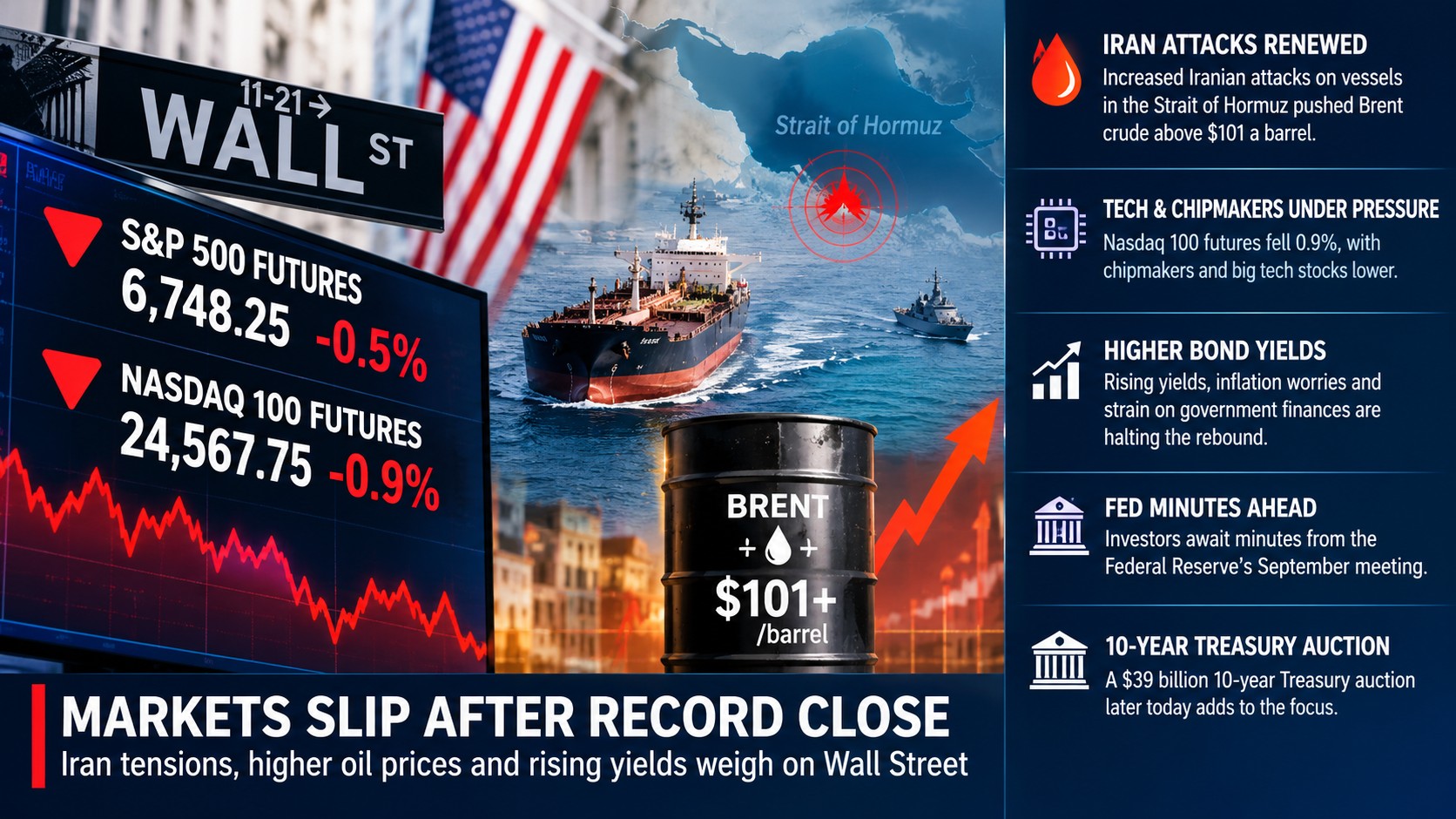
US stock futures pointed lower on Wednesday, October 7, after the S&P 500 and Nasdaq Composite closed at record highs on Tuesday. S&P 500 futures fell 0.5%, while Nasdaq 100 futures dropped 0.9%, with chipmakers and large technology stocks under pressure in early trading, according to Bloomberg.
The catalyst was a renewed flare-up in the Middle East. A pickup in Iranian attacks on vessels in the Strait of Hormuz weighed on sentiment and lifted Brent crude above $101 a barrel. The waterway is a critical conduit for global energy flows, so any sign of disruption tends to feed quickly into oil prices, inflation expectations and bond yields.
Bond markets compounded the pressure. Bloomberg reported that concerns over inflation and strain on government finances were putting the brakes on a rebound in bond markets, pushing yields higher. By the morning session, Yahoo Finance reported the Dow Jones Industrial Average down 0.9%, the S&P 500 off 0.5% and the Nasdaq Composite lower by 0.7%, as global bonds sold off.
The retreat follows a constructive session. On Tuesday the Dow rose 0.5% to 51,521.04, the S&P 500 gained 0.6% to 7,818.95 and the Nasdaq Composite advanced 0.5% to 27,599.79, according to a Zacks market summary published by Yahoo Finance. Ten of the 11 S&P 500 sectors finished higher, and the CBOE Volatility Index slipped 3.3% to 15.01, a subdued reading that left little fear priced in ahead of today's risks. Ciena led S&P 500 gainers with a 13.9% jump.
Two scheduled events add to the uncertainty. Investors are awaiting the minutes of the Federal Reserve's September meeting, which will be scrutinized for hints on how policymakers view inflation and the path of interest rates. A $39 billion 10-year Treasury auction later in the session will test appetite for long-dated government debt at a moment when yields are already rising. Market commentary from Cardinal Bridge Capital put the odds of an October rate hike at roughly 17% to 20% following last week's weak jobs report.
For portfolio positioning, the setup argues for caution rather than conviction. Indexes at record levels have ignored rising yields for about a week, according to the same commentary, which raises the stakes if the minutes read hawkish or the auction is poorly received. A sustained move in Brent above $100 would also reinforce the inflation narrative that has kept the rate-hike debate alive.
Sector reaction is likely to diverge. Energy-linked assets typically benefit from higher crude, while rate-sensitive and long-duration growth stocks, including semiconductors, tend to be vulnerable when yields climb. Defensive positioning and cash may look attractive until the day's event risk clears.
Traders will watch whether futures stabilize after the minutes and auction. A recovery would suggest the record rally retains momentum, while a deeper slide could mark the first meaningful test of a market that has so far looked past higher yields and elevated oil.
This article is for informational purposes only and does not constitute investment advice.