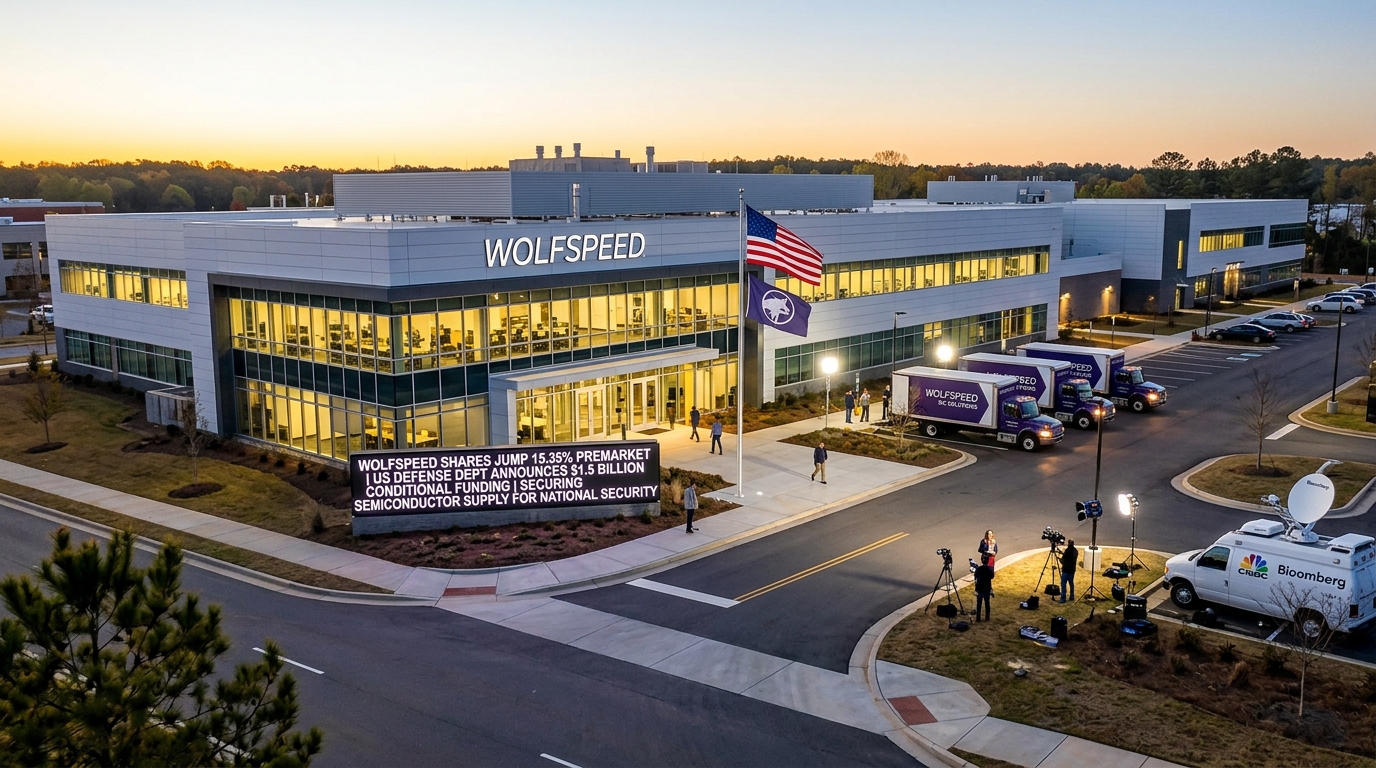
Wolfspeed shares jumped 15.35% in premarket trading Thursday after the silicon carbide semiconductor manufacturer announced a conditional financing commitment of up to $1.5 billion from the U.S. Defense Department.
The funding is meant to support domestic production and technology development for national security applications, according to TheStreet's premarket report. The commitment is conditional, meaning disbursement depends on terms and milestones that have not been fully detailed in initial reports, and the figure is a ceiling rather than a guaranteed payment.
Silicon carbide devices handle high voltages and temperatures more efficiently than conventional silicon, which makes them useful in power electronics for electric vehicles, industrial equipment, energy systems and, increasingly, the power infrastructure behind data centers. For defense customers, the appeal is a secure, domestic supply of advanced materials and chips that do not depend on foreign fabrication, a priority Washington has pursued across the semiconductor industry.
The announcement landed on a day when most semiconductor-related names were under pressure. Analog chip stocks sold off in a macro-driven decline and optical communications shares retreated, while the Nasdaq fell 0.47% and the Russell 2000 gave up 1.31% in early trading. Against that backdrop, a double-digit premarket gain suggests investors view government backing as a distinct, company-specific catalyst rather than a sector move.
Rising interest rates add to the significance. With the 10-year Treasury yield trading around 5.3%, capital-intensive manufacturers face expensive private financing, and government-supported funding can lower the cost of expanding capacity. Elevated borrowing costs are also one reason some strategists have warned about stress in capital-heavy technology buildouts.
Still, premarket jumps do not always hold. Shares can retrace once regular trading begins, particularly when the catalyst is a conditional commitment rather than a signed, fully funded award. Investors will want to see the specific conditions, the timeline for any disbursement, whether the financing takes the form of a loan, grant or other structure, and how it affects the company's capital needs and dilution risk.
Execution risk also remains. Scaling silicon carbide production requires high manufacturing yields, consistent crystal growth and reliable customer demand, and government support does not by itself guarantee any of those. Defense-related funding tends to arrive in tranches tied to deliverables, so the stock may be sensitive to every update on milestones and to any change in demand from automotive and industrial customers.
For portfolio managers, the news supports a watch-list position rather than a chase entry. Position size should reflect the stock's volatility and the unresolved details of the commitment, and a confirmed structure from the company's filings would be the next signal worth waiting for. This is analysis, not investment advice.