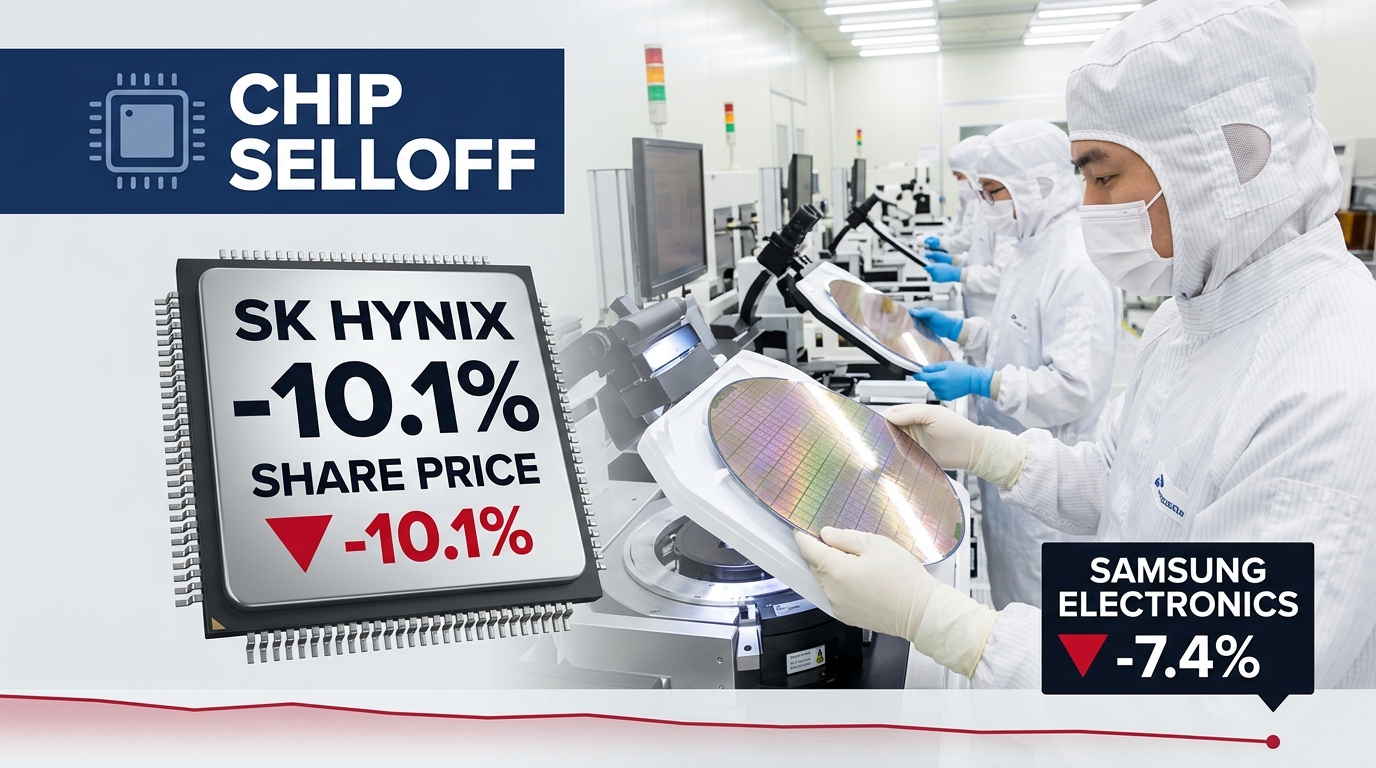
Shares of South Korea's two largest memory chipmakers fell sharply on Tuesday as a semiconductor selloff that began on Wall Street spread across Asia. SK Hynix closed down 10.09% at 1.443 million won, while Samsung Electronics dropped 7.39%, according to JoongAng Daily. Both stocks had already slid roughly 4.4% and 4.5% on Monday and were on course for a fifth straight session of declines.
The immediate catalyst was a report that China's ChangXin Memory Technologies, known as CXMT, is advancing a higher-density 4F2 DRAM design, with next-generation server-memory products targeted for year-end. CXMT has not demonstrated large-scale production and still trails the incumbents, but Samsung, SK Hynix and Micron together hold about 90% of the global DRAM market. Any credible challenger therefore raises questions about pricing power in a segment that has powered much of the AI-related rally.
South Korea's KOSPI fell as much as roughly 7% during the session to about 5,944 points. Foreign investors were net sellers of about 2.3 trillion won, equal to roughly $1.6 billion, while retail investors were net buyers. The MSCI Asia Pacific Index lost 1.7% and was heading for its lowest close since August, underscoring how concentrated regional equity benchmarks have become in a handful of AI-linked hardware names.
The Asian rout followed a weak Monday in the United States. The Philadelphia Semiconductor Index sank 2.7% to its lowest level since mid-September and the Nasdaq Composite fell about 0.4%. Micron dropped 3.9%, Nvidia lost 1.3%, Intel slid 3% and SanDisk fell 6%. Reports said executives at Broadcom and Intel had flagged financing constraints around AI infrastructure, adding to doubts about how long the current pace of spending can be sustained. Nasdaq 100 futures were down roughly 0.8% early Tuesday, while S&P 500 futures were little changed.
Positioning is also a factor. Memory stocks have rallied hard over the past year, and some analysts said the decline partly reflects valuation fatigue and thinning institutional demand: Samsung has completed a share repurchase program and SK Hynix's buyback is nearing completion. Others argue that a memory shortage could persist into 2028 and that the underlying AI demand story remains intact, noting that SK Hynix still carries a Strong Buy consensus rating with meaningful implied upside.
For U.S. traders the near-term calendar is dense. Big-bank earnings began Tuesday, September consumer price index data arrives Wednesday morning, and results from ASML and TSMC are due later this week, which should offer a fresh read on chip demand and capital spending. A hot inflation print could add pressure to richly valued technology names that are already sensitive to a 10-year Treasury yield near 5.2%.
The takeaway for portfolios is that memory and AI hardware names are likely to stay volatile until CXMT's claims are tested and supply-chain earnings are in. Investors may prefer to wait for stabilization rather than catch falling prices, while the pullback in sector leaders could offer entry points for those with a longer horizon, defined risk and the discipline to size positions modestly into a data-heavy week.